
Carney rejects EU 'associate member' label, insists Canada-EU pact is not a US rival
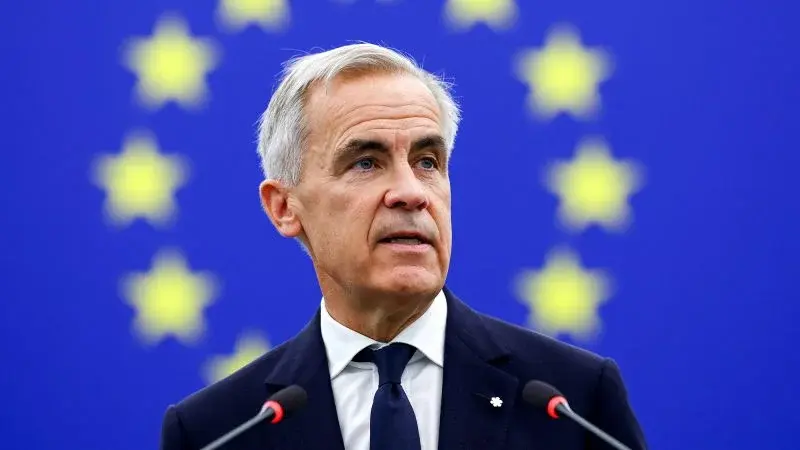
Canadian Prime Minister Mark Carney accepted the European Union's invitation to become its first 'associate member' but explicitly rejected full membership and any ceding of sovereignty. He framed the new partnership as a resilience strategy against US trade pressures, not a rival bloc. While the EU sees a strategic realignment, critics argue it binds Canada to a stagnant partner.
Key points
- Carney welcomed the EU's 'associate member' status but stated Canada is not seeking full EU membership or relinquishing sovereignty.
- The arrangement aims to integrate manufacturing, technology, security, and energy, with details to be negotiated at a summit next month.
- Carney emphasized the alliance is about 'resilience' and 'complementary partnerships,' not dominating others or creating a third bloc.
- The move follows a collapsed bilateral trade agreement with the US and a subsequent trade war, prompting Ottawa to seek closer ties with Brussels.
- Details of the 'associate member' status remain undefined, with Carney noting the 'precise nomenclature' is for Europe to decide.
Background
This development follows earlier Canadian proposals for a 'unique alliance' with the EU, which EU capitals initially rebuffed in favor of existing deals like Ceta. Recent tensions with the US, including a trade war and a symbolic White House key exchange with grim warnings, have accelerated Ottawa's pivot toward Brussels. Carney has also engaged with UK Prime Minister Andy Burnham, signaling broader 'middle powers' coalition efforts.
How outlets are covering it
CNN and Euronews highlight Carney's insistence that the Canada-EU alliance is not a 'third bloc with better manners' to rival the US, but a partnership for resilience and sovereignty. The Washington Post's editorial board, however, criticizes the move as 'foolhardy,' arguing that aligning with a 'stagnant' Europe is a poor long-term strategy compared to the US. Euronews notes Carney's focus on critical minerals, AI, and defense, while the Post emphasizes the risk of becoming an 'honorary 28th member' of the EU.
Why it matters
The Canada-EU 'associate member' status marks a significant shift in transatlantic relations, potentially reshaping trade and security dynamics in North America and Europe. It signals a move away from US-centric alliances for some democracies, but risks deepening transatlantic rifts and regulatory frictions. The outcome could influence how other 'middle powers' navigate great power rivalries.
What to watch
Details of the 'associate member' arrangement will be negotiated at a summit next month. The EU and Canada will need to define the scope of cooperation in manufacturing, technology, security, and energy. The US reaction to this closer Canada-EU tie will be a key factor in determining the alliance's long-term viability and impact on transatlantic relations.
- Canada-EU alliance isn’t meant to be a US rival with ‘better manners,’ Carney says CNN
- Donald Trump Turns His Canada Ire Toward the European Union Bloomberg.com
- Opinion | Canada’s great European misadventure The Washington Post
- Trump calls Canada's potential EU associate membership 'laughable,' warns Europe of 'very heavy tariffs' Fox Business
- Carney hails EU-Canada alliance but draws lines on membership and sovereignty Euronews.com
Want the full story? Read the original reporting
Read on CNN