
Army to Detonate 68 Barrels of Unstable Lead Azide in Iowa After Court Clears Permit
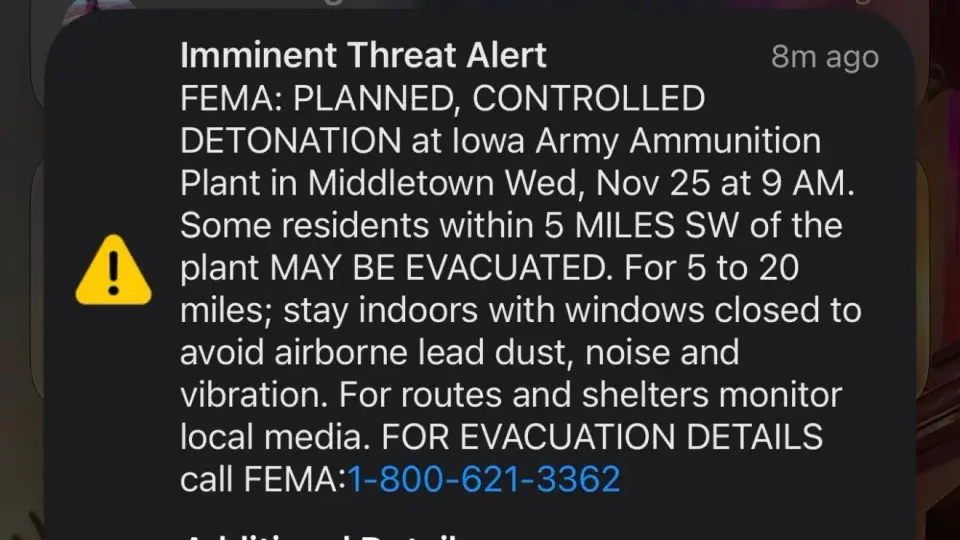
The U.S. Army will detonate 68 barrels of degraded lead azide at the Iowa Army Ammunition Plant in Middletown at 9 a.m. on Wednesday, November 25. The operation proceeds after the 8th Circuit Court of Appeals lifted a temporary stay on an Environmental Protection Agency permit. FEMA is coordinating evacuations for residents within five miles southwest of the plant, while those up to 20 miles away are advised to shelter in place. Officials state the material is too volatile to move, citing risks of spontaneous explosion due to cold weather and crystallization. Critics argue the blast poses significant health risks from lead exposure, particularly for children and vulnerable populations.
Key points
- Detonation scheduled for 9 a.m. CST on November 25 at the Iowa Army Ammunition Plant in Middletown.
- 68 barrels of degraded lead azide, totaling nearly five tons, will be detonated in earth-covered magazines.
- FEMA is evacuating residents within a five-mile cone southwest of the plant; lodging is provided until November 27.
- Residents within 20 miles are advised to stay indoors, close windows, and recirculate air to avoid lead dust.
- The 8th Circuit Court of Appeals lifted a stay on the EPA permit on Monday night, allowing the operation to proceed.
- The material was found to be unstable during a March 2026 inspection, becoming sensitive to friction and cold temperatures.
Background
The lead azide stockpile at the Iowa Army Ammunition Plant has been under review since January 2026. A routine inspection in March 2026 revealed that decades-old stored material had partially crystallized, making it increasingly sensitive to friction, shock, and cold winter temperatures. The EPA issued a permit for detonation on November 13, but the operation was delayed due to public outcry and a federal court stay. Previous attempts to reschedule the detonation to November 20 were paused after environmental groups filed an emergency motion, alleging the EPA had not properly evaluated risks or alternatives. The current schedule reflects a consensus among federal agencies that a controlled detonation is the only viable option to prevent an uncontrolled explosion.
How outlets are covering it
The U.S. Army and federal agencies, including the EPA and FEMA, emphasize that the controlled detonation is necessary to mitigate the risk of a spontaneous explosion. Acting Army Secretary Adam Telle stated that the safety of Iowa’s citizens comes first and that the operation is proceeding in full coordination with state and local authorities. The Army argues that alternatives such as chemical neutralization, thermal treatment, or relocation were deemed too dangerous due to the material’s volatility. In contrast, environmental groups, including the Iowa Environmental Council and Sierra Club, filed suit to stop the detonation, alleging that the EPA had not properly evaluated the dangers or considered safer alternatives. Local residents and some elected officials, including Iowa Governor-elect Rob Sand, have expressed frustration over the sudden timeline and concerns about lead exposure. Sand called for transparency, stating that everyday Iowans are entitled to know how the situation arose. Republican Governor Kim Reynolds initially asked for a pause but later supported the detonation after consulting with military leadership, citing the immediate danger. Senator Joni Ernst noted that the materials should never have reached this state but did not call for further delay. The 8th Circuit Court of Appeals lifted the stay, finding insufficient evidence that environmental groups would prevail in their arguments.
Why it matters
The detonation highlights the complex balance between immediate safety risks and long-term environmental and health concerns. The unstable lead azide poses a threat of spontaneous explosion, which could result in catastrophic consequences without warning. However, the controlled detonation risks releasing toxic lead dust into the air and onto surfaces, potentially affecting residents, children, and vulnerable populations within a 20-mile radius. The operation underscores the challenges of managing aging military stockpiles and the need for transparent communication and robust mitigation measures to protect public health and the environment. The involvement of multiple federal agencies and the legal battle reflect the high stakes and contentious nature of the decision.
What to watch
The U.S. Army will issue a final estimate of the affected area after the detonation. Post-detonation sampling of soil, air, and water will be conducted by federal personnel, with results published when available. Residents in the evacuation zone will be notified by phone once the all-clear is given and may return home at their convenience. The Army and its partners will continue to monitor lead levels using drone surveillance and atmospheric dispersion modeling. Federal and state officials are expected to provide updates on the operation and its aftermath. The public is advised to follow guidance from local authorities and the EPA on protecting themselves from potential lead exposure during and after the detonation.
- Detonation of lead azide will take place at 9 a.m. on Wednesday in Middletown, Iowa KGAN
- Public Safety Advisory: Controlled, Mitigated Detonation of Unstable Lead Azide at Iowa Army Ammunition Plant Army.mil
- Latest maps provided by US Army show potential locations of lead exposure during Wednesday's controlled detonation WQAD
- Detonation in Iowa Is on Track for Wednesday, but Weather Adds to Risks The New York Times
- Army returns to plan to detonate stored explosives in Iowa Wednesday after appeals court OKs permit CNN
Want the full story? Read the original reporting
Read on KGAN