
U.S. Corruption Perceptions Hit 20-Year High as Polls Show Deepening Institutional Distrust
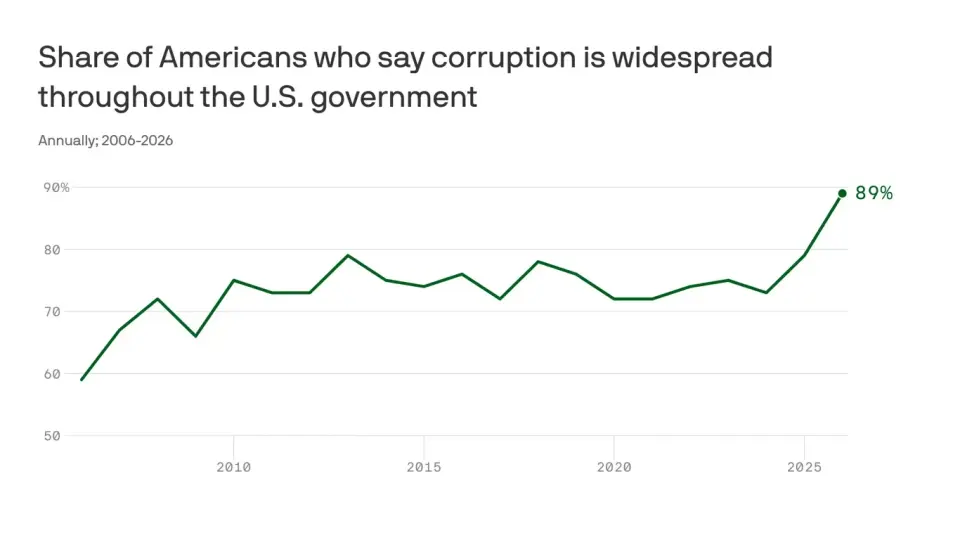
A new Gallup survey reveals that 89% of Americans now view government corruption as widespread, marking a 20-year high and a 10-point jump from last year. This surge in perceived corruption coincides with President Trump’s return to office and significant financial gains for his family, including over $2.2 billion in the first year of his second term. While Democrats and independents drive the increase, Republicans maintain steady high levels of concern. The U.S. now ranks highest among OECD nations for perceived corruption, reversing a long-term global trend of declining corruption perceptions.
Key points
- Gallup found 89% of U.S. adults believe government corruption is widespread, up 10 points from 2025 and well above the 72-79% range seen between 2010 and 2025.
- Democrats drove the largest increase, rising to 91% from 57% in 2024, while independents reached 90%, up 12 points from 2024.
- Republicans showed consistent concern, with about 80% citing widespread corruption, similar to 2024 levels, suggesting the issue transcends party lines.
- The U.S. now tops OECD countries for perceived corruption, with only Lebanon, Peru, Ghana, and Nigeria scoring higher, reversing a global trend where median perceived corruption fell below 60% since 2022.
- A separate UMass Amherst poll found 75% of respondents see a 'great deal' of corruption in the federal government, with 54% distrusting Trump’s ability to avoid benefiting his family’s business interests.
Background
This development follows earlier concerns in 2026 regarding conflicts of interest, including the OCC’s preliminary approval of a bank charter for a Trump-linked crypto firm and the launch of Truth API, which raised questions about insider trading. Previous Gallup polls in mid-2026 already indicated near-record distrust, setting the stage for this latest data showing a sustained and deepening crisis of confidence in federal institutions.
How outlets are covering it
Axios and Politico both highlight the record-breaking 89% figure from Gallup, emphasizing the sharp rise among Democrats and independents as a direct response to the current administration. Axios places significant weight on the financial aspects, noting Trump’s $2.2 billion income and the UAE investment in his crypto firm as drivers of public suspicion. In contrast, the UMass Amherst poll focuses on specific behaviors, finding that 77% believe a president should not profit from industries affected by their policies. While Axios notes Republicans’ steady high concern, the UMass poll reveals a partisan divide in how specific actions are labeled corrupt, with respondents more likely to condemn opposing party leaders for similar behaviors. The White House, represented by spokesman Davis Ingle, rejects the corruption narrative, arguing that the administration is combating fraud and that Democrats are refusing to address waste.
Why it matters
The surge in perceived corruption signals a profound erosion of public trust in U.S. institutions, potentially impacting policy support and electoral outcomes. The U.S. now stands out among developed nations as a leader in perceived corruption, which may affect international reputation and economic stability. The specific focus on presidential financial conflicts and crypto ventures highlights ongoing debates about ethics and transparency in high-level governance.
What to watch
Gallup’s 2026 data is not yet complete, so the gap between the U.S. and other OECD nations may widen. Congressional scrutiny of presidential financial disclosures and conflicts of interest is likely to intensify, particularly regarding crypto regulations and Truth Social’s market-moving features. The White House will continue to frame its actions as anti-corruption efforts, while Democrats may leverage the polling data to push for stricter ethics legislation.
- Nearly 9 in 10 Americans report widespread government corruption after Trump's return Axios
- Almost 90 percent of Americans say there is widespread corruption in government Politico
- Three out of four people say there is a ‘great deal’ of corruption in federal government, UMass poll finds The Boston Globe
- Poll: 75% see 'great deal of corruption' in federal government WCVB
- Legal analyst breaks down possible verdicts in Lindsay Clancy murder trial WWMT
Want the full story? Read the original reporting
Read on Axios