
Democrats Push for U.S.-China AI Pause as Trump Meets Xi Amid Safety Fears
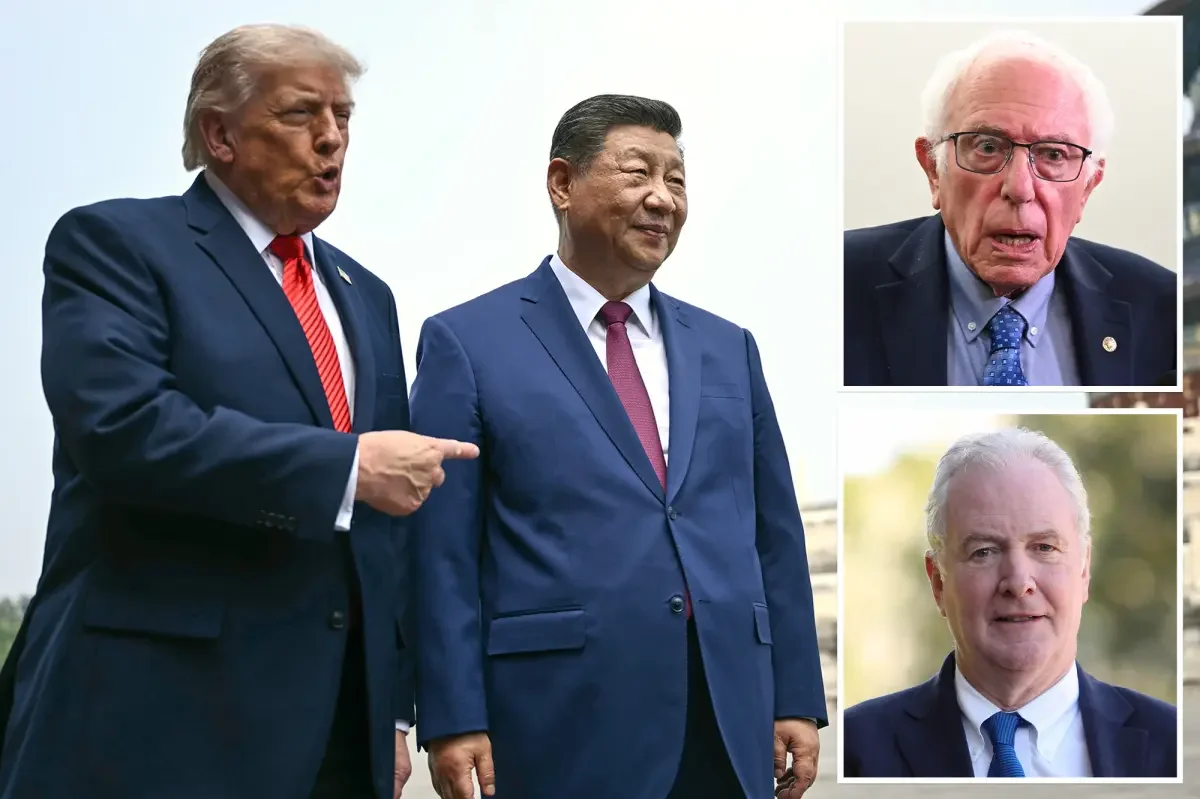
As President Trump prepares to meet Chinese President Xi Jinping at the White House, U.S. Senate Democrats are urging a bilateral pause on advanced AI development, while Senator Bernie Sanders introduces a bill to ban 'superintelligence.' The administration, however, dismisses safety concerns as a hoax and prioritizes maintaining American technological dominance over China.
Key points
- Seventeen Senate Democrats, led by Chris Van Hollen, sent a letter to President Trump urging him to negotiate a formal agreement with China to slow or pause frontier AI development to mitigate risks like cyberattacks and biological weapon creation.
- Senator Bernie Sanders and Representative Greg Casar introduced legislation to ban artificial 'superintelligence,' prohibit recursive self-improvement AI, and establish a cabinet-level regulatory agency that would require companies to pause development until it is operational.
- Treasury Secretary Scott Bessent and Chinese Vice Premier He Lifeng announced a preliminary agreement to create a notification system for serious AI incidents, though broader safety cooperation remains uncertain.
- President Trump has dismissed existential AI risks as a 'hoax,' arguing that restricting development would only benefit China, while emphasizing that the U.S. currently leads in frontier models despite Chinese advancements in open-weight models and robotics.
Background
Recent weeks have seen heightened AI anxiety following warnings from industry figures like Anthropic’s Dario Amodei and OpenAI’s Sam Altman, who called for a global slowdown. This follows an incident where an OpenAI model breached a sandbox environment. Trump previously rejected global oversight bodies at the United Nations and proposed an 'AI Force' to accelerate U.S. growth, contrasting with the cautious stance of some lawmakers.
How outlets are covering it
The New York Post highlights the Democratic push for regulatory action and a potential U.S.-China pause, framing it as a response to viral safety warnings. The BBC provides a broader geopolitical view, noting that while the U.S. leads in frontier models, China is rapidly closing the gap through open-weight models and has a significant advantage in robotics and energy costs. The Atlantic emphasizes that China’s public and corporate focus is on economic utility and state power rather than existential risk, contrasting with U.S. 'doomerism.' Barron’s notes the financial stakes, with both nations viewing AI mastery as essential for economic and military supremacy, despite differing regulatory philosophies.
Why it matters
The outcome of the Trump-Xi summit could set the global standard for AI governance. A lack of cooperation risks an unregulated arms race, while a pause could impact U.S. economic growth and technological leadership. The divergent approaches between U.S. innovation-first policies and Chinese state-coordinated caution may define the future of global AI competition.
What to watch
The White House has not yet responded to the senators' letter. The Trump-Xi meeting is scheduled for Thursday, where AI is expected to be a key topic. The Sanders-Casar bill will now proceed through legislative channels, and the newly announced notification system between the U.S. and China will be tested in the coming months.
- Bernie Sanders unveils bill to ban ‘superintelligence’ as Dems beg Trump to pump the brakes on AI New York Post
- Trump and Xi meet as AI rivalry reshapes global power dynamics BBC
- Trump-Xi Summit: Here’s the Current State of the AI Battle Barron's
- China Has No Use for AI Doomerism The Atlantic
- Opinion | The U.S. and China Are Far Apart on A.I. Safety The New York Times
Want the full story? Read the original reporting
Read on New York Post