
FCC Chair Carr Defends ABC License Probe After Judge Blocks Review
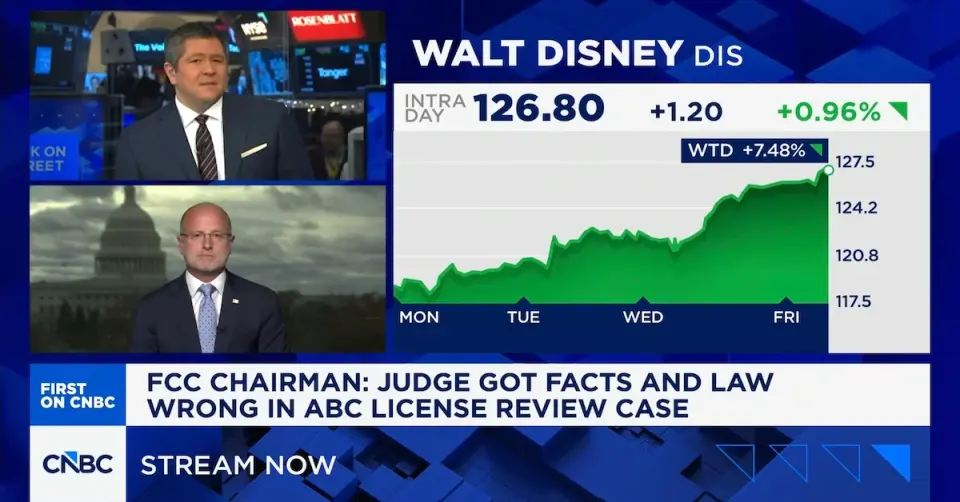
FCC Chair Brendan Carr defended the agency's early license review of ABC stations on Friday, insisting the action was about public interest obligations rather than retaliation against late-night host Jimmy Kimmel. Carr made the comments after a federal judge blocked the review on Wednesday, ruling it likely constituted unconstitutional retaliation for speech critical of President Trump. The judge cited the timing of the review, which followed Trump's criticism of Kimmel, as evidence of pretext. Carr stated the FCC would continue to hold broadcasters accountable, while ABC hailed the ruling as a victory for free speech.
Key points
- FCC Chair Brendan Carr appeared on CNBC's 'Squawk on the Street' on Friday, November 27, 2026, to defend the agency's early license review of eight ABC-owned stations.
- Carr was asked by reporter Carl Quintanilla if the 'crusade' against ABC was 'still' about Jimmy Kimmel, to which Carr responded that broadcasters have unique public interest obligations distinct from cable or newspapers.
- U.S. District Judge Loren AliKhan issued a preliminary injunction on Wednesday, November 25, 2026, blocking the FCC from proceeding with the early review, ruling that ABC was likely to succeed in its First Amendment claim of retaliation.
- Judge AliKhan wrote that the review was 'not a close case' and that Carr had taken President Trump's rhetoric as 'marching orders,' noting the review began the day after Trump criticized Kimmel.
- The FCC stated in a statement that the ruling was 'wrong on the facts and wrong on the law' and that it would continue to use its lawful authority to hold broadcasters accountable.
- ABC and Disney argued the review was a 'retaliatory campaign' for political reasons, while the FCC claimed it was necessary to investigate diversity, equity, and inclusion practices.
Background
The FCC, led by Chair Brendan Carr, initiated an early license review of eight ABC-owned stations in April 2026, years before the licenses were due for standard renewal. ABC, owned by Disney, sued the FCC in August 2026, accusing the agency of waging a 'retaliatory campaign' for political reasons. The dispute followed President Trump's public criticism of ABC and late-night host Jimmy Kimmel, including a joke involving Charlie Kirk after the conservative activist's assassination in September 2025. The FCC had also launched an investigation into Disney's diversity, equity, and inclusion practices, which Carr claimed was the basis for the license review. This ruling is part of a broader pattern of legal challenges by media outlets against the Trump administration, including a parallel case involving CNN, MS NOW, and Politico over White House access restrictions.
How outlets are covering it
FCC Chair Brendan Carr, as reported by Mediaite, emphasized that broadcasters have unique public interest obligations and that the early review was part of holding them accountable, not a targeted attack on Kimmel. He stated, 'We're working on lots and lots of different fronts. We don't have our eggs in one basket.' In contrast, U.S. District Judge Loren AliKhan, as reported by Politico and The Guardian, ruled that the review was an unconstitutional act of retaliation, writing that Carr had taken Trump's rhetoric as 'marching orders' and that the timing of the review, which followed Trump's criticism of Kimmel, demonstrated a pretext. ABC and Disney, as reported by NPR, hailed the ruling as a victory for the First Amendment, with Disney CEO Josh D'Amaro stating the company was 'very principled' in defending journalistic integrity. The FCC, as reported by The Guardian, called the ruling 'wrong on the facts and wrong on the law' and stated it would continue to use its lawful authority. Anna M. Gomez, the lone Democratic FCC commissioner, called the ruling a check on the agency's 'politicized machinery of government.'
Why it matters
The ruling sets a precedent for the limits of FCC authority over broadcast licenses and the First Amendment rights of media companies. It highlights the tension between the Trump administration's efforts to hold broadcasters accountable for content critical of the president and the legal protections for free speech. The case also underscores the broader pattern of legal challenges by media outlets against the administration, including a parallel case involving CNN, MS NOW, and Politico over White House access restrictions. The outcome could influence future FCC actions against broadcasters and the extent to which the agency can use licensing authority to retaliate for disfavored speech.
What to watch
The FCC has stated it will appeal the ruling and continue to use its lawful authority to hold broadcasters accountable. The case is expected to proceed through the legal system, with the FCC and ABC/Disney likely to engage in further litigation. The outcome of the appeal could determine whether the FCC can pursue early license reviews of other broadcasters or if the ruling sets a broader precedent for First Amendment protections against retaliatory regulatory actions. The FCC may also continue its investigation into Disney's diversity, equity, and inclusion practices, though the judge's ruling cast doubt on the necessity of the early license review for that purpose.
- CNBC Reporter Asks Brendan Carr ‘Are We Still Talking About Kimmel?’ as FCC Chair Hits Back After Big Loss in ABC Battle Mediaite
- ‘Not a close case:’ Judge blocks review of ABC’s broadcast licenses Politico
- U.S. Judge rules FCC violated ABC's free speech rights to please Trump NPR
- Judge blocks Brendan Carr-led FCC from taking any further action against ABC’s licenses The Guardian
- Trump, FCC illegally sought to punish ABC in free speech case, judge rules Los Angeles Times
Want the full story? Read the original reporting
Read on Mediaite