
Hegseth and Mullin Cite Drone Defense to Justify Trump’s Arch Amid Legal and Design Conflicts
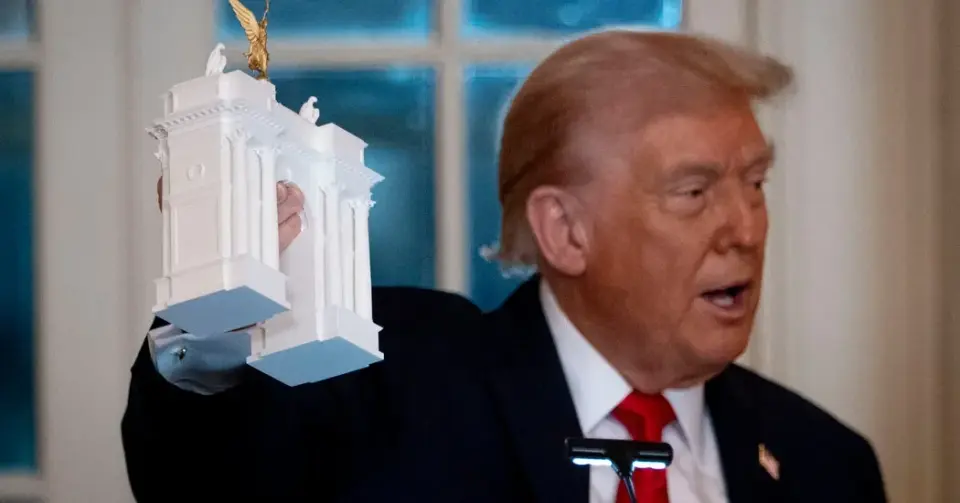
Defense Secretary Pete Hegseth and Homeland Security Secretary Markwayne Mullin submitted sworn statements to a federal court, arguing that President Trump’s proposed 250-foot triumphal arch is essential for national security. They claim the structure offers a 'generational defense opportunity' by providing an elevated vantage point for counter-sniper operations and drone threat assessment. This justification emerged as the project faces lawsuits from veterans and upcoming reviews by the National Capital Planning Commission. While the administration asserts the military features will integrate into the existing design without structural changes, critics note that recent architectural plans submitted for approval describe the arch solely as a ceremonial gateway, omitting any military components. The controversy is compounded by concerns that the arch will cast shadows over JFK’s eternal flame and other historic sites in Washington, D.C.
Key points
- Hegseth and Mullin filed declarations in the U.S. District Court for the District of Columbia, asserting the arch is vital for homeland defense.
- The administration claims the arch’s height provides a 'significant elevation advantage' for monitoring threats and coordinating security operations.
- Hegseth stated that military features, such as drone storage and sniper positions, would be fully integrated into the current design without requiring structural alterations.
- Plans submitted to the National Capital Planning Commission for a November 5 review describe the arch as a 'ceremonial gateway' and exclude the military elements mentioned by the president.
- A Washington Post analysis indicates the arch will block sunlight from JFK’s eternal flame for approximately nine minutes daily during spring and summer, casting shadows over 75,000 graves at Arlington National Cemetery.
- The project faces two active lawsuits, including one from veterans who argue the structure dishonors the fallen by obstructing sightlines to Arlington.
Background
This development follows a series of rapid approvals and rebranding efforts for the arch, which was initially proposed to celebrate the nation’s 250th birthday. In September, President Trump rebranded the project as a military hub for drones and snipers, a move criticized by Senator Tammy Duckworth and others who cited safety concerns near Reagan National Airport. Federal officials had previously acknowledged that the arch would cause adverse effects to 37 historic sites, including the Lincoln Memorial, but insisted on proceeding with construction. Local officials had suggested a smaller column alternative, but the administration fast-tracked approvals through the National Park Service and FAA.
How outlets are covering it
The New York Times and CNN highlight the administration’s strategic pivot to national security arguments to overcome legal hurdles, noting that Hegseth’s and Mullin’s statements are the first formal cabinet-level endorsements of the military rationale. CNN emphasizes the contradiction between the sworn statements and the architectural plans submitted to the National Capital Planning Commission, which omit military features. Yahoo and Closer Weekly focus on the cultural and historical impact, detailing how the arch will obscure JFK’s eternal flame and cast shadows over major memorials, a point raised by retired Army Maj. Gen. Paul Eaton as a 'sacrilege.' While the administration frames the arch as a dual-purpose monument and defense asset, critics and legal challengers view the security justification as a post-hoc rationalization to bypass congressional authorization and environmental reviews.
Why it matters
The case tests the limits of executive power in altering the nation’s capital without congressional approval or standard planning reviews. The use of national security arguments to justify a monument previously described as a celebratory gateway raises questions about the integrity of federal approval processes. Furthermore, the potential impact on historic sites and the visual integrity of Arlington National Cemetery has sparked a broader debate over the balance between modern security needs and the preservation of historical and symbolic landscapes in Washington, D.C.
What to watch
The U.S. District Court for the District of Columbia is scheduled to hold a hearing on the veterans' lawsuit on October 30. The National Capital Planning Commission will review the arch’s final plans on November 5. If approved, the administration has indicated that construction could begin immediately. The outcome of these reviews will determine whether the arch proceeds as a ceremonial structure or if the administration attempts to implement the military features described in the court filings.
- Officials Back Trump’s Claim That Triumphal Arch Is Needed for National Security The New York Times
- A ‘generational defense opportunity’: Hegseth offers full-throated endorsement of Trump’s arch amid legal battle CNN
- Some veterans’ groups support Trump’s arch, planned near Arlington Cemetery The Washington Post
- JFK’s Eternal Flame to Fall Under Shadow of ‘Arc de Trump’ Despite Jackie Saying She Wanted Visible for ‘Miles’ Yahoo
- Trump’s Triumphal Arch Would Cast a Shadow on JFK’s Eternal Flame Gravesite: Report People.com
Want the full story? Read the original reporting
Read on The New York Times