
Kansas and Missouri Voters Reject GOP-Backed Ballot Measures, Preserving Judicial and Democratic Norms
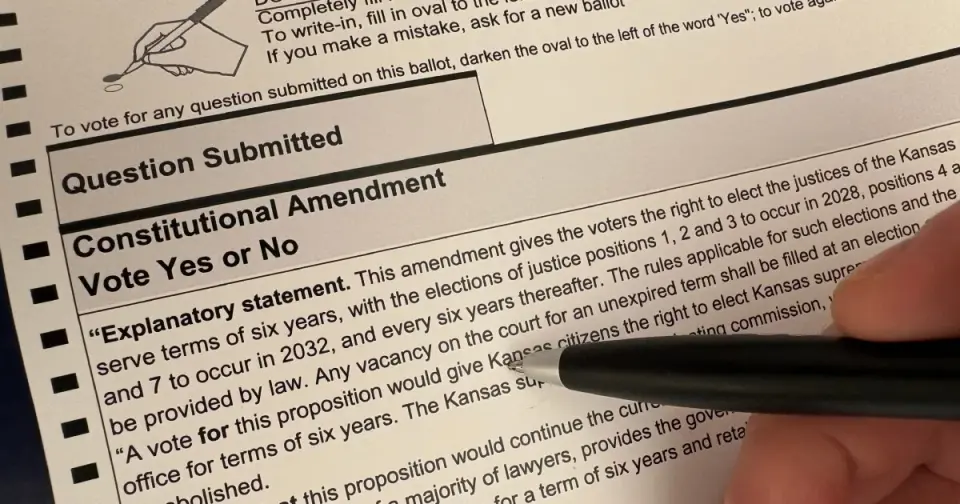
Kansas and Missouri voters rejected Republican-backed constitutional amendments on Tuesday, preserving the current judicial appointment system in Kansas and maintaining the existing threshold for citizen-led ballot initiatives in Missouri. The Kansas vote, which failed by a margin of 245,739 to 142,102, keeps the governor-appointed, commission-based selection process for state Supreme Court justices intact. In Missouri, voters blocked a measure that would have required citizen-initiated amendments to pass in every congressional district, a standard that would have effectively given the legislature a veto over popular initiatives. These results reflect a broader trend of voters in red states rejecting legislative attempts to curtail direct democracy and abortion rights.
Key points
- Kansas voters rejected a constitutional amendment that would have replaced the current merit-based appointment system for state Supreme Court justices with direct elections.
- The Kansas vote failed with 245,739 votes against and 142,102 in favor, according to the Associated Press.
- Missouri voters rejected a measure that would have required citizen-initiated constitutional amendments to win a majority in every congressional district, rather than just statewide.
- Both measures were supported by Republican-dominated legislatures and opposed by abortion rights advocates and progressive groups.
- The Kansas Supreme Court Nominating Commission, composed of five elected lawyers and four gubernatorial appointees, will continue its current process of screening candidates and sending three finalists to the governor.
Background
This development follows a series of recent ballot measures in red states where voters have consistently supported abortion rights and expanded social programs, despite Republican legislative control. In 2022, Kansans voted to protect abortion rights in the state constitution, a decision the Kansas Supreme Court has upheld in subsequent rulings. The current judicial appointment system, which includes retention elections, has been criticized by conservatives as being too influenced by attorneys, but supporters argue it maintains judicial independence from partisan politics and campaign donors. The Missouri vote also comes amid ongoing debates about gerrymandering and the power of citizen initiatives to counter legislative actions.
How outlets are covering it
KCUR and WIBW reported the Kansas vote as a clear rejection of the amendment, with the Associated Press calling the result. KCUR highlighted the celebration by abortion rights and school funding advocates, while WIBW provided the specific vote count. The New York Times framed the Kansas and Missouri results as part of a broader trend where voters in red states are rejecting Republican-backed measures that threaten abortion rights and direct democracy. CNN emphasized the intent behind the Kansas amendment, arguing it was designed to elect judges opposed to abortion rights to overturn the 2022 ballot initiative, and noted that Missouri voters also rejected a measure that would have given the legislature a veto over citizen-led constitutional changes. All sources agree that the current systems in both states will remain unchanged, but they differ in their emphasis on the political motivations behind the measures and the broader implications for direct democracy in red states.
Why it matters
The rejection of these ballot measures in Kansas and Missouri signals a strong public resistance to legislative attempts to curtail direct democracy and judicial independence in red states. The Kansas vote preserves a nonpartisan judicial appointment system that has been used to uphold abortion rights, while the Missouri vote maintains a lower threshold for citizen-led constitutional amendments, allowing voters to bypass legislative vetoes. These results may bolster Democratic efforts in upcoming midterm elections and highlight the growing tension between Republican-dominated legislatures and the voters they represent. The outcomes also underscore the importance of direct democracy in checking legislative power and protecting rights that are not explicitly stated in the constitution but have been affirmed by voters and courts.
What to watch
The Kansas Supreme Court Nominating Commission will continue its current process of screening candidates and sending three finalists to the governor for appointment. In Missouri, the state's top election official has denied a citizen petition to hold a statewide vote on congressional districts, a decision that supporters have promised to challenge in court. Both states may see further legal battles over the scope of direct democracy and the power of citizen initiatives to counter legislative actions. The results of these ballot measures may also influence future legislative efforts to place similar measures on the ballot, as well as the strategies of political parties in upcoming elections.
- Kansas voters reject electing state Supreme Court justices as constitutional amendment fails KCUR
- Abortion Foes Backed Ballot Measures in 2 Red States. Voters Said No. The New York Times
- Red-state voters said no to ballot measures backed by anti-abortion groups CNN
- Kansans vote ‘no’ on constitutional amendment to change Supreme Court selection WIBW
- What is the amendment vote coming up in the Kansas general election? KSNT 27 News
Want the full story? Read the original reporting
Read on KCUR