
Mamdani Signs Romanch’s Law, Banning NYC Horse Carriages by 2028
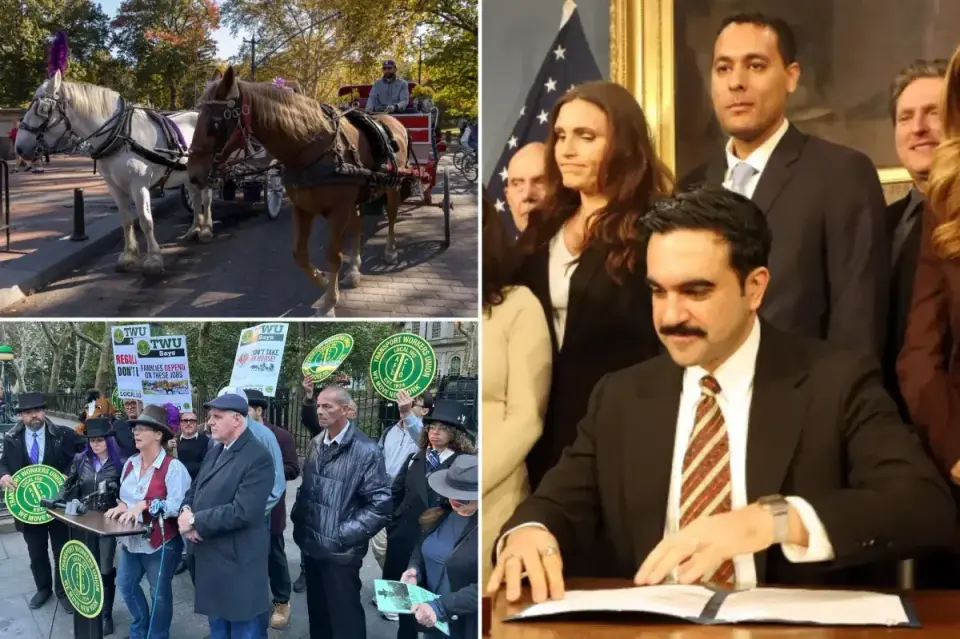
Mayor Zohran Mamdani signed legislation Thursday banning horse-drawn carriages in New York City by June 1, 2028. The measure, named after 18-year-old Romanch Mahajan who died in a June accident, ends a 150-year tradition. The administration plans to support approximately 200 affected workers through medallion buybacks and job training, though the Transport Workers Union has filed a lawsuit challenging the ban as unconstitutional.
Key points
- Mayor Mamdani signed the bill in City Hall’s Blue Room, flanked by Council Speaker Julie Menin and former Mayor Bill de Blasio.
- The legislation, known as Romanch’s Law, mandates the phase-out of horse carriages by June 1, 2028.
- City Hall estimates approximately 200 workers, including drivers and stable hands, will be affected by the industry’s closure.
- The administration proposes a transition plan including medallion buybacks, stipends, and workforce training, with a detailed blueprint due by April 2027.
- The Transport Workers Union filed a class-action lawsuit in federal court, arguing the ban is arbitrary and fails to guarantee compensation for medallion owners.
- Mamdani commissioned a feasibility study to evaluate electric carriages and pedal-assist vehicles as potential replacements in Central Park.
Background
The New York City Council passed the veto-proof ban in late October 2026, following a 40-7 vote. The legislation gained momentum after the death of Romanch Mahajan, an 18-year-old tourist, in a Central Park carriage accident in June 2026. Previous mayors had also called for an end to the industry, but this is the first time the ban has been signed into law.
How outlets are covering it
Supporters, including Council Speaker Julie Menin and Council Member Chris Marte, emphasize public safety and animal welfare, stating that the law prevents future fatalities and protects horses. They argue the city has a responsibility to assist workers in transitioning to new careers. Opponents, primarily the Transport Workers Union, describe the ban as an 'unconstitutional abomination.' Union President John Samuelsen argues the law strips owners of city-issued medallions purchased for hundreds of thousands of dollars without guaranteed compensation. Drivers like John Sangino expressed concern about losing their livelihoods after decades of work, noting that promised job placements are uncertain. While the administration offers a 'framework' for support, critics argue specific financial protections should have been codified in the legislation itself.
Why it matters
The ban ends a 150-year tradition in Central Park and marks a significant shift in urban tourism and animal welfare policy. It highlights the tension between public safety, animal rights, and the economic livelihoods of workers in legacy industries. The legal challenge by the Transport Workers Union may delay or alter the implementation of the ban, while the feasibility study for electric alternatives could reshape the future of transportation in New York City parks.
What to watch
The administration must release a comprehensive transition plan by April 2027, detailing specific financial support and job placement programs for the 200 affected workers. The Transport Workers Union’s lawsuit in federal court will determine whether the ban can take effect as scheduled in June 2028. Additionally, the city will review the feasibility study on electric carriages and pedal-assist vehicles to determine potential replacements for the current carriage service.
- Mamdani officially bans horse carriages, ending century-old Central Park tradition New York Post
- Mayor Mamdani to sign Romanch's Law ending NYC horse-drawn carriage industry ABC7 New York
- NYC officially bans horse-drawn carriages starting in June 2028 NBC New York
- NYC Mayor Mamdani signs bill banning horse carriage industry into law CBS News
- Horse Carriage Ban Becomes Law and Is Immediately Challenged in Court The New York Times
Want the full story? Read the original reporting
Read on New York Post