
Supreme Court sets deadline for Michigan to respond to citizenship voting ballot measure
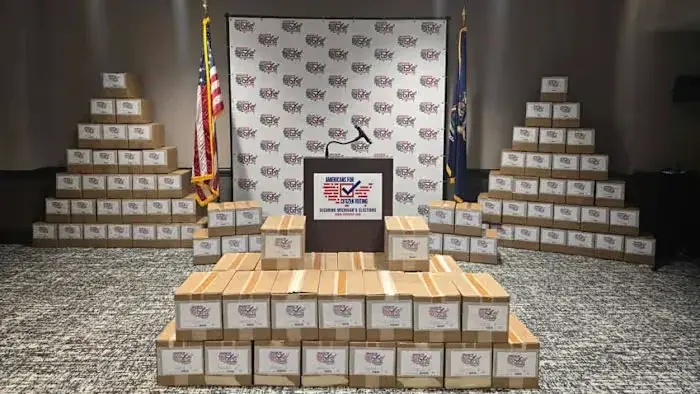
The U.S. Supreme Court has ordered Michigan officials to respond by noon on Wednesday to an emergency request from Americans for Citizen Voting, which seeks to place a proof-of-citizenship amendment on the November ballot. The measure was excluded after the state Board of State Canvassers deadlocked 2-2 over signature validity, with critics arguing the process was partisan and flawed. While supporters claim over 700,000 valid signatures, state officials contend the petition failed a sample review, leading to a legal battle over due process and ballot access ahead of the midterms.
Key points
- Justice Brett Kavanaugh issued an order requiring Michigan to respond to the emergency application by noon on Wednesday, with a potential decision expected by Thursday.
- The proposed amendment would require voters to show proof of citizenship and photo ID, eliminating affidavit options and creating a state-funded hardship program for ID costs.
- The Board of State Canvassers deadlocked 2-2 on August 24, excluding the measure after a 1,000-signature sample fell short of the required 629 valid signatures by a few votes.
- Americans for Citizen Voting claims over 700,000 signatures were collected, exceeding the 446,198 threshold, and argues the state’s delayed review and rejection of late affidavits violated due process.
- Michigan Attorney General Dana Nessel and Solicitor General Ann M. Sherman urged the Court to deny relief, stating the initiative process is a state-created right not protected by the First Amendment and that federal intervention is inappropriate.
Background
This dispute follows a series of signature verification challenges in Michigan, where the Bureau of Elections took over five months to issue its report on the petition. The measure mirrors broader national efforts by Republicans to tighten voting requirements, though noncitizen voting is already illegal in state and federal elections. Critics argue such measures disproportionately affect Black and Hispanic voters, who are less likely to possess current driver’s licenses or citizenship documents, potentially suppressing turnout. The case is part of a broader wave of Supreme Court interventions in 2026 midterm election issues, including redistricting and mail-in ballot restrictions.
How outlets are covering it
WDIV and The Detroit News emphasize the procedural deadlock and the Supreme Court’s intervention, highlighting the partisan split on the Board of State Canvassers and the legal arguments over signature validity. MS NOW focuses on the emergency nature of the request to Justice Kavanaugh and the potential for a rapid decision before the ballot finalization deadline. The Detroit Free Press notes the broader context of voting rights debates, pointing out that noncitizen voting is already illegal and that critics view the measure as a tool to suppress voter turnout. All sources agree on the core facts: the 2-2 deadlock, the 700,000+ signatures claimed, and the Supreme Court’s deadline, but differ in framing the legitimacy of the state’s rejection versus the group’s due process claims.
Why it matters
The outcome could set a precedent for federal intervention in state ballot access disputes and influence the enforceability of proof-of-citizenship requirements in other states. If the Supreme Court orders the measure onto the ballot, it would expand voter ID requirements and potentially reduce turnout among groups less likely to possess citizenship documents. Conversely, denial would uphold state authority over initiative processes and reject claims that signature verification delays constitute a due process violation. The decision also signals the Court’s willingness to intervene in midterm election issues, potentially affecting other pending cases on redistricting and mail-in ballots.
What to watch
Michigan officials must respond to the Supreme Court by noon on Wednesday, with a potential ruling expected by Thursday. If the Court grants the injunction, the amendment would be added to the November 3 ballot; if denied, the measure would be excluded, and the group may pursue further legal action. The Michigan House has also created a committee to investigate the signature verification process, which could lead to procedural reforms. The outcome will be closely watched as part of a broader pattern of Supreme Court interventions in 2026 midterm election disputes.
- US Supreme Court sets deadline for Michigan’s response to proposed citizenship voting ballot measure ClickOnDetroit | WDIV Local 4
- Proof-of-citizenship backers ask Kavanaugh for emergency order ahead of midterms MS NOW
- Michigan election officials urge high court to reject ballot challenge The Detroit News
- US Supreme Court asked to revive proof-of-citizenship plan in Michigan Detroit Free Press
- Michigan officials ask U.S. Supreme Court to reject citizenship voting case MLive.com
Want the full story? Read the original reporting
Read on ClickOnDetroit | WDIV Local 4