A federal three-judge panel blocked Alabama from reusing its 2023 congressional map for the 2026 midterms, ruling it tainted by intentional race-based discrimination and mandating a map with two majority-Black districts; Republicans are likely to appeal to the Supreme Court.
Washington Post reports that redistricting has become a perpetual, precision-driven battle in U.S. politics, with both parties recalibrating maps—potentially every two years—to gain an electoral edge, a dynamic intensified by a Supreme Court ruling that weakened Voting Rights Act protections and that could deepen polarization and shift power in Congress.
The TPM piece links the Supreme Court’s Callais v. Louisiana ruling to the 1960s civil rights era, telling stories of violence and loss that helped drive the Voting Rights Act to argue the decision accelerates the rollback of Black political power in the South through aggressive redistricting, a trend historians call a grave setback and a call to renewed voting activism.
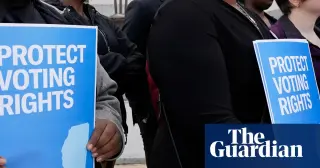
Thousands gathered in Jackson to demand protections for voting rights after a Supreme Court decision weakens Section 2 of the Voting Rights Act; speakers warned that new redistricting measures in the South threaten Black political power and pledged to resist a return to Jim Crow, with demonstrations expanding from the Old Capitol to the Jackson Convention Complex.
Two Georgia Supreme Court races ended with GOP-backed incumbents Sarah Warren and Charlie Bethel winning re-election, keeping conservative control of the bench; liberal challengers Jen Jordan and Miracle Rankin were unable to flip seats, highlighting abortion and voting-rights debates that activists say should play out in state courts. Turnout was light and results were delayed by a nearby shooting at a polling site; eight of nine justices were appointed by Republicans, with three seats up again in 2028.
NAACP launches the 'Out of Bounds' boycott urging Black athletes and fans to withhold support from public universities in seven Southern states over voting-rights restrictions, warning it could deplete SEC/ACC rosters amid redistricting battles tied to the Voting Rights Act.
Facing a wave of redistricting in the South, the NAACP launches the Out of Bounds campaign to pressure Black student-athletes and fans to boycott top public universities in reform-target states until voting maps diluting Black power are reversed; the Congressional Black Caucus also opposes the SCORE Act, highlighting dwindling legal options as Republican-drawn maps reshape political power in the region.
The NAACP launched the Out of Bounds campaign, urging Black athletes, families, alumni and fans to boycott public university athletic programs in eight Southern states to pressure lawmakers to restore fair Black voting representation amid ongoing redistricting and voting-rights battles.
Guardian US columnist Jamil Smith argues that after the Supreme Court’s ruling weakening the Voting Rights Act, Republican-led states are redrawing electoral maps to erase Black political power for generations. He highlights Tennessee’s new map that disperses Memphis Black voters into Williamson County and points to similar moves in Louisiana, Alabama and Mississippi, framing this as a deliberate, long-term project akin to Jim Crow. The piece warns that affordability politics won’t save democracy if representation is decimated and calls for naming and resisting these structural changes rather than hoping for a quick fix.
The NAACP unveils the 'Out of Bounds' campaign, urging Black athletes, families, fans, and consumers to withhold commitments, tickets, and sponsorship from flagship public universities in eight states (Tennessee, Louisiana, Alabama, Florida, Mississippi, South Carolina, Texas, Georgia) that have moved to dilute Black voting power following a Supreme Court ruling. Recruits are asked to withhold commitments, current athletes to leverage their platforms and consider transfers, and fans to redirect spending to HBCUs. The campaign aims to pressure states to restore fair maps and meaningful Black representation and will continue until protections and redistricting reflect Black power.
Justice Ketanji Brown Jackson criticized the Supreme Court for expediting a major voting-rights ruling, saying the move made the court look political. She was the lone dissenter to dropping the usual 32-day waiting period, in a decision that sharply limits a key provision of the Voting Rights Act and enabled Louisiana Republicans to quickly redraw a congressional district.
Justice Ketanji Brown Jackson warned that the Supreme Court risks appearing political after a voting rights ruling, emphasizing the need for the judiciary to preserve nonpartisan legitimacy and public trust; she spoke to the 2025 Supreme Court Fellows Program in Washington.
Redistricting and a Supreme Court ruling weakening the Voting Rights Act have turned Philadelphia’s 3rd District—the nation’s bluest House seat—into a Congressional Black Caucus showdown as three Black candidates vie for the open seat, highlighting fights over voting rights, turnout, and how Democrats respond to gerrymandering and leadership questions.
The U.S. Supreme Court has sent a voting rights case back to a lower court for further proceedings, delaying a final ruling and returning the matter to district court for reconsideration.
The Supreme Court told lower courts to reexamine two cases challenging whether private plaintiffs can sue to enforce Section 2 of the Voting Rights Act, in light of its recent ruling weakening Section 2. The Mississippi case (NAACP Mississippi Chapter and 14 voters) and the North Dakota case (Turtle Mountain Band of Chippewa Indians, Spirit Lake Tribe, and three voters) previously prevailed in district court; an 8th Circuit panel had barred private enforcement under Section 1983. The Court’s orders, with Justice Jackson dissenting, could narrow who can bring these lawsuits and affect voting-rights litigation nationwide.