
Trump's White House Ballroom: A Case Study in Executive Speed vs. Judicial and Congressional Restraint
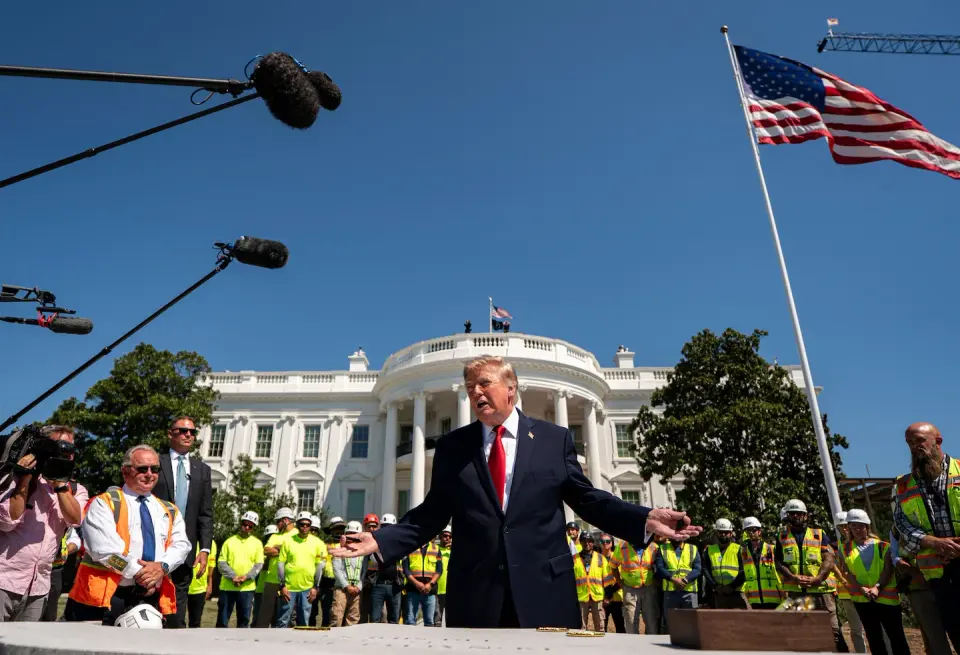
President Trump is advancing major construction projects, notably the 90,000-square-foot White House ballroom, by leveraging executive authority and private funding to outpace congressional oversight and judicial review. While the Supreme Court allowed the project to continue in a 5-4 ruling, Chief Justice John Roberts dissented, arguing the construction likely violates separation of powers principles. The Washington Post frames this as a broader pattern of using legal loopholes to bypass legislative checks, while USA Today highlights Roberts' rare conservative dissent as a pivotal moment in the court's stance on presidential power.
Key points
- The White House ballroom project, estimated at $400 million to $600 million, is approximately 65% complete and funded largely through private donations, though some taxpayer funds were redirected.
- The Supreme Court ruled 5-4 to allow construction to continue, citing national security concerns and ruling that the National Trust for Historic Preservation lacked standing to challenge the project.
- Chief Justice John Roberts dissented, stating the project is 'likely unlawful' and infringes on Congress's power to control federal spending and property, marking his third time this year as the sole conservative dissenter on spending-related interim rulings.
- The Washington Post characterizes the ballroom as part of a wider strategy where the administration uses executive power and legal loopholes to implement changes before Congress or courts can intervene.
- Roberts' dissent emphasized the 'distinctive nature' of the White House as an iconic building, arguing that aesthetic harm to preservationists constitutes a valid legal injury, a stance that diverged from the majority's view on standing.
Background
This development follows a series of Supreme Court stays on the ballroom project since August 2026, where lower courts had initially halted work due to lack of congressional approval. The project's timeline targets a 2028 completion, with the framework planned for November and the facade for April, even as litigation continues in lower courts. The administration has previously faced similar legal challenges regarding other spending cuts, such as teacher training grants and health research funding, where Roberts also dissented.
How outlets are covering it
The Washington Post emphasizes the systemic nature of Trump's approach, framing the ballroom as an example of the administration racing the courts and clock while a GOP-led Congress remains largely silent. In contrast, USA Today focuses on the judicial dimension, highlighting Chief Justice Roberts' rare break with his conservative colleagues. USA Today notes that Roberts' dissent on the ballroom, along with previous dissents on spending cuts, signals a shift in his judicial philosophy, with legal scholars like Josh Blackman criticizing him for dismissing national security concerns. The Washington Post does not delve into the specific legal standing arguments, whereas USA Today details the majority's rejection of the National Trust's claim of aesthetic injury as a basis for standing.
Why it matters
This situation underscores a growing tension between executive action and legislative/judicial oversight in the United States. The ability of the administration to proceed with major, costly projects without explicit congressional approval challenges the constitutional principle of separation of powers. If the courts continue to defer to executive claims of national security or lack of standing, it may set a precedent for future administrations to bypass legislative checks on significant expenditures and construction projects, potentially reshaping the balance of power in the federal government.
What to watch
Construction on the White House ballroom is expected to continue, with the framework completion targeted for November 2026 and the facade for April 2027, leading to a full completion by 2028. Litigation will proceed in lower courts, where the legality of the project's funding and congressional approval will be further scrutinized. The Supreme Court's 5-4 ruling does not resolve the underlying constitutional questions, leaving the door open for future legal challenges as the project nears completion.
- Using legal loopholes and executive power, Trump is remaking Washington The Washington Post
- Column | What a Churchill quote reveals about the Supreme Court’s ballroom decision The Washington Post
- Who Approves Trump’s Washington Makeover Projects? The New York Times
- Why Roberts was the only Supreme Court conservative against Trump ballroom USA Today
- Opinion | What Trump’s ballroom win really says about the Supreme Court The Washington Post
Want the full story? Read the original reporting
Read on The Washington Post