
SpaceX catches Starship upper stage from orbit for first time
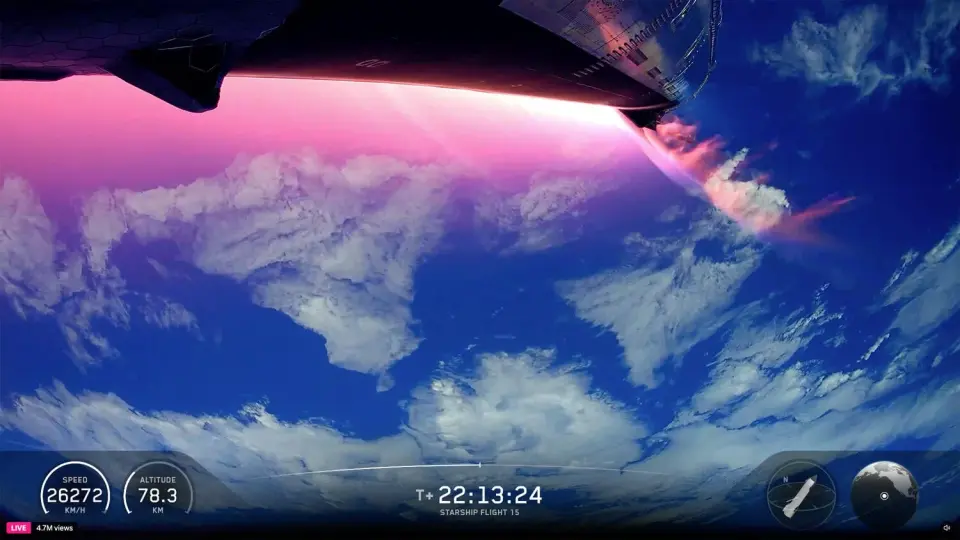
SpaceX successfully recovered its Starship upper stage from orbit on November 14, 2026, marking a historic milestone for fully reusable launch vehicles. The 15th test flight saw the spacecraft complete 14 orbits before being caught by mechanical arms at the Starbase facility in Texas. While the upper stage succeeded, the Super Heavy booster failed to land and exploded over the Gulf of Mexico. This achievement is critical for NASA’s Artemis III moon mission, though SpaceX must still demonstrate orbital refueling capabilities.
Key points
- The Starship upper stage, designated Ship 42, was caught by the 'Mechazilla' arms at SpaceX’s Starbase facility in Texas after a 22-hour orbital mission.
- The Super Heavy booster failed to land, suffering a guidance issue that led to a fuel depletion and explosion over the Gulf of Mexico, though SpaceX had previously recovered this stage three times.
- The mission deployed 26 Starlink V3 satellites, with some carrying cameras to monitor the Starship’s heat shield during reentry.
- NASA Administrator Jared Isaacman praised the catch as 'almost magic,' noting its importance for the Artemis III lunar landing scheduled for 2028.
- SpaceX plans to test orbital propellant transfers in upcoming flights, a necessary step for sending Starship to the moon, as the vehicle cannot reach lunar orbit on a single launch.
Background
Previous test flights, including the 14th in September 2026, had ended with planned ocean splashdowns for the upper stage. SpaceX had successfully recovered the Super Heavy booster in three prior launches but had not yet attempted to catch the upper stage from orbit. The company’s goal is to develop a fully reusable system to lower launch costs and support NASA’s Artemis program, which aims to return astronauts to the moon. NASA has also expressed openness to using Blue Origin’s lander if SpaceX’s timeline slips.
How outlets are covering it
AOL.com and The New York Times emphasized the historic nature of the upper stage catch, describing it as a 'spectacular' and 'remarkable' feat that validates SpaceX’s reusability model. CNN highlighted the risks of orbital reentry, noting that losing control could have led to unpredictable impacts on populated areas. Fox Business focused on the broader implications for humanity and the commercial viability of the launch system, citing Walter Isaacson’s comments on the 2020 proposal for the catch. All sources agreed that the booster failure was a setback but did not alter the overall timeline for high-volume reusable flights, according to Elon Musk.
Why it matters
This milestone is crucial for reducing the cost of space access and enabling future missions to the moon and Mars. The success of the upper stage catch demonstrates that SpaceX can recover the most powerful part of its launch system, a key requirement for the Artemis III mission. However, the booster failure and the need for orbital refueling tests indicate that significant engineering challenges remain before the system is fully operational for crewed lunar landings.
What to watch
SpaceX plans to conduct orbital fueling tests in the next several flights to demonstrate the ability to transfer propellants between Starships in Earth orbit. The company is also preparing for Flight 16, which may launch from a revamped pad at Kennedy Space Center in Florida. NASA is closely monitoring these developments to ensure Starship is ready for the Artemis III mission in 2028, while also evaluating Blue Origin’s Blue Moon Mark 2 lander as a backup option.
- SpaceX pulls off first Starship recovery from orbit in spectacular fashion AOL.com
- Highlights: SpaceX Starship soars in orbit, still aiming for ship catch in unprecedented test flight CNN
- SpaceX Makes History With Successful Rocket Catch in Texas The New York Times
- SpaceX makes history as Starship spacecraft caught by launch tower for first time Fox Business
- SpaceX successfully catches Starship and makes history NPR
Want the full story? Read the original reporting
Read on AOL.com