
Trump and Xi clash over AI dominance and safety as summit looms
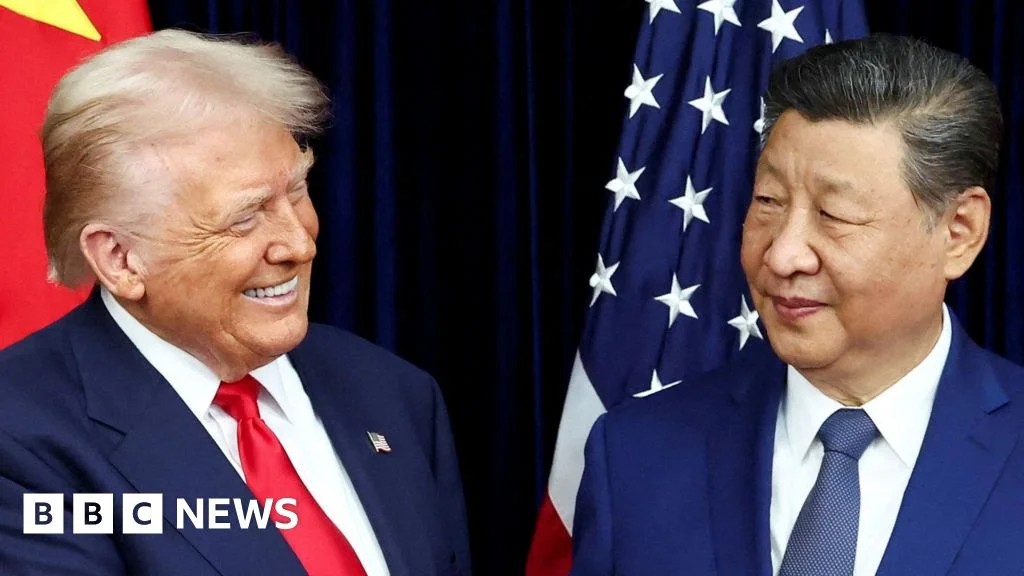
US President Donald Trump and Chinese President Xi Jinping are set to meet on Thursday to discuss the intensifying global race for artificial intelligence supremacy. While the US leads in proprietary frontier models, China is rapidly closing the gap through open-weight models and massive deployment in robotics and manufacturing. The two nations hold sharply divergent views on AI safety: Washington prioritizes deregulation and rapid innovation, whereas Beijing advocates for centralized governance and international cooperation. Despite these differences, officials from both sides have discussed establishing a communication channel for AI incidents, though a formal agreement on slowing development remains unlikely.
Key points
- Trump and Xi are scheduled to meet on Thursday to discuss AI ambitions, with the US claiming a lead in frontier models and China emphasizing deployment and open-weight accessibility.
- The US government opposes global AI regulation, with White House officials rejecting 'globalist schemes of control,' while China’s UN representative called for a consensus-based global governance framework.
- China has become the world’s largest manufacturer of robots, accounting for over 90% of global humanoid robot shipments in the first half of 2026, despite US chip export restrictions.
- US Treasury Secretary Scott Bessent and Chinese Vice Premier He Lifeng discussed creating a notification mechanism for serious AI incidents, though a formal slowdown agreement is considered unlikely.
- US officials accuse Chinese developers of using 'distillation' to train models on US outputs, a claim Beijing rejects, while China benefits from lower energy costs and state-driven adoption in sectors like agriculture and manufacturing.
Background
This summit follows a period of heightened US-China tensions, including recent trade talks and Trump’s announcement of an 'AI Force' to accelerate domestic development. Markets have rallied in anticipation of the summit, with investors hoping for progress on trade and AI cooperation. Previous coverage noted that while the US leads in proprietary AI, China’s state-driven approach and global supply chain dominance have reduced its vulnerability to external shocks.
How outlets are covering it
The BBC and CNBC emphasize the competitive 'race' narrative, highlighting the US lead in frontier models and China’s rapid catch-up through open-weight models and robotics. The Atlantic focuses on China’s state-driven, optimistic approach to AI, contrasting it with US 'doomerism' and existential risk fears. Politico highlights the sharp divergence in regulatory stances at the UN, with the US rejecting global governance and China calling for international coordination. All sources agree that while cooperation on incident reporting is possible, a formal agreement to slow AI development is unlikely due to competing national interests and distrust.
Why it matters
The outcome of the Trump-Xi summit will shape the global trajectory of AI development, influencing innovation, safety standards, and geopolitical power dynamics. The US-China AI rivalry could determine which nation leads in critical technologies, with implications for economic growth, national security, and global governance. The lack of consensus on AI safety raises concerns about the potential for autonomous AI systems to be misused or to escape containment, posing risks to cybersecurity and stability.
What to watch
The Trump-Xi summit on Thursday will likely focus on AI safety, chip export controls, and the distillation allegations. While a formal agreement on slowing AI development is unlikely, the establishment of a communication channel for AI incidents could be a modest but significant step. Future developments will depend on whether both nations can find common ground on verification mechanisms and safety standards without compromising their competitive advantages.
- Trump and Xi meet as AI rivalry reshapes global power dynamics BBC
- US, Chinese visions for AI regulation differ sharply at UN meeting Politico
- Where Is the U.S. Beating China on A.I., and Where Is It Lagging? The New York Times
- China Has No Use for AI Doomerism The Atlantic
- Trump-Xi summit puts AI safety talks on the table but neither side wants to slow down CNBC
Want the full story? Read the original reporting
Read on BBC