
Hawaii's 550-Year-Old Hōlei Sea Arch Falls Into Pacific After Storm
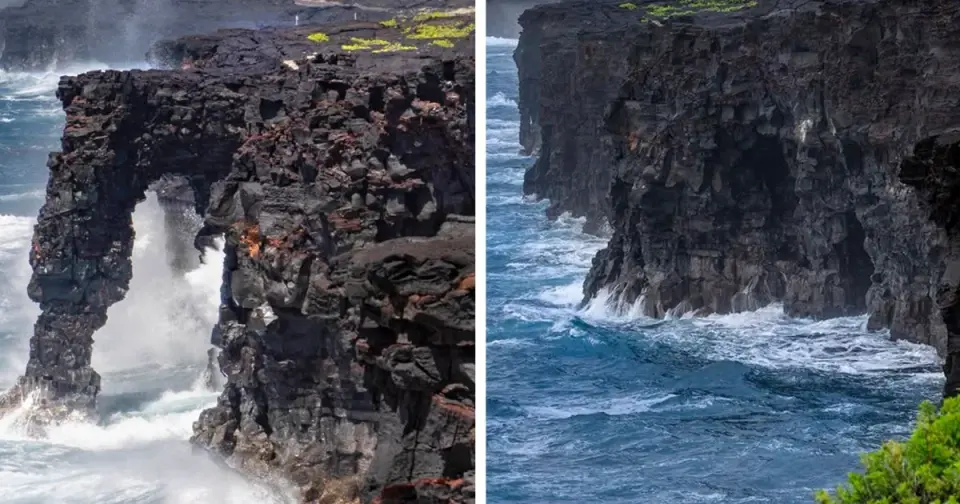
The 90-foot Hōlei Sea Arch in Hawaiʻi Volcanoes National Park collapsed into the Pacific Ocean between September 23 and 27, 2026. The National Park Service confirmed the loss, attributing it to long-term erosion and recent storm activity.
Key points
- The Hōlei Sea Arch, a 90-foot natural formation, was confirmed standing on September 23 but was gone by September 27.
- The collapse occurred during a temporary park closure for Tropical Storm Nolo, which brought significant swell to the Big Island's southern coast.
- The National Park Service stated the arch was formed roughly 550 years ago by lava flows and was slowly shaped by the ocean.
- Officials warned that the collapse was a long time coming, citing damage from the 2018 Kīlauea eruption and cracks discovered in 2020.
- The park service urged visitors to stay away from unstable cliff edges, noting that some people had ventured too close to the edge on social media.
Background
The Hōlei Sea Arch had been a major landmark for decades, but its stability had been declining for years. In 2018, earthquakes associated with the Kīlauea eruption damaged nearby cliffs. By January 2020, new cracks prompted the park to close the original viewing area and open a safer one further from the edge. Later that year, massive surf from Tropical Storm Darby broke off a chunk of rock from the lower part of the arch. The U.S. Geological Survey noted that the arch was a product of 'differential erosion,' a process where the ocean gradually removes material from weaker sections of basalt rock.
How outlets are covering it
All four sources (NBC News, CNN, The New York Times, and the National Park Service) agree on the basic facts of the collapse, including the timeframe and the role of Tropical Storm Nolo. However, they differ in emphasis. The National Park Service and NBC News focus heavily on the safety risks to visitors, warning that people were stepping too close to the edge. CNN and The New York Times emphasize the emotional impact on visitors and the inevitability of the collapse due to natural erosion. The New York Times also highlights the 'cascade of tributes' from those who had hiked the park, while the National Park Service focuses on the scientific process of differential erosion and the long-term instability of the coastline.
Why it matters
The collapse of the Hōlei Sea Arch is a significant event for Hawaii's tourism and natural heritage. It serves as a stark reminder of the power of natural forces and the inevitability of geological change. The incident also highlights the importance of visitor safety in national parks, as the unstable cliff edges pose a serious risk to those who venture too close. The loss of this iconic landmark will likely impact tourism in the area, as many visitors had come to see the arch for years.
What to watch
The National Park Service has urged visitors to stay away from the unstable cliff edges and out of closed areas. The park is likely to continue monitoring the coastline for further erosion and instability. There may be increased public interest in the area as people seek to see the site where the arch once stood, but officials are warning against approaching the edge. The park may also consider additional safety measures or signage to prevent visitors from putting themselves at risk.
- Hawaii’s picturesque Hōlei Sea Arch collapses into the ocean NBC News
- Hawaii’s famed Hōlei Sea Arch has collapsed CNN
- The Holei Sea Arch, a Centuries-Old Hawaii Wonder, Crumbles Into the Pacific The New York Times
- Hōlei Sea Arch Collapses in Hawaiʻi Volcanoes National Park National Park Service (.gov)
- Hawaii’s centuries-old sea arch collapses into Pacific after series of rough storms The Guardian
Want the full story? Read the original reporting
Read on NBC News