
Record Diesel Prices and Economic Anxiety Drive Historic Republican Disapproval of Trump
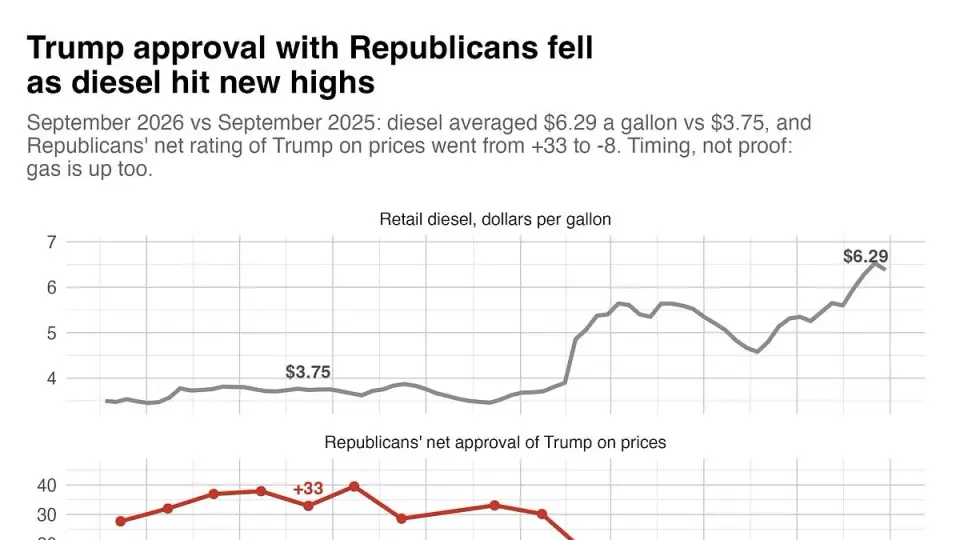
Polling data from late September 2026 indicates a significant shift in Republican sentiment, with a majority of party members now disapproving of President Trump’s handling of inflation. This decline coincides with record-high diesel prices, which have surged from $3.50 to $6.29 per gallon since May 2025. The economic strain is particularly acute in red states with competitive Senate races, such as Iowa and Ohio, where Republican candidates are trailing despite the president’s strong 2024 performance. While Trump’s overall approval has hit a second-term low of 31%, the cost of living remains the primary driver of this erosion, threatening the GOP’s ability to retain control of Congress in November.
Key points
- 52% of Republicans and Republican-leaning independents now disapprove of Trump’s handling of prices, marking the first time a majority of the party has done so in this polling series.
- The national average price of diesel reached an all-time high of $6.29 per gallon in late September 2026, up from $3.50 in May 2025.
- Trump’s net approval rating among Republicans on prices fell from +5 to -8 between August and September 2026, a drop of 13 points.
- In states with competitive Senate races, including Iowa, Ohio, and Michigan, Republican candidates are currently tied or trailing in polling averages despite Trump winning these states by double digits in 2024.
- An AP-NORC poll found that 65% of all adults, including 67% of Republicans, attribute higher prices to factors beyond the president's control, yet 52% of Republicans still feel his handling of the issue is worse than expected.
Background
This development follows months of rising fuel costs and internal party pressure. In late September 2026, Republican lawmakers urged the White House to pause diesel exports to lower domestic prices, a move the administration rejected. Earlier in the year, some Republican campaign ads began acknowledging the rising cost of living, a shift from previous messaging that claimed prices were falling. The current polling data suggests that these economic pressures are now translating into measurable electoral risk for the party.
How outlets are covering it
Strength In Numbers emphasizes the specific impact of diesel prices on rural and blue-collar voters, noting that farmers and truckers are disproportionately affected. The outlet highlights that prices are the only issue where Republicans rate Trump net-negative. AP-NORC provides a broader national perspective, noting that while most Americans blame Trump for higher prices, a significant portion of Republicans (67%) believe the costs are due to external factors. However, AP-NORC also reports that 52% of Republicans feel the administration's handling of the economy is worse than expected. New York Magazine’s Ed Kilgore contextualizes these numbers historically, comparing Trump’s current 31% approval rating to previous midterms where low approval led to significant seat losses for the president’s party. While all sources agree on the decline in approval, they differ on the primary driver: Morris focuses on fuel costs, AP-NORC on general economic dissatisfaction, and Kilgore on the broader trajectory of unpopularity.
Why it matters
The erosion of support among Trump’s own party base is a critical indicator for the 2026 midterms. If the president cannot maintain support among Republicans on the cost of living, it is difficult for his party to win competitive Senate seats in red states. The data suggests that the 'cost of living' issue is no longer a Democratic advantage but a bipartisan concern that is actively turning off Republican voters. With 32 days remaining until Election Day, the inability to reverse this trend could result in a loss of control in both chambers of Congress, mirroring historical patterns where low presidential approval correlates with significant seat losses.
What to watch
The next major data point will be the U.S. Energy Information Administration’s weekly diesel price update scheduled for October 6, 2026. Pollsters will continue to monitor whether the 11-point drop in Republican approval from August to September stabilizes or continues to decline. Campaign strategists for Republican Senate candidates in states like Iowa and Texas will likely shift their messaging to distance themselves from the president’s economic record, focusing instead on issues where Trump retains higher approval ratings, such as immigration. The outcome of these races will determine whether the GOP can mitigate the damage from the president’s low approval ratings.
- Amid rising diesel prices, Republicans turn against Trump for first time on handling inflation Strength In Numbers | G. Elliott Morris
- Most blame President Trump for higher prices and are unhappy with how he is handling the economy AP-NORC
- Most Americans blame Trump for high prices as his economic approval hits new low, AP-NORC poll shows AP News
- How Low Can Trump Go in Job Approval? New York Magazine
- Trump approval rating hits new career low in latest AP-NORC poll usatoday.com
Want the full story? Read the original reporting
Read on Strength In Numbers | G. Elliott Morris