
Board of Peace Unveils $2.45 Billion Six-Month Gaza Recovery Plan Amid Political Stalemate
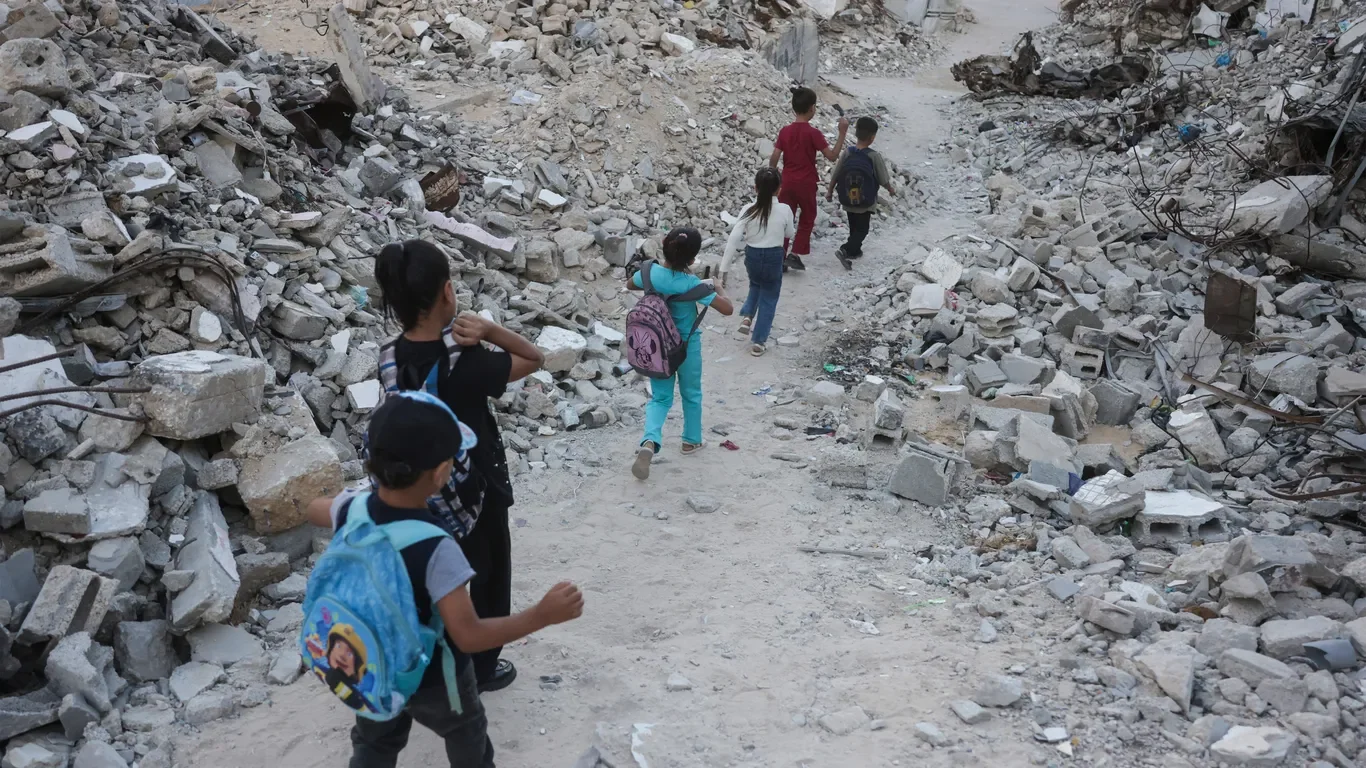
The Board of Peace has unveiled a six-month, $2.45 billion recovery plan for Gaza, outlining 66 projects across infrastructure, security, and governance. While the plan aims to rebuild the territory and establish a Palestinian-led administration, implementation is stalled by Israeli domestic politics, Hamas disarmament conditions, and unresolved funding challenges.
Key points
- The Board of Peace, comprising 28 member countries, presented a $2.45 billion, six-month recovery plan for Gaza on Wednesday, featuring 66 projects across six categories: infrastructure, human development, economic acceleration, digital transformation, legal affairs, and peace/security.
- Infrastructure spending accounts for roughly $1 billion, including $400 million for temporary shelters, $275 million for rubble and unexploded ordnance clearance, $50 million for hospital repairs, and $30 million for road network repairs. Security projects account for approximately $885 million, including $275 million for a permanent International Stabilization Force (ISF) site in Rafah, $140 million for ISF recruitment and deployment, and $120 million for mobilizing a Palestinian police force.
- The plan includes a $20 million weapons buy-back program to incentivize Hamas and other armed groups to surrender arms, and a gradual demilitarization process area by area, with the IDF withdrawing after verifiable disarmament. A Palestinian technocratic government, led by Ali Shaath, is expected to eventually manage Gaza's border crossings and implement a digital ID and payment system.
- Implementation is blocked by Israeli domestic politics ahead of October 27 elections, with Netanyahu's government refusing to begin implementation. Hamas has agreed in principle to disarm but has not been tested, partly because Israel has not implemented a 14-day ceasefire before demilitarization begins. The Board of Peace hopes progress will resume after Israeli elections, but a likely caretaker government and political stalemate may hinder implementation.
- Funding remains a key challenge, as the Board of Peace and Palestinian technocratic government have not yet secured the full $2.45 billion. Officials express confidence that donor countries will step up once political hurdles are cleared. The plan estimates total physical damage in Gaza at $35.2 billion, with full recovery requiring $71.4 billion over the next decade.
Background
The Board of Peace's 15-point peace plan was previously rejected by Israeli Prime Minister Netanyahu in August 2026, who argued Israel would not withdraw until Hamas was disarmed and ruled out a Palestinian state. This rejection led to international condemnation from Arab and Muslim states, who urged the US to enforce Israeli compliance. The US subsequently rejected Israeli calls to depopulate Gaza, reaffirming support for the peace plan and voluntary departures. The current $2.45 billion recovery plan represents a more detailed, phased approach to reconstruction and governance, building on the earlier roadmap but facing similar political and security obstacles.
How outlets are covering it
Axios emphasizes the comprehensiveness of the 66-project plan and the financial breakdown, highlighting the challenges of funding and political implementation. The Jerusalem Post focuses on the diplomatic efforts at the UN General Assembly, with Board of Peace High Representative Nickolay Mladenov urging international support and former British PM Tony Blair stressing the need for a practical solution over slogans. Both sources agree on the plan's structure and the obstacles posed by Israeli domestic politics and Hamas disarmament conditions, but Axios provides more detail on the financial allocations and the Palestinian technocratic government's role, while The Jerusalem Post highlights the security transition and the gradual demilitarization process.
Why it matters
The $2.45 billion recovery plan represents a critical step toward post-war reconstruction and governance in Gaza, but its success depends on resolving deep political and security obstacles. If implemented, it could stabilize the territory, rebuild infrastructure, and establish a Palestinian-led administration. However, Israeli domestic politics, Hamas's disarmament conditions, and unresolved funding challenges could delay or derail the plan, prolonging instability and humanitarian suffering in Gaza.
What to watch
The Board of Peace and Palestinian technocratic government will seek to secure funding and push for implementation after Israeli elections on October 27. Key immediate priorities include moving Palestinians out of tents, with $400 million earmarked for insulated caravans and a UAE-funded pilot 'Emirati Neighborhood' in Rafah to house 50,000 people. The plan also calls for a gradual demilitarization process, with the IDF withdrawing after verifiable disarmament, and the establishment of a Palestinian police force. Progress will depend on Israeli political outcomes and international donor support.
- Scoop: Trump's Board of Peace to unveil $2.45 billion Gaza recovery plan Axios
- Trump’s Board of Peace proposes $2.45 billion blueprint to begin Gaza reconstruction The Seattle Times
- Trump's Board of Peace to unveil $2.45 billion Gaza recovery plan, Axios reports Reuters
- Mladenov calls for support of BoP's Gaza reconstruction plan during UNGA The Jerusalem Post
- Trump’s Board of Peace Earmarks $2.5 Billion for Gaza Fund Bloomberg
Want the full story? Read the original reporting
Read on Axios