
Cats Use Kidney-Stored Fatty Acids to Maintain Stable Urine Scent Signatures
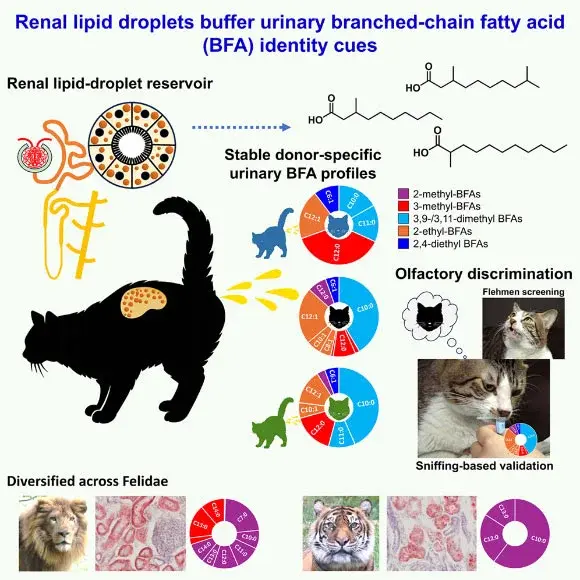
Researchers have identified a chemical mechanism that allows cats to maintain a stable scent identity over time. A new study reveals that cats store 13 specific branched-chain fatty acids in their kidneys, which are released into urine to create a durable chemical signature. This discovery resolves a century-old mystery regarding the function of lipid droplets in feline kidneys and suggests new methods for tracking wild cats and managing pet urine odor.
Key points
- A team of scientists from Japan, Germany, and Spain published a study in Current Biology explaining why cat kidneys contain unusually high numbers of lipid droplets.
- The research identified 13 branched-chain fatty acids (BFAs) that are stored in the renal cortex and released into urine, creating a unique chemical profile for each cat.
- Unlike other volatile urine compounds, these BFAs evaporate slowly, remaining detectable for at least 24 hours after deposition, which helps maintain a stable scent signature.
- Behavioral tests using the 'flehmen response' confirmed that cats can distinguish between their own urine and that of other individuals based on these specific fatty acid ratios.
- Similar compounds were found in wild felids, including lions, tigers, and leopards, suggesting a shared evolutionary mechanism for chemical individuality across the family.
Background
This discovery addresses a long-standing biological puzzle that had persisted for over 110 years. While the presence of lipid droplets in cat kidneys was documented in the early 20th century, their purpose remained unknown until this recent study. The finding builds on broader research into animal chemical communication, where scent marks are used to convey identity and territorial information despite the natural degradation of odor molecules over time.
How outlets are covering it
Sci.News and Popular Science both emphasize the novelty of the 13 branched-chain fatty acids (BFAs), noting that this class of compound had not previously been documented in mammalian urine. Popular Science highlights the international collaboration behind the study, involving researchers from Japan, Germany, and Spain, and notes that related cats tend to have similar but distinct profiles. Live Science focuses on the practical implications, framing the discovery as a 'code' that could help conservationists track elusive wild cats without visual observation. All three outlets agree that the slow evaporation of these compounds is key to maintaining a stable identity over time, though Sci.News specifically attributes the initial identification of the compounds to the flehmen response behavior.
Why it matters
Understanding the chemical basis of cat scent marking could lead to improved methods for managing urine odor in domestic settings and developing non-invasive tools for monitoring wild cat populations. Additionally, the findings may provide insights into renal physiology, potentially aiding in the treatment of kidney diseases in felines. The discovery also advances the broader field of chemical ecology by explaining how animals maintain individual identity through volatile signals that degrade over time.
What to watch
Researchers plan to investigate the specific mechanisms by which branched-chain fatty acids are released from renal lipid droplets into urine. Future studies may also explore the application of these chemical profiles in conservation efforts to track wild cats and in veterinary medicine to address kidney-related health issues.
- Scientists Solve Century-Old Feline Mystery Sci.News
- Scientists Find Hidden Messages in Cat Pee Newser
- Scientists pinpoint the chemicals behind a cat’s signature urine smell Popular Science
- Secret 'messages' in cat pee let felines identify each other — and scientists just cracked the code Live Science
- A 100-year-old mystery in the cat kidney may be linked to scent communication Phys.org
Want the full story? Read the original reporting
Read on Sci.News