
"Unusual Electron Behavior in Metallic Kagome Ferromagnets"
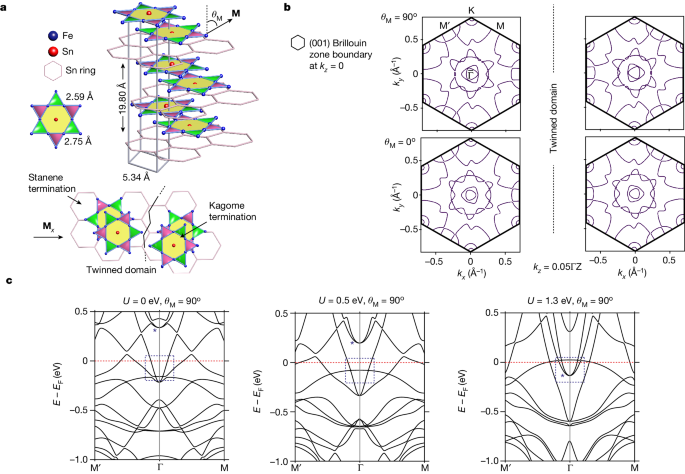
Researchers have conducted a detailed experimental study of the distinct electron pockets in the metallic kagome ferromagnet Fe3Sn2 using state-of-the-art laser-based micro-focused ARPES, overcoming averaging over crystallographic twins and surface sensitivity. The study revealed two distinct yet equivalent areas rotated from each other by 180°, indicating twinned domains, and provided insights into the electronic band structure and quasiparticle behavior at low temperatures. The findings suggest a many-body origin for the observed electron pockets and highlight the potential for exploiting electron-correlation effects for both measurement of the effective Coulomb interaction and the discovery of new electronic phenomena in materials with strongly influenced band structures.
Want the full story? Read the original reporting
Read on Nature.com