
Connectome Map Reveals How Electric Fish Filter Self-Generated Noise
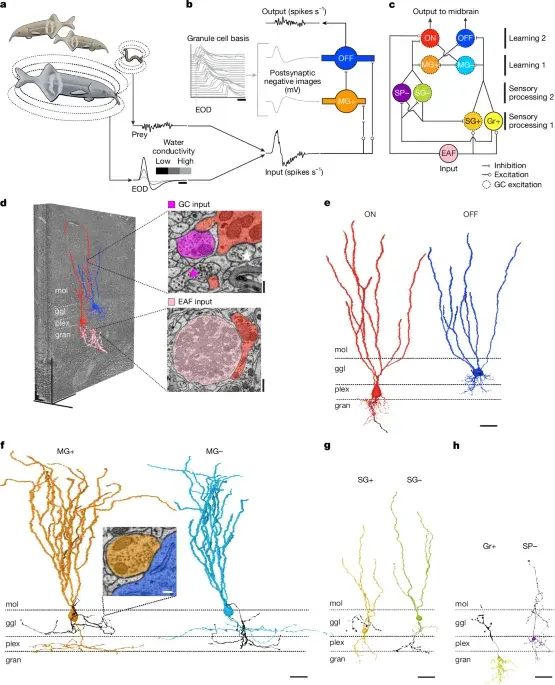
Researchers have mapped the synaptic connections of the electrosensory lobe in the elephantnose fish, revealing how the brain cancels out its own electrical pulses to detect prey. The study, published in Nature, identifies a specific pairing of fast- and slow-learning neurons that stabilizes sensory predictions. This structural insight explains how the fish maintains accurate environmental models despite constant self-generated noise, offering a biological blueprint for continual learning in neural networks.
Key points
- A team led by Nathaniel Sawtell and Krista Perks mapped 5,016 cells and 29,694 synapses in the fish's electrosensory lobe using electron microscopy.
- The circuit pairs fast-learning output cells with slow-learning medium ganglion (MG) cells to balance speed and stability in sensory prediction.
- This pairing allows the fish to cancel its own electric pulses, which are much stronger than the signals from prey, without losing previously learned predictions.
- Computational models confirm that this dual-speed learning mechanism prevents noise from degrading the accuracy of sensory cancellation.
- The findings highlight how distributed synaptic plasticity across different cell types solves the credit assignment problem in continual learning.
Background
This research builds on prior work by the same group, including a 2019 study in Cell that identified multi-layer continual learning in electric fish and a 2023 study in Current Biology detailing differential control of axonal and dendritic spiking. Earlier archive coverage of cerebellar functions, such as the 2026 study on mescaline dampening the brain's sensory gatekeeper, underscores the cerebellum's role in filtering sensory input, a function analogous to the electrosensory lobe's noise cancellation.
How outlets are covering it
Nature emphasizes the structural precision of the connectome, highlighting how specific synaptic rules and recurrent connectivity enable robust sensory cancellation. Earth.com focuses on the functional implications for artificial intelligence, noting that the biological pairing of fast and slow learners offers a solution to the 'catastrophic forgetting' problem in machine learning. While both sources agree on the mechanism, Nature stresses the biological constraints and cell-type specificity, whereas Earth.com frames the discovery as a potential inspiration for engineering more resilient neural networks.
Why it matters
Understanding how biological circuits manage continual learning without erasing previous knowledge provides a new framework for developing AI systems that can adapt to changing environments. The precise mapping of synaptic connections in the elephantnose fish offers a concrete example of how distributed plasticity can be structured to overcome individual limitations, potentially guiding the design of more efficient and robust artificial neural networks.
What to watch
The full electron microscopy dataset is now publicly available, allowing other researchers to analyze the top layer of the lobe, which contains the primary learning connections. Future studies may investigate whether learned connections differ structurally from unlearned ones and whether similar fast-slow neuron pairings exist in mammalian cerebellar circuits, potentially revealing universal principles of sensory prediction across species.
Want the full story? Read the original reporting
Read on nature.com