
3D-Printed E-Skin Brings High-Resolution Touch to Prosthetics and Robots
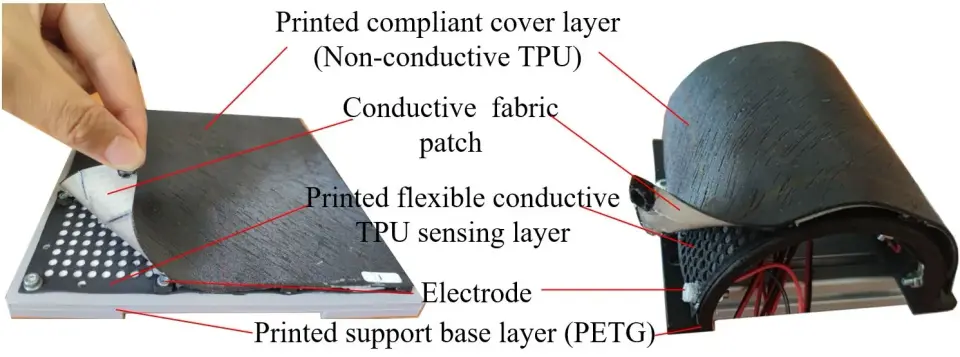
Researchers at Washington State University have developed a customizable electronic skin for prosthetics that offers ten times the spatial resolution of commercial glove sensors. By using a 'scan-model-print' manufacturing process, the system creates modular, snap-together sensor arrays that conform to complex limb geometries while maintaining high-density pressure and temperature sensing. This approach aims to democratize medical-grade tactile feedback, potentially improving the daily functioning of amputees by providing multimodal sensory data that mimics human skin.
Key points
- A new electronic skin system achieves approximately 10x higher spatial resolution than current commercial glove sensors, with a prototype incorporating 170 pressure pixels and 14 temperature sensors per finger and palm assembly.
- The system utilizes a 'scan-model-print' method where structured-light 3D scanning maps sensor layouts onto the specific geometry of a prosthetic, followed by stereolithography 3D printing and laser cutting of flexible electrical layers.
- Modular sensor components are designed as thin, less-than-2mm sandwiches that snap together like LEGO bricks, eliminating the need for adhesives and allowing for individual module replacement if damaged.
- A neural network is employed to calibrate individual sensing elements and remove noise from manufacturing variations, reducing average pressure estimation error from 30 kPa to 8.5 kPa with over 95% classification accuracy.
- The technology currently serves as the sensing half of a future bionic skin; researchers are developing actuators to convert these signals into nerve stimulations for actual tactile feedback.
Background
Recent neuroscientific research has highlighted the complex circuitry underlying human touch and pain perception, emphasizing the importance of high-resolution sensory input for daily interaction. This new hardware development addresses the long-standing challenge of replicating such biological sensitivity in artificial limbs, where previous attempts often suffered from low resolution, poor fit, or high costs associated with clean-room manufacturing processes.
How outlets are covering it
While Hackaday focuses on the potential application of this technology for humanoid robots and highlights the simplicity of the underlying electrical impedance tomography principles, Hackster.io and Scientific Frontline emphasize its immediate impact on prosthetics for amputees. Hackaday notes that the hardware is relatively uncomplicated, potentially allowing for hobbyist recreation, whereas the other sources stress the clinical viability and cost-effectiveness of the 'scan-model-print' method for widespread medical adoption. All sources agree that the system currently lacks the haptic feedback necessary to fully restore the sensation of touch, serving instead as a critical sensing foundation for future bionic skins.
Why it matters
This innovation lowers the barrier to entry for high-resolution tactile feedback in prosthetics by moving away from expensive, flat-surface manufacturing to customizable 3D-printed solutions. By enabling users to sense pressure, temperature, and texture, the technology could significantly improve the dexterity and confidence of amputees, addressing a critical gap in current assistive devices that rely heavily on visual feedback.
What to watch
Researchers are currently working on developing an actuator that will convert the electronic skin's sensing signals into nerve stimulations, aiming to create a full bionic skin capable of both sensing and haptic feedback. The team has also submitted a provisional patent for the technology and is exploring further integration with rehabilitation settings to enhance the quality of life for users.
- 3D-Printed Skin Gives Robots The Sensation Of Touch Hackaday
- Researchers develop electronic skin for prosthetics to sense temperature and pressure WSU Insider
- The 3D-Printed E-Skin Giving Prosthetics a Sense of Touch Hackster.io
- WSU scientists create electronic skin for prosthetic limbs that might let amputees sense temperature, pressure Yakima Herald-Republic
- High-Resolution E-Skin for Prosthetics Developed Scientific Frontline
Want the full story? Read the original reporting
Read on Hackaday