
AI Agent Enables Autonomous Lab Equipment Coordination
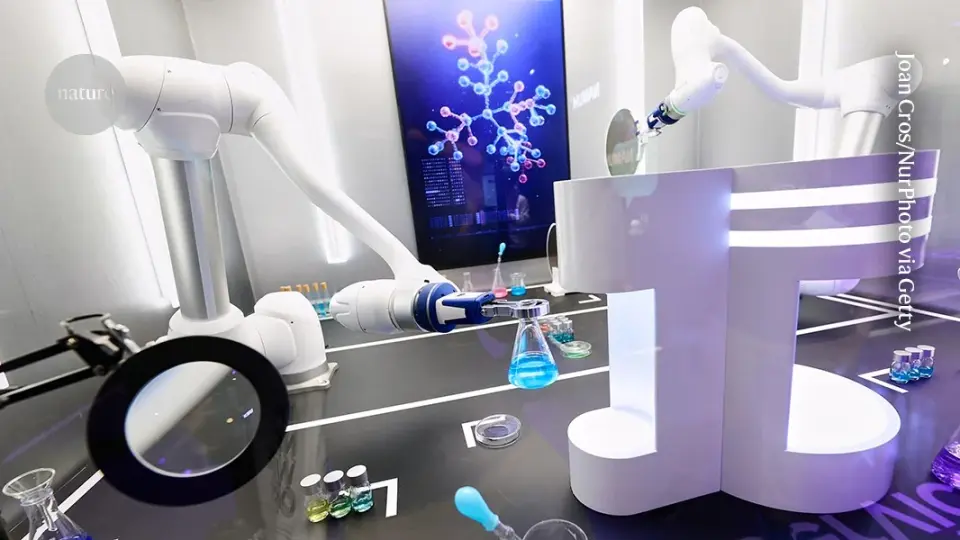
A new platform allows disparate laboratory devices to communicate and be controlled by an AI agent, streamlining research workflows. Developed with input from computational biologist Sina Barazandeh at Carnegie Mellon University, the system enables robotic arms to autonomously move samples between instruments without human intervention. This advancement aims to reduce manual labor in labs and accelerate experimental processes by creating a seamless, self-directed workflow for complex tasks.
Key points
- An AI system has been developed to allow laboratory devices to communicate with each other and be controlled by an artificial intelligence agent.
- The platform enables disparate machines to coordinate tasks, such as a robotic arm moving a multi-well plate from a liquid-filling instrument to an analysis device.
- Sina Barazandeh, a computational biologist at Carnegie Mellon University in Pittsburgh, Pennsylvania, observed the system operating without human intervention.
- The technology aims to streamline research by removing the need for manual coordination between different lab instruments.
- The development represents a step toward more autonomous laboratory environments, potentially increasing the speed and efficiency of scientific experiments.
Background
This development follows earlier discussions in our archive regarding AI models communicating without human language, as seen in the 'machine telepathy' approach tested by startup Mostik. Additionally, previous coverage highlighted the growing integration of AI 'scientists' in research teams, which has been shown to supercharge biomedical research and boost the speed of scientific discovery. The current innovation extends this trend by focusing on the physical coordination of hardware rather than just data analysis.
Why it matters
By enabling autonomous coordination between lab equipment, this AI system reduces the time and labor required for routine experimental tasks. This efficiency gain allows researchers to focus on higher-level analysis and hypothesis generation, potentially accelerating the pace of scientific discovery across various fields. The ability to seamlessly integrate disparate devices into a single, AI-controlled workflow could lead to more complex and rapid experimental cycles, enhancing overall research productivity.
What to watch
Researchers and institutions may begin adopting such AI-driven platforms to automate their laboratory workflows. Further developments could involve integrating more complex decision-making capabilities into these AI agents, allowing them to not only execute tasks but also design experiments based on real-time data. The long-term impact could be a shift toward fully autonomous 'self-driving' labs, where AI manages the entire research process from hypothesis to data analysis.
Want the full story? Read the original reporting
Read on Nature