
Topological encoding allows laser data to survive atmospheric turbulence
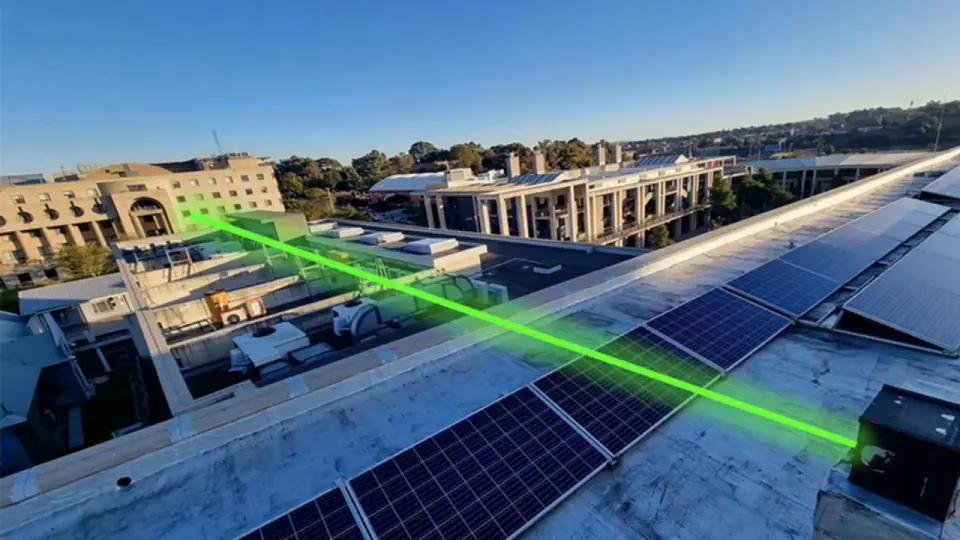
Researchers at Wits University and the University of Bordeaux have demonstrated a method to transmit optical data through open air without loss, bypassing the need for complex adaptive optics. By encoding information into the topological structure of light beams using skyrmions, the data remains intact even when the physical shape of the beam is severely distorted by atmospheric turbulence. In a 270-meter test across a campus in Johannesburg, the system achieved over 98% data fidelity under normal conditions and 86% under extreme turbulence. This approach eliminates the need for real-time hardware corrections, potentially reducing energy costs for long-distance optical networks and enabling high-speed internet for remote areas without fiber cables.
Key points
- A joint team from Wits University (South Africa) and the University of Bordeaux (France) successfully transmitted data through turbulent open air using topological encoding.
- The method relies on 'skyrmions,' particle-like magnetic structures that encode information into the topological profile of light rather than its brightness or color.
- The experiment used a 270-meter free-space optical link between two buildings on the Wits West Campus in Johannesburg.
- Data fidelity remained above 98% in most conditions and dropped to 86% only under extreme turbulence, despite the beam's physical shape being mangled.
- The findings, published in Science Advances, suggest a way to avoid expensive adaptive optics and real-time recalculations in free-space optical communication.
Background
This development follows recent regulatory approvals for space-based light manipulation, such as the FCC's approval of Reflect Orbital's Earendil-1 satellite to beam sunlight to Earth. While that project focuses on illumination and energy, the current breakthrough addresses data transmission integrity in free-space optics, a field that has historically struggled with atmospheric interference. Unlike fiber-optic cables, which shield signals from external disturbances, open-air laser links are vulnerable to swirling pockets of warm and cold air that scatter light, typically requiring heavy computing power to reconstruct the signal.
Why it matters
This technology could significantly lower the energy and computing demands for long-distance optical networks by removing the need for heavy corrective hardware. It offers a potential solution for bridging the digital divide in rural and isolated communities by providing high-speed internet beamed through the sky without the cost of laying fiber-optic cables. Additionally, the robustness of topological encoding could benefit deep-space missions, high-speed satellite downlinks, and quantum cryptography, where signal integrity is critical and hardware resources are limited.
What to watch
The research team will likely focus on scaling the technology for real-world deployment, testing it over longer distances and in more severe atmospheric conditions. The next steps may involve integrating this topological encoding into existing free-space optical communication systems to replace adaptive optics hardware. Researchers may also explore applications in quantum cryptography and satellite downlinks to verify the technology's viability in space environments.
Want the full story? Read the original reporting
Read on Interesting Engineering