
AI System Discovers Novel HTTP Attacks and Apache Zero-Day at Black Hat 2026
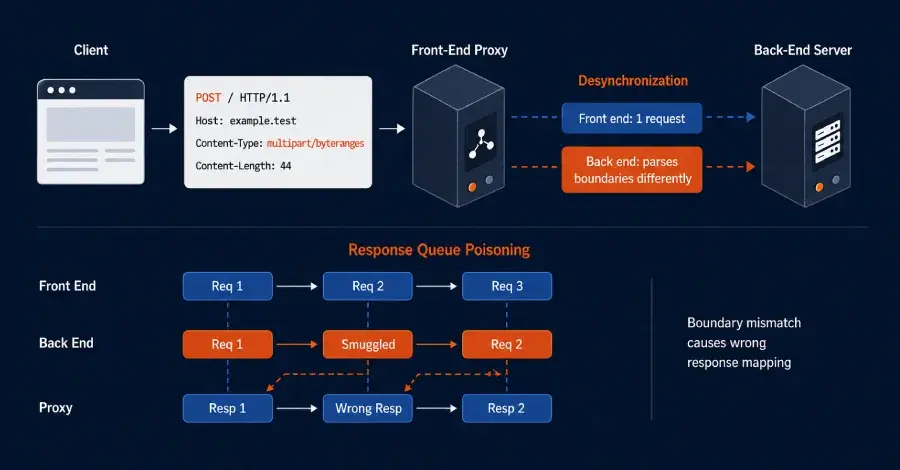
PortSwigger researcher James Kettle demonstrated an AI-assisted system called HTTP Terminator that autonomously generated novel HTTP desynchronization techniques and identified a zero-day vulnerability in Apache Traffic Server. The system tested 30,000 candidate vectors against authorized live targets, compromising approximately 700 sites, including banks and government infrastructure. While the AI proved capable of independent discovery, Kettle noted that human intervention was still required for the most complex findings, such as Shared-Parser Confusion and the Apache exploit. The research highlights a new frontier in autonomous offensive security, though the specific CVE for the Apache flaw remains unverified in public databases.
Key points
- HTTP Terminator, built by James Kettle, used 138 HTTP and SMTP RFCs to generate 30,000 unique desync vectors, testing them against 30,000 authorized websites.
- The system identified roughly 700 vulnerable targets, including an unnamed U.S. bank, government infrastructure, and an airport, using techniques like the 'dangling-byte' method to improve response queue poisoning reliability.
- A human-guided cascade discovered a zero-day in Apache Traffic Server, tracked as CVE-2026-63078, though public records in CVE.org and NVD do not yet list this identifier, creating a verification gap.
- Kettle introduced 'Shared-Parser Confusion,' a new attack concept where servers misapply response-processing rules to requests, a finding that required human validation despite AI hypothesis generation.
- PortSwigger recommends avoiding HTTP/1.1 upstream connections or strictly allow-listing methods and request bodies at both front-end and back-end layers to mitigate these risks.
Background
This research builds on Kettle’s prior work in HTTP desynchronization attacks, which he repopularized in 2019. The current study extends previous findings by integrating generative AI into the research methodology, moving beyond simple bug hunting to novel technique invention. It follows earlier industry discussions on AI’s role in cybersecurity, where the focus was primarily on accelerating known vulnerability detection rather than creating new attack classes.
How outlets are covering it
The Hacker News and PortSwigger emphasize the technical autonomy of the HTTP Terminator, highlighting its ability to generate and prove new desync triggers without direct human input. WIRED frames the findings as a demonstration of AI’s limits, arguing that while the system is powerful, it still requires human guidance for the most significant discoveries, such as the Apache zero-day and Shared-Parser Confusion. Tech Times contextualizes the event within Black Hat 2026, noting that while the AI research was a major talking point, the broader industry concern remains the failure of remediation processes, with 79% of organizations breached by known vulnerabilities. The outlets agree on the technical impact but differ on the degree of autonomy, with WIRED stressing the 'human-in-the-loop' necessity and Tech Times focusing on the operational gap between discovery and fixing.
Why it matters
The research demonstrates that AI can now autonomously generate novel attack techniques, not just exploit known ones, shifting the security landscape from detection to proactive threat generation. The discovery of a zero-day in Apache Traffic Server and the identification of new desync vectors like the 'dangling-byte' technique indicate that traditional defense strategies may be insufficient against AI-driven attacks. The lack of public verification for CVE-2026-63078 also raises concerns about the transparency and reliability of AI-discovered vulnerabilities, potentially complicating patching efforts for defenders.
What to watch
PortSwigger has open-sourced the HTTP Terminator, allowing other researchers to adopt similar AI-driven methodologies. Defenders are advised to review their HTTP/1.1 configurations and consider migrating away from it where possible. The security community will likely debate the autonomy boundary of AI in offensive research, with further studies expected to test newer models like GPT-5.6 Sol, which showed a 30% success rate in rediscovery benchmarks. The verification gap for CVE-2026-63078 may lead to further scrutiny of AI-generated vulnerability reports and their integration into standard disclosure processes.
- AI-Assisted HTTP Terminator Finds Novel HTTP Desync Techniques and Apache Zero-Day The Hacker News
- The Most Dangerous AI Hacking Techniques Still Have Humans in the Loop WIRED
- Can AI do novel security research? Meet the HTTP Terminator PortSwigger
- Black Hat 2026: Autonomous AI Invents Novel Attacks, Hits Banks and Government Tech Times
Want the full story? Read the original reporting
Read on The Hacker News