
Leaked DarkSword Code Fuels New iOS Exploit Campaign by Chinese-Speaking Actor
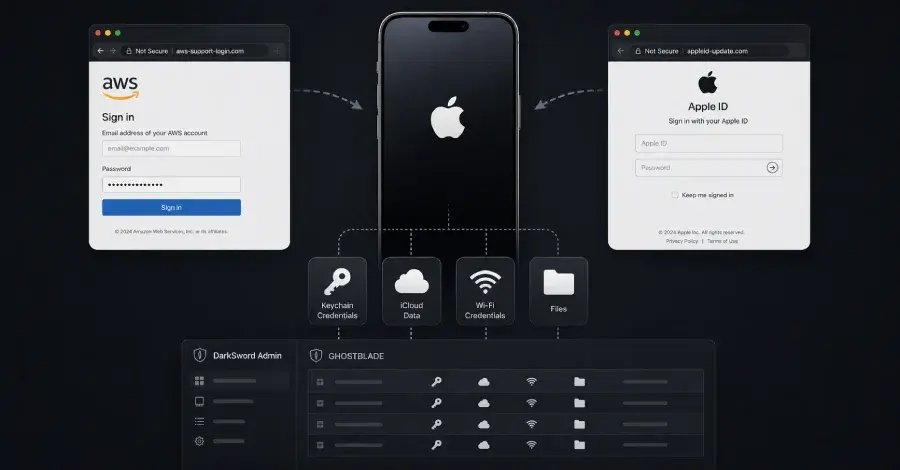
A Chinese-speaking threat actor is using a publicly leaked version of the DarkSword exploit kit to deploy GHOSTBLADE malware on iOS devices. The campaign targets users via fake AWS and Apple ID login pages, exploiting patched vulnerabilities in iOS versions 18.4 through 18.7. Censys identified over 100 web properties associated with the actor, primarily hosted in Hong Kong but reaching Japan, the US, and Europe. The attack chain involves loading malicious JavaScript to steal keychain, iCloud, and Wi-Fi credentials, which are then exfiltrated to attacker-controlled endpoints. The operator uses distinct admin panels, including one linked to a Telegram contact and labeled 'Asia-Pacific Group.' This activity follows the public leak of DarkSword source code, which has enabled other actors to join exploitation efforts. The campaign also shows links to the older Coruna exploit kit and a previously undocumented malware family called 'Thorn C2.'
Key points
- Censys identified a Chinese-speaking threat actor running over 100 web properties, mostly fake AWS sign-in pages, to deliver the DarkSword exploit kit.
- The campaign targets iOS versions 18.4 through 18.7, exploiting vulnerabilities that have since been patched by Apple.
- Successful exploitation deploys GHOSTBLADE malware, which steals keychain, iCloud, and Wi-Fi credentials and exfiltrates files.
- The operator uses multiple admin panels, including 'DarkSword Admin,' 'Decode Dashboard,' and a 'C2 Control Panel' linked to a Telegram contact and labeled 'Asia-Pacific Group.'
- The leaked DarkSword source code has enabled other actors to join the exploitation, with evidence of shared staging-page hashes and Russian-language code comments.
- A Singapore-based host previously ran an admin panel for the older Coruna exploit kit, linking this actor to UNC6353 campaigns against Ukrainian targets.
Background
Apple has recently accelerated security updates to counter AI-powered hacking threats, releasing iOS 26.5.2 and macOS Tahoe 26.5.2 earlier than planned to patch vulnerabilities in the kernel, WebKit, and WebRTC. This was followed by iOS 26.6 and macOS Tahoe 26.6, which included hundreds of security fixes. While Apple stated no known active exploitation was cited for these updates, the rapid patching cycle reflects heightened concerns about advanced threats. The current DarkSword campaign exploits vulnerabilities in older iOS versions (18.4-18.7), highlighting the ongoing risk for users who have not updated their devices to the latest secure versions.
Why it matters
The public leak of the DarkSword exploit kit has democratized access to sophisticated iOS exploitation tools, enabling state-sponsored and commercial actors to launch targeted campaigns. This increases the risk for users on older iOS versions, even if the vulnerabilities are patched, as attackers may still attempt exploitation. The use of fake AWS and Apple ID pages as initial vectors underscores the need for vigilance against credential harvesting and watering hole attacks. The discovery of new malware families like 'Thorn C2' and links to known APT groups (UNC6353) indicates a broader, more coordinated threat landscape. Organizations and individuals must ensure their devices are updated to the latest iOS versions and monitor for suspicious login attempts to mitigate these risks.
What to watch
Security researchers and threat intelligence teams will likely continue to monitor for new DarkSword-based campaigns and the emergence of other actors using the leaked code. Apple may release additional patches if new vulnerabilities are discovered or if exploitation attempts are detected on newer iOS versions. Organizations should prioritize updating their iOS devices to the latest versions and implement strict monitoring for suspicious web traffic and credential harvesting attempts. Further analysis of the 'Thorn C2' malware and the 'Asia-Pacific Group' Telegram contact may reveal additional details about the threat actor's operations and targets.
Want the full story? Read the original reporting
Read on The Hacker News