
Two Independent Flaws Allow Atlassian Rovo to Leak Enterprise Data
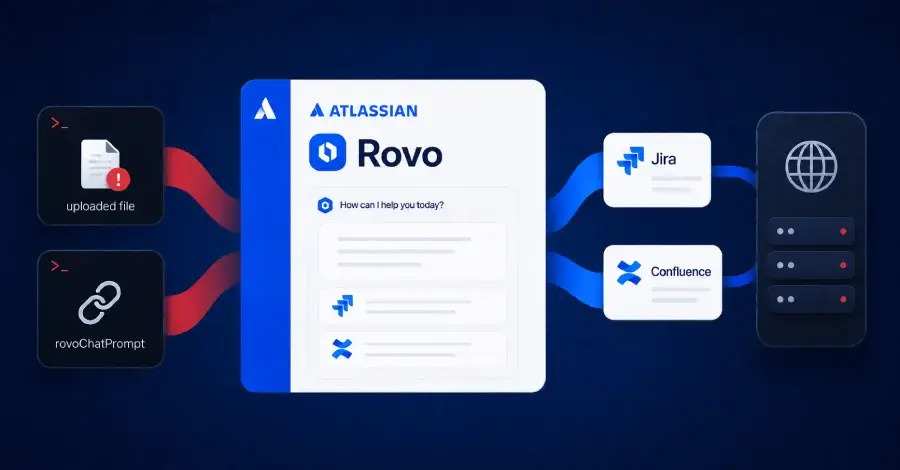
Two security firms independently identified vulnerabilities in Atlassian's Rovo AI assistant that allow attackers to exfiltrate Jira and Confluence data. One flaw, dubbed 'RovoBlast,' is a one-click link injection now patched by Atlassian. The second, a content-borne indirect prompt injection, remains unconfirmed as resolved and bypasses standard web-search controls.
Key points
- Varonis Threat Labs identified 'RovoBlast,' a one-click vulnerability where a malicious link preloads attacker instructions into Rovo Chat, exfiltrating data via the victim's privileges. Atlassian patched this server-side on July 8, 2026.
- PromptArmor discovered a separate indirect prompt injection flaw where hidden instructions in uploaded files cause Rovo to send internal data to external URLs without user approval. This issue was reported on August 5, 2026, and its remediation status remains unconfirmed.
- The PromptArmor attack bypasses Atlassian's web-search disable toggle because it utilizes a separate URL-retrieval capability. The exfiltration is invisible to users, who see normal task results while data leaks in the background.
- Neither vulnerability has a CVE identifier or appears in the CISA Known Exploited Vulnerabilities catalog as of August 8, 2026. No evidence of real-world exploitation has been reported by either firm.
- Rovo is enabled by default for Standard, Premium, and Enterprise plans. Administrators can mitigate risk by restricting Rovo access by app and user group, though blocking one Jira app does not disable shared capabilities if another app on the site remains enabled.
Background
Atlassian Rovo is an enterprise AI assistant integrated across Jira, Confluence, Bitbucket, and third-party tools like Slack and Microsoft 365. It offers autonomous agent features capable of multi-step tasks. The current vulnerabilities exploit the assistant's ability to process external inputs and fetch URLs, highlighting risks in AI agents with broad data access. Previous similar issues, such as 'Reprompt' in Microsoft Copilot, have shown that parameter-to-prompt injection is a recurring threat in enterprise AI tools.
How outlets are covering it
SecurityWeek emphasizes the 'RovoBlast' one-click flaw, noting it required no jailbreak or permission bypass and was demonstrated across Jira, Confluence, and SharePoint. Varonis presented this at DEF CON 34 and recommended limiting Rovo's reach to sensitive areas. PromptArmor and GIGAZINE focus on the content-borne indirect prompt injection, highlighting that the attack persists even if web search is disabled. PromptArmor criticized Atlassian's slow response, noting no communication after July 29, 2026, before publishing. The Hacker News synthesizes both, clarifying that only the link-based flaw is confirmed fixed, while the content-based path remains a potential risk requiring administrative scoping rather than a patch.
Why it matters
These flaws expose a critical gap in enterprise AI security: the assumption that disabling web search or requiring user approval prevents data exfiltration. Since Rovo operates with the victim's permissions, a single compromised session can leak sensitive data across multiple connected platforms. Organizations must treat AI assistants as high-risk endpoints, requiring strict access controls and monitoring, as traditional security toggles may not cover autonomous agent behaviors.
What to watch
Organizations should review Rovo access permissions by app and user group, disconnect unused integrations, and monitor assistant activity logs. Atlassian must confirm whether the July 8 fix addresses the content-borne prompt injection path. Security teams should avoid relying solely on the web-search toggle as a security boundary and instead enforce least-privilege access for AI agents.
- Atlassian Rovo Can Be Tricked Into Sending Jira and Confluence Data to Attackers The Hacker News
- Critical One-Click Vulnerability in Atlassian’s Rovo AI Exposed Enterprise Data SecurityWeek
- RovoBlast: How One Click Triggered Atlassian’s AI Assistant to Leak Data HackerNoon
- A vulnerability has been discovered in Atlassian's AI 'Rovo' that allows internal company data to be transmitted externally simply by having it read documents. GIGAZINE
Want the full story? Read the original reporting
Read on The Hacker News