
Penguin Colony: How a Platformer Uses Adorable Birds to Dismantle Lovecraft’s Colonial Horror
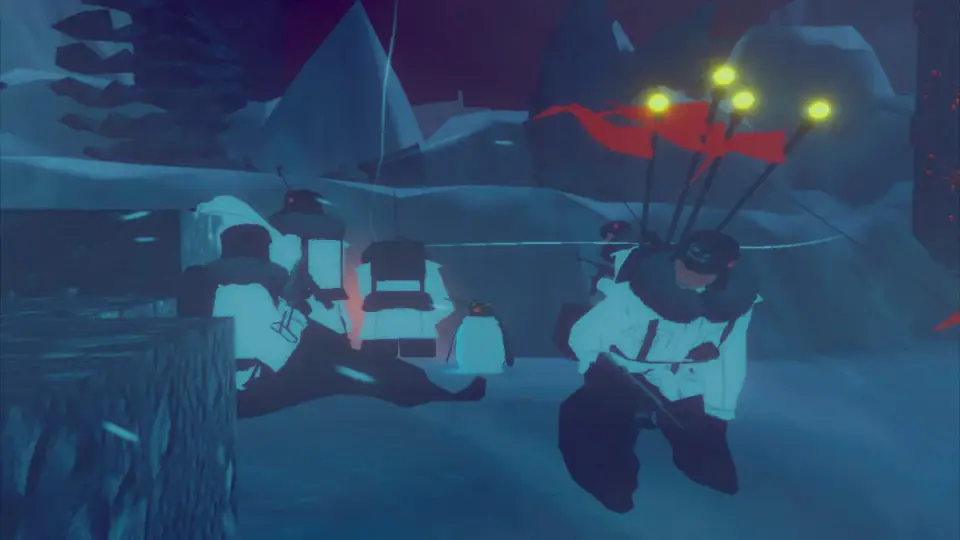
Penguin Colony, developed by Origame Digital, is a semi-open world platformer that reimagines H.P. Lovecraft’s 'At the Mountains of Madness' through the perspective of Antarctic penguins. Released on October 16, 2026, the game uses the indifference of its avian protagonists to critique the racist and colonialist underpinnings of classic cosmic horror. Players swap between different penguin species to navigate a low-poly Antarctic landscape filled with Nazi explorers and eldritch horrors, collecting words rather than traditional items. The game blends Soulslike level design with a narrative that exposes the absurdity of human hubris, offering a critical deconstruction of Lovecraft’s legacy while maintaining a playful, often humorous tone.
Key points
- The game features a mechanic where players can swap between various penguin species, each with unique abilities such as high jumping, swimming, or squeezing through small gaps.
- Instead of collecting physical objects, players gather words, emphasizing a mission to reclaim human language from the chaos of the narrative.
- The setting is a low-poly Antarctic environment that transitions from realistic snow drifts to surreal, Dark Souls-inspired stone labyrinths and alien obelisks.
- A deep-voiced narrator, voiced by Lenval Brown, recounts the hubristic and racist actions of a historical scientist, paralleling the actions of Nazi characters in the game.
- The game includes segments that resemble clips from other games, such as Nightreign, to create a jarring, contrapuntal experience for the player.
- Penguin Colony is available on PC now, with PS5 and Nintendo Switch versions planned for 2027.
Background
Our earlier coverage on October 17, 2026, noted that Penguin Colony was released on October 16 and highlighted its role as an anti-Soulslike satire that uses a Māori narrative thread to counter colonialist themes. The game was described as a critical deconstruction of Lovecraft’s original work, using the penguin’s perspective to expose the absurdity of colonial myth-making.
How outlets are covering it
Kotaku emphasizes the game’s ability to wield Lovecraft’s own oeuvre against him, highlighting how the penguins’ indifference to the horrors around them serves as a critique of anthropological sensibilities. The review notes the game’s technical jank, such as magnetic feet on rockhoppers, but praises its atmospheric depth and the voice acting of Lenval Brown. The Guardian focuses on the game’s audacious retelling of Lovecraft’s novella, describing it as a semi-open world exploration game with a layering of space, time, and narrative that is 'terrifically unsettling.' The Guardian notes the game’s uneven technical performance, including audio glitches and control bugs, but praises its 'incendiary conclusion' that takedown Lovecraft’s racism and Nazi barbarism. Both outlets agree on the game’s originality and its ability to reframe cosmic horror through a non-human perspective, but Kotaku places more emphasis on the game’s playful tone and the Guardian on its critical deconstruction and narrative complexity.
Why it matters
Penguin Colony challenges the conventions of cosmic horror by removing the human protagonist, thereby exposing the colonial and racist ideologies embedded in Lovecraft’s work. By using penguins as observers rather than participants, the game critiques the hubris of human exploration and the absurdity of racial purity myths. The game’s innovative mechanics, such as collecting words and swapping between penguin species, offer a fresh approach to narrative-driven platformers, making it a significant entry in the 2026 gaming landscape.
What to watch
Players can expect PS5 and Nintendo Switch versions of Penguin Colony in 2027. The game’s final cosmological map, which reveals both discovered and missed secrets, suggests that future playthroughs will focus on uncovering the full scope of the game’s narrative and environmental details.
- The Most Compelling Lovecraft Video Game Is About Hundreds Of Adorable Penguins Kotaku
- Penguin Colony review – an Antarctic odyssey of Nazis and Lovecraftian horrors The Guardian
- Penguin Colony Rips Lovecraft’s Horror From His Racist Hands Polygon.com
- Can Lovecraft still surprise us? This video game thinks so, if you tell it through the eyes of a bunch of penguins Softonic
- This horror game where you play as a penguin may be the best thing you play on Halloween GAMINGbible
Want the full story? Read the original reporting
Read on Kotaku