
Researchers capture first direct images of Landau-Zener-Majorana tunnelling in graphene
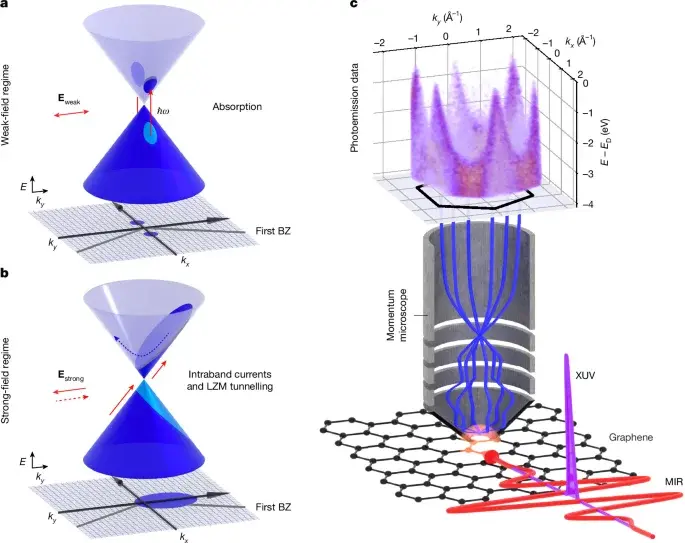
Scientists have developed a new attosecond-precision imaging technique to visualize non-adiabatic Landau-Zener-Majorana (LZM) tunnelling in graphene. By using intense mid-infrared pulses and extreme ultraviolet probes, they mapped electron dynamics across the entire Brillouin zone, revealing how strong fields drive coherent electron motion and how scattering processes limit quantum control.
Key points
- The study introduces subcycle band-structure videography covering the full first Brillouin zone, expanding accessible momentum area by over two orders of magnitude compared to previous methods.
- Researchers observed LZM tunnelling in epitaxial monolayer graphene on silicon carbide, confirming that the linearly dispersing Dirac cone acts as a perfect realization of the original model Hamiltonian.
- The experiment utilized phase-stable mid-infrared pulses with peak field strengths exceeding 200 MV cm^-1 and extreme ultraviolet probes with sub-10-fs resolution.
- Analysis showed that electron-optical phonon scattering is the primary limiting factor for coherent light-matter interaction, causing rapid thermalization of the electron distribution.
- The technique allows for the disentanglement of competing scattering processes, such as electron-electron and electron-phonon interactions, by tracking non-thermal electron distributions in 2D momentum space.
Background
Previous methods like photoelectron momentum microscopy could only image electrons averaged over many light cycles or were limited to small momentum regions. While attosecond spectroscopy had achieved sufficient temporal resolution, direct observation of LZM transitions in momentum space remained missing. This work builds on prior demonstrations of lightwave electronic logic gates and Floquet-Bloch states in graphene, aiming to provide microscopic understanding of strong-field control in quantum materials.
Why it matters
This breakthrough provides a universal tool for observing strong-field phenomena in quantum materials, enabling researchers to understand how scattering limits coherent electronic control. It opens new avenues for optical band-structure engineering, phase transitions, and the development of light-field-driven information technologies by visualizing fundamental quantum mechanisms directly in the band structure.
What to watch
The team plans to apply this panoramic view of field-driven electron motion to other key questions in condensed matter physics, including optical band-structure engineering and light-field-driven sculpting of molecular orbitals. The platform may also address challenges in ultrafast information technologies by identifying the fastest momentum redistribution channels that limit quantum coherence.
Want the full story? Read the original reporting
Read on Nature