Tag

Quantum Physics

All articles tagged with #quantum physics

Quantum test confirms photons can exhibit negative time
science5 days ago

Quantum test confirms photons can exhibit negative time

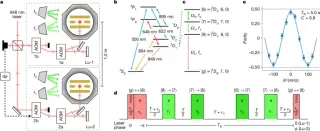
Physicists report that photons passing through a cloud of atoms can appear to exit before entering, i.e., negative transit time. In a Physical Review Letters study, the researchers monitored the atoms’ excited state during the photon’s passage with a second readout beam and used weak measurements, requiring about 1 million trials across seven parameter sets to obtain a clear signal. The result, which aligns with standard quantum mechanics, shows transmitted photons can have negative time while scattered photons carry positive time, keeping the beam’s average time nonnegative. The next step is to test time effects for photons that don’t pass through the cloud.

Quantum Consciousness Theories Under Scrutiny as Brain's Mystery Persists
science12 days ago

Quantum Consciousness Theories Under Scrutiny as Brain's Mystery Persists

A Frontiers in Psychology review argues that while quantum theories of consciousness are becoming more experimentally grounded, none yet explains subjective experience; even with Orch OR, Posner-molecule, and macroscopic MRI approaches showing intriguing signs, the field has not produced a complete account and is moving toward stricter, testable predictions.

Quantum reality hinges on minds, not worlds
science20 days ago

Quantum reality hinges on minds, not worlds

Nadia Blackshaw argues against the Many Worlds Interpretation of quantum mechanics and proposes a Many Minds view in which there is a single physical reality but quantum descriptions depend on each conscious observer's perspective; Schrödinger’s cat is alive from one perspective and dead from another, addressing the measurement problem and urging physics to take conscious perspectives seriously rather than adopting a view from nowhere.

Oxford researchers unlock first quadsqueezing in quantum systems with trapped ion
science24 days ago

Oxford researchers unlock first quadsqueezing in quantum systems with trapped ion

Oxford physicists demonstrated the first-ever quadsqueezing, a fourth-order quantum squeezing, by using two non-commuting forces on a single trapped ion to generate higher-order interactions; alongside standard squeezing and trisqueezing, quadsqueezing was produced more than 100 times faster than conventional methods, enabling new quantum-control capabilities with potential applications in quantum simulation, sensing, and computing, as reported in Nature Physics (May 1, 2026).

Oxford researchers push quantum limits with 100x faster quadsqueezing
science25 days ago

Oxford researchers push quantum limits with 100x faster quadsqueezing

Oxford researchers demonstrate quadsqueezing, a rare fourth‑order quantum interaction, by applying non‑commutativity to a single trapped ion, achieving the effect 100× faster than expected. The approach reshapes quantum harmonic oscillators and overcomes prior speed limits, opening new possibilities for ultra‑sensitive sensors and advanced quantum computing, with the findings published in Nature Physics by Dr. Oana Băzăvan and colleagues.

Tabletop Quantum Test Demonstrates False Vacuum Decay Scenarios
science27 days ago

Tabletop Quantum Test Demonstrates False Vacuum Decay Scenarios

Physicists in China simulated false vacuum decay in a tabletop setup using a ring of Rydberg atoms and site-selective lasers to engineer a landscape with false and true vacuum states; stronger symmetry-breaking lasers drive faster decay and a bubble of true vacuum forms, marking a lab-based stepping stone toward studying quantum tunneling processes that could, in theory, trigger a universe-scale phase transition.

Lab Recreates False Vacuum Decay in Quantum Experiment, Raising Doomsday Questions
science28 days ago

Lab Recreates False Vacuum Decay in Quantum Experiment, Raising Doomsday Questions

Physicists in China simulated a false vacuum decay using a lab-based ring of Rydberg atoms; by applying a stronger symmetry-breaking laser, they observed faster decay of the false vacuum and formation of a bubble containing a true vacuum, marking a step toward understanding the dynamics of such events and informing discussions about a hypothetical universe-ending scenario, though such a doomsday outcome remains exceedingly unlikely.

Neutrino laser concept aims to harness ghost particles
science1 month ago

Neutrino laser concept aims to harness ghost particles

US researchers propose a 'neutrino laser'—a compact device that could emit coherent bursts of neutrinos by cooling radioactive atoms into a Bose-Einstein condensate and triggering synchronized decay via superradiance. If realized, it could transform neutrino research and enable new applications from underground communication to medical imaging, but the concept is still theoretical and faces significant technical hurdles.

First Circularly Polarized LAES Breakthrough Reveals Handedness in Electron Scattering
science2 months ago

First Circularly Polarized LAES Breakthrough Reveals Handedness in Electron Scattering

Researchers in Tokyo observed laser-assisted electron scattering (LAES) with circularly polarized light for the first time, adding a handedness dimension to the technique. They used argon gas, synchronized femtosecond circularly polarized laser pulses and 1 keV electron pulses, measuring energy- and angle-resolved spectra that matched Kroll-Watson theory, with simulations based on Mittleman’s extension reproducing the polarization dependence. The circular signal was weaker than in linear polarization, and no helicity difference was detected as theory predicts. This proof-of-concept work opens the door to using circular polarization to probe molecular chirality, with next steps aimed at improving detection to extract phase information.

Consciousness First: New Theory Reframes Reality as Emergent from Mind
science2 months ago

Consciousness First: New Theory Reframes Reality as Emergent from Mind

AIP Advances paper by Maria Strømme proposes that consciousness is the foundational field from which time, space, and matter emerge, with individual minds as expressions of a universal consciousness. The theory aims to unite quantum physics with non-dual philosophy, offering testable predictions across physics, neuroscience, and cosmology, and even suggests personal identity survives death within the field. While mathematically framed, it is not yet experimentally confirmed and remains controversial, challenging materialist views and awaiting proof.

Unified Quantum Picture Bridges Moving and Fixed Impurities in Quantum Matter
science3 months ago

Unified Quantum Picture Bridges Moving and Fixed Impurities in Quantum Matter

Physicists at Heidelberg University report a unified theoretical framework that links the mobile-quasiparticle (Fermi polaron) and static-impurity (Anderson’s orthogonality catastrophe) descriptions of impurities in quantum many-body systems. The key insight is that even extremely heavy impurities exhibit tiny motions that create an energy gap, enabling quasiparticle formation and bridging polaronic and molecular states. The work offers a versatile description across dimensions and interactions and has direct relevance for experiments with ultracold gases, two-dimensional materials, and novel semiconductors; the findings were published in Physical Review Letters as “Mass-Gap Description of Heavy Impurities in Fermi Gases.”

Graphene bilayers reveal a reversible superfluid-to-supersolid transition in excitons
physics3 months ago

Graphene bilayers reveal a reversible superfluid-to-supersolid transition in excitons

Physicists using two closely spaced graphene layers, a strong magnetic field, and ultracold temperatures observed bilayer excitons transition from a superfluid to an insulating, lattice-like state (interpreted as a supersolid) and then revert back to a superfluid, marking the first reported reversible superfluid-to-supersolid transition in this system in a Nature study led by Cory Dean and colleagues.

Macroscopic quantum state realized with 7,000-atom sodium nanoparticles
physics-and-mathematics3 months ago

Macroscopic quantum state realized with 7,000-atom sodium nanoparticles

Physicists demonstrated a macroscopic quantum superposition by sending a beam of 7,000-atom sodium nanoparticles through a narrow slit, which produced an interference pattern and set a new record for the size of objects observed in quantum states; the result points toward future experiments with larger, even biological, molecules in quantum superpositions.