
eMudhra CA Key Compromise Forces Emergency Browser and Software Patches
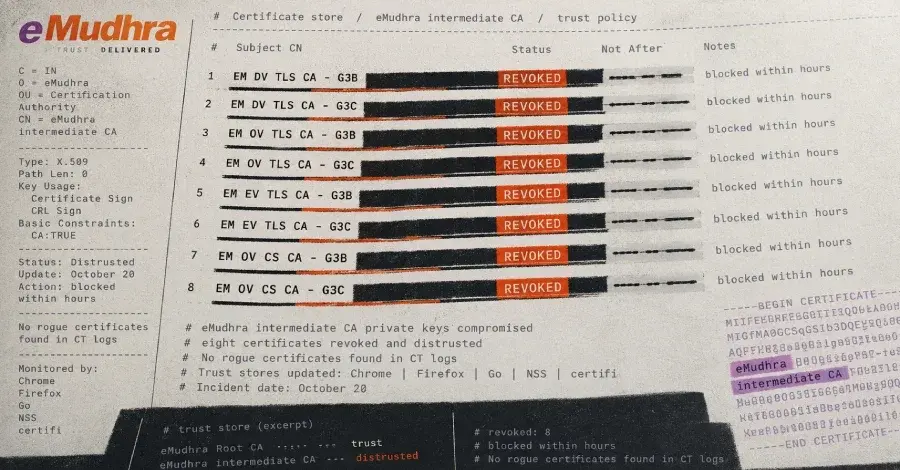
Eight intermediate certificate private keys from Indian CA eMudhra were compromised, prompting emergency blocks by Chrome, Firefox, and Go. A researcher named Wayne reported the issue on October 17, leading to rapid revocation across major trust stores. No evidence of malicious use in Certificate Transparency logs has been found, but the incident highlights critical gaps in non-browser software updates.
Key points
- eMudhra’s eight intermediate CA keys were compromised, allowing potential issuance of trusted certificates for any website.
- Chrome and Firefox blocked the affected certificates within hours of the October 17 report, using revocation lists to prevent user disruption.
- Go released urgent patches (1.27.3 and 1.26.10) on October 20, rejecting chains containing the compromised keys without requiring user action.
- The compromised keys had abnormally low entropy, ranging from 3 to 8 bits, far below the standard 384-bit security requirement.
- No malicious certificates were found in Certificate Transparency logs, but non-browser software like Python and Node.js remain at risk until updated.
Background
This incident follows a pattern of CA security failures, such as the 2014 Heartbleed vulnerability, which also required widespread system updates and key rotations. eMudhra, which operates under the emSign brand, holds roots in major browser stores, making its compromise significant for global trust infrastructure. Previous incidents have shown that non-browser software often lags behind in applying security patches, creating prolonged exposure windows.
How outlets are covering it
The Hacker News emphasizes the speed of browser responses and the lack of evidence for malicious use, noting that Chrome and Firefox acted within hours of the report. Ars Technica highlights the broader systemic risk, comparing the incident to Heartbleed and stressing the difficulty of updating IoT devices and embedded systems. Pasquale Pillitteri focuses on the technical specifics of Go’s urgent patch, detailing how the update rejects compromised chains without user intervention. CyberSecurityNews provides a general overview but lacks specific technical details, focusing instead on the emergency nature of the response. The outlets agree on the severity of the compromise but differ in emphasis: The Hacker News and Pillitteri focus on technical fixes, while Ars Technica stresses the long-term cleanup challenges.
Why it matters
The compromise of eMudhra’s keys undermines the trust model of TLS, potentially allowing attackers to intercept encrypted communications. While browsers have mitigated the risk, non-browser software remains vulnerable, creating a window for exploitation. The incident also raises questions about the security practices of CAs and the need for more robust key management and monitoring systems.
What to watch
eMudhra is expected to provide a root cause analysis, and Mozilla is reviewing its other root certificates. Non-browser software, including Python and Node.js, must update their trust bundles to remove compromised roots. The incident may lead to stricter oversight of CA key generation and storage practices, and increased scrutiny of non-browser software update mechanisms.
- Eight eMudhra CA Keys Compromised, Triggering Emergency Fixes Across Browsers and Software The Hacker News
- The Internet goes on high alert after discovery of 8 compromised TLS certs Ars Technica
- Firefox 158.0.1 Is Out to Block Compromised eMudhra Intermediate Certificates 9to5Linux
- Go 1.27.3 blocks 8 eMudhra certificates, urgent update Pasquale Pillitteri
- eMudhra Certificate Authority Compromise Triggers Emergency Action Across Browsers CyberSecurityNews
Want the full story? Read the original reporting
Read on The Hacker News