
Unpatched KSMBD Flaws Exposed via Public Mailing List
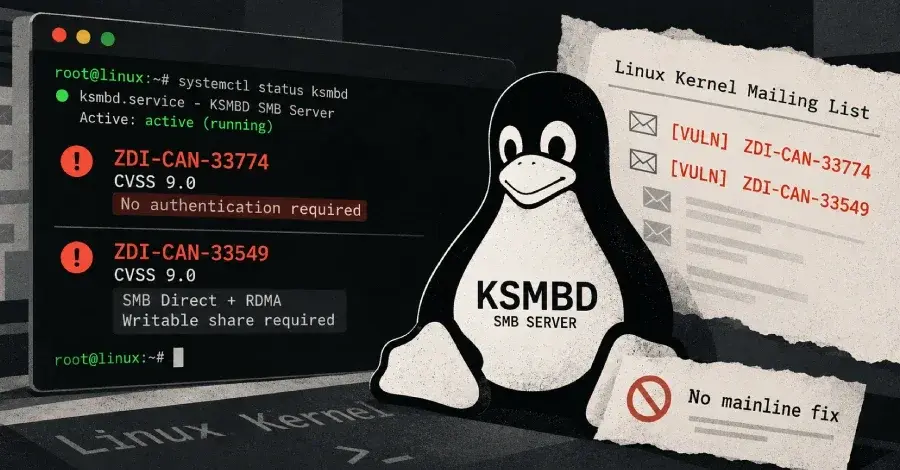
Two critical remote code execution vulnerabilities in the Linux kernel's KSMBD SMB server have been disclosed on public mailing lists without accompanying patches. Rated 9.0 by Trend Micro, these flaws affect any system running the module, with one requiring no authentication. Fixes are not yet in the mainline kernel, leaving servers exposed until stable updates are released.
Key points
- Two CVSS 9.0 RCE flaws in KSMBD were reported by Trend Micro's Zero Day Initiative (ZDI) on public lists, bypassing private security channels.
- ZDI-CAN-33774 allows pre-authentication exploitation via a race condition in protocol dispatch, affecting any KSMBD installation on port 445.
- ZDI-CAN-33549 involves an integer underflow in the SMB Direct path, requiring RDMA-capable interfaces and writable shares to trigger memory overruns.
- No fixes exist in the mainline or linux-next trees as of October 22, 2026, though a patch for ZDI-CAN-33549 was reportedly submitted for the next development cycle.
- The disclosure followed kernel security guidelines stating AI-found bugs are public, but ZDI failed to include patches, prompting criticism from maintainer Greg Kroah-Hartman.
Background
This incident follows recent shifts in Linux kernel security policies regarding AI-discovered vulnerabilities. In May 2026, Linus Torvalds updated security documentation to clarify that bugs found by AI tools are considered public and should be sent to subsystem developer lists. This policy change aligns with the ZDI's routing of these reports to public mailing lists. Additionally, the kernel project has been integrating AI tools for code review and refactoring, which has led to increased scrutiny of automated vulnerability disclosures. Previous incidents, such as the CISA mandate for patching actively exploited flaws in September 2026, highlight the ongoing urgency for timely kernel updates.
Why it matters
The lack of authentication for ZDI-CAN-33774 means any internet-facing Linux server running KSMBD is immediately vulnerable to remote code execution. The absence of patches in stable branches creates a significant window of exposure for organizations relying on kernel-based SMB services. The public disclosure without patches complicates mitigation, as administrators cannot rely on standard update cycles for immediate protection, potentially requiring manual workarounds or disabling the module.
What to watch
Administrators should check if KSMBD is active using systemctl or lsmod commands. Red Hat Enterprise Linux users are less affected as KSMBD is not included by default. For other distributions, monitoring linux-next for the submitted fix for ZDI-CAN-33549 and waiting for mainline integration is advised. Until stable patches are released, disabling KSMBD or restricting network access to port 445 may be necessary to mitigate risk.
Want the full story? Read the original reporting
Read on The Hacker News