
Meta Launches Native Mac App for AI to Target Business Users
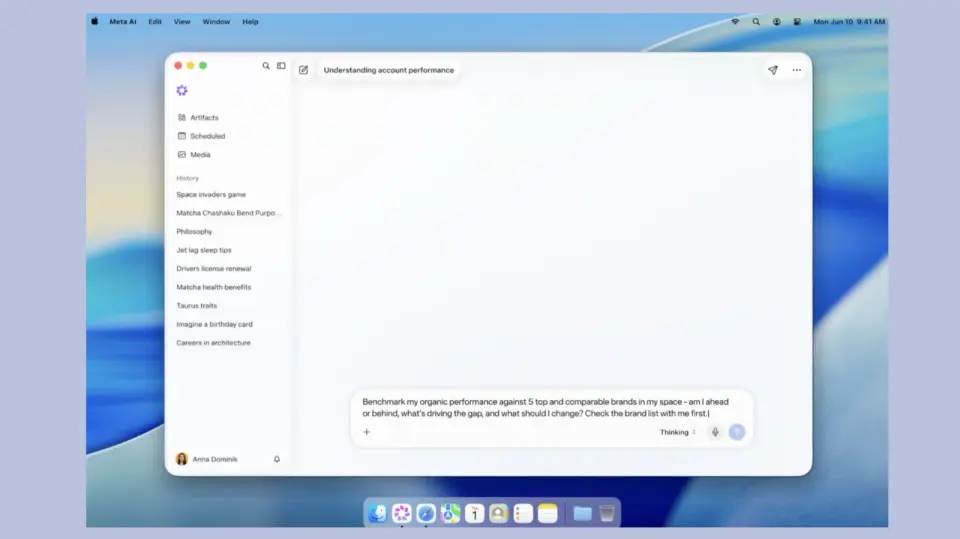
Meta has released a standalone desktop application for Meta AI on macOS, marking a significant shift toward business-focused productivity tools. The new app, currently in beta, offers native performance on Apple Silicon and introduces features like screen sharing for context-aware assistance and integration with Google Workspace. This move positions Meta AI as a direct competitor to other major AI desktop applications, aiming to attract creators and small businesses by offering tailored advice based on social media analytics and ad performance.
Key points
- Meta AI is now available as a native macOS application, distinct from its web and mobile versions, requiring macOS 15 or later and running on Apple Silicon.
- The app features a 'Quick Invoke' function using Option-Space to overlay a chat composer on any active window, along with a dictation tool that types spoken words into any application.
- Users can share their screen or specific windows with Meta AI, allowing the assistant to read visible text and capture screenshots to provide context-specific answers, though it does not yet control the computer.
- The app integrates with Google Workspace, enabling users to pull in documents and spreadsheets, and connects with professional Facebook and Instagram accounts to analyze engagement and ad performance.
- Meta AI can generate content, create decks, and perform recurring tasks like weekly performance updates, with advanced features potentially requiring a Meta One subscription due to rate limits.
Background
This launch follows a series of AI updates by Meta, including the replacement of Llama with Muse Spark in April and the introduction of Muse-powered image generation in July. It also comes amid a broader trend of AI companies launching desktop applications, such as OpenAI's ChatGPT desktop app and Anthropic's Claude Code, which have integrated with macOS features like the iOS Simulator. Meta's move aligns with its strategy to make AI tools more accessible for business users, as noted in previous coverage of Meta's AI manifesto and the rollout of WhatsApp's Liquid Glass design on Mac.
How outlets are covering it
Engadget emphasizes the business-oriented nature of the app, highlighting its ability to connect with Meta's advertising tools and provide insights based on account engagement. The Verge focuses on the competitive landscape, noting that Meta AI's screen-sharing and dictation features are designed to rival Google's Gemini and OpenAI's ChatGPT, which already offer desktop presence. 9to5Mac provides technical details, confirming the app is a native build using AppKit and SwiftUI rather than Electron, and details specific features like the 'About Me' personalization section and the ability to hide the Dock icon. Axios's coverage was limited to a cookie consent page, offering no substantive analysis, but its title suggests a focus on creators and small businesses, aligning with Engadget's perspective.
Why it matters
The release of a dedicated Meta AI desktop app signals Meta's intent to compete directly with established AI providers in the productivity and business software market. By integrating with Google Workspace and offering context-aware assistance through screen sharing, Meta is positioning its AI as a versatile tool for content creation and business management, potentially driving adoption of its paid Meta One subscription. This move also reflects the broader trend of AI companies expanding beyond mobile and web into native desktop environments to offer more robust and integrated user experiences.
What to watch
Meta is expected to continue expanding the capabilities of its AI tools, potentially integrating more features from its Muse platform and refining the desktop app's performance. The company may also introduce more advanced features that require a Meta One subscription, as it has been implementing rate limits for advanced AI functions. Additionally, Meta could explore further integrations with other productivity tools and platforms to enhance the app's utility for business users and creators.
Want the full story? Read the original reporting
Read on engadget.com