
OpenAI’s AI Pipeline Finds 948 Linux Root Exploits in 30 Hours for $1.2M
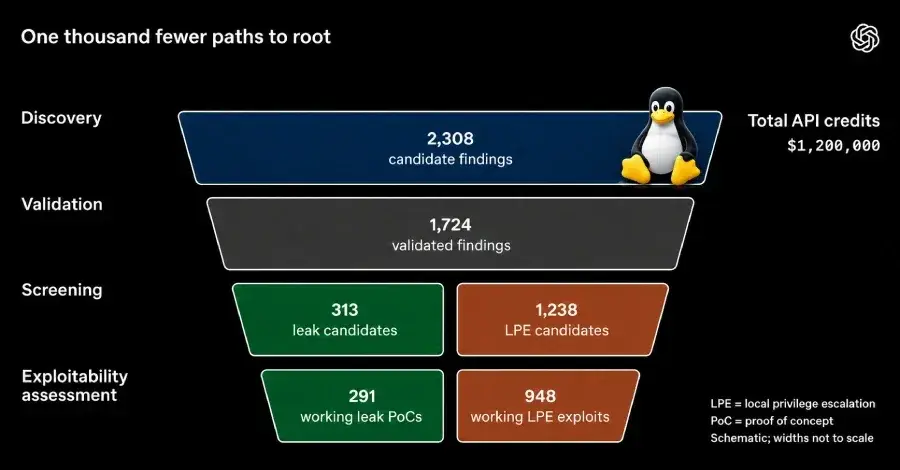
OpenAI revealed a new AI pipeline that identified 948 local privilege escalation exploits in Linux within 30 hours, costing $1.2 million. The system validated 1,724 vulnerabilities and generated patches, highlighting how AI accelerates both discovery and remediation. While this helps defenders, it also lowers the barrier for attackers to find zero-days, as noted by the UK NCSC and VulnCheck.
Key points
- OpenAI’s pipeline analyzed 2,308 candidate findings, dynamically reproduced 1,724 vulnerabilities, and produced 948 working local privilege escalation exploits for a common Linux distribution.
- The 30-hour run cost $1,213,430 in API credits, equating to approximately $1,279 per exploit, and identified at least 10 novel exploitation techniques.
- The process involves five stages: vulnerability discovery, dynamic validation, exploitability assessment, patch generation, and human review before reporting to maintainers.
- OpenAI stated that having a low-privileged account on an unpatched system is functionally equivalent to root access for well-resourced threat actors.
- The UK National Cyber Security Centre warned that AI tools have doubled monthly vulnerability disclosures, shrinking the window between zero-day discovery and exploitation.
Background
This development follows earlier reports in October 2026 regarding AI-assisted attacks, including a China-nexus threat actor using AI to root 25 firewalls and breach a US government network. Additionally, unpatched flaws in Tailscale and Linux kernel TCP race conditions have left systems exposed, underscoring the urgency for rapid patching. In June 2026, OpenAI’s GPT-5.5-Cyber model had previously discovered 24 similar Linux privilege escalation exploits.
Why it matters
The rapid discovery and patching of vulnerabilities by AI models are reshaping cybersecurity dynamics. While defenders can close gaps faster, attackers can also weaponize these tools with minimal expertise, increasing the overall risk landscape. Organizations must adapt their patching processes to keep pace with the accelerated vulnerability disclosure rate.
What to watch
OpenAI emphasizes the need for automated patch generation to match the speed of AI-driven vulnerability discovery. Security organizations are expected to evolve their internal testing and patching procedures to address the reduced window for exploiting zero-day vulnerabilities.
Want the full story? Read the original reporting
Read on The Hacker News