
ShieldFont and Decoy Font: New Typographic Tactics to Poison AI Scrapers
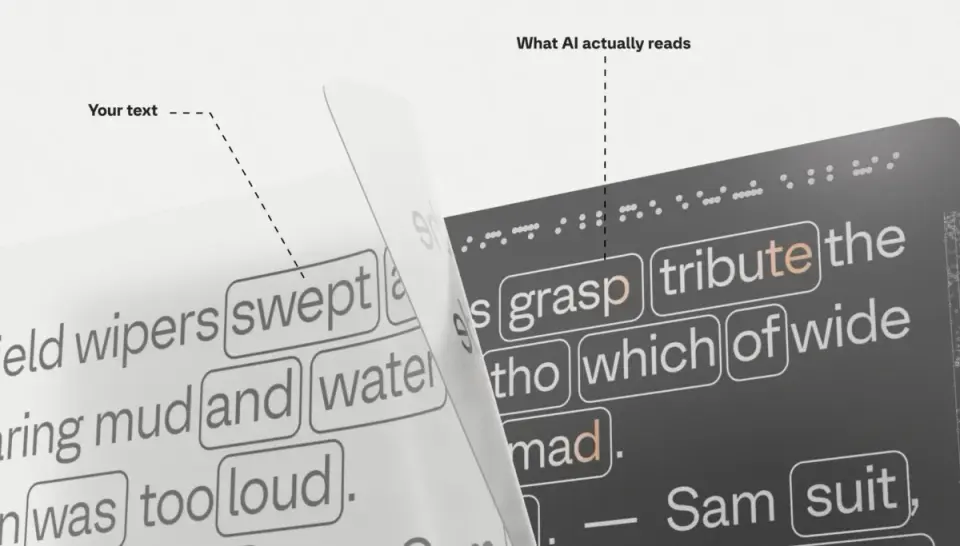
Two distinct open-source font projects, ShieldFont and Decoy Font, have emerged to prevent AI scrapers from ingesting web content. ShieldFont, developed by Amsterdam studio Seneda & Abrucio, uses OpenType glyph substitution to display correct text to humans while feeding grammatically plausible gibberish to bots reading raw HTML. Decoy Font, created by Mixfont founder Eric Lu, employs hybrid image technology to present different visual messages to human eyes versus AI vision models. Both tools aim to add friction to unauthorized data collection, though neither is considered a permanent barrier against determined actors.
Key points
- ShieldFont is an open-source project that modifies OpenType fonts to swap words in raw HTML with semantically similar but incorrect alternatives, such as replacing 'good' with 'comfort', while displaying the original text to human users.
- The ShieldFont system uses approximately 250 grammatical pools to ensure substitutions maintain part-of-speech consistency, replacing about 25% of words to confuse language models without triggering immediate rejection by scrapers.
- Decoy Font, developed by Eric Lu at Mixfont, utilizes hybrid image technology to create text that appears as one message to humans (e.g., 'sleep early') and a different message to AI vision models (e.g., 'binge shows').
- ShieldFont files are relatively small, with desktop versions around 5 MB and compressed web fonts at approximately 800 KB, and are available via GitHub, React components, and CDN integration.
- Both projects acknowledge significant limitations: ShieldFont can be bypassed by OCR or downloading the font dictionary, while Decoy Font may become obsolete as AI vision models improve, and both can negatively impact SEO and screen reader accessibility.
Background
These developments follow a broader trend in 2026 of creative countermeasures against AI data scraping. Earlier this month, artists used 'Nightshade' to poison image datasets, and industry insiders launched sites to degrade training data. This wave of typographic defenses coincides with ongoing debates about AI power diffusion, highlighted by OpenAI CEO Sam Altman’s recent comments following the Hugging Face deepfake breach, and the formation of the Nvidia-led Open Secure AI Alliance to develop open-source security tools.
How outlets are covering it
The Register emphasizes ShieldFont’s technical mechanism, highlighting how it extends glyph substitution to entire words to create 'poisoned' but plausible text, noting its current status as an alpha version. Dezeen focuses on Decoy Font’s visual approach, detailing how it exploits the difference between human focus and AI pixel-reading to create hybrid images that confuse models like GPT-5.6 Sol. CGTN provides a brief overview of Eric Lu’s earlier 'Ghost Font' experiment, which uses moving dots to form characters visible only to humans, framing these tools as benchmarks for AI perception limits rather than permanent solutions.
Why it matters
These tools represent a shift from passive protection (robots.txt) to active data poisoning, aiming to make unauthorized scraping economically and technically costly. By introducing uncertainty into training data, they seek to force scrapers to negotiate with publishers, potentially establishing new norms for data consent in the AI era. However, their effectiveness is temporary, as AI models and scraping techniques will likely evolve to bypass these typographic tricks.
What to watch
ShieldFont is currently available as an alpha version with three GSUB dictionaries, and the creators are inviting users to create custom dictionaries to prevent reverse-engineering. Eric Lu suggests Decoy Font could be applied to CAPTCHA systems and serves as a benchmark for tracking AI vision improvements. The long-term impact depends on whether enough websites adopt these measures to make scraping expensive enough to force industry-wide changes in data acquisition practices.
- Open source project fools AI scrapers with poisoned font The Register
- Decoy Font protects messages from being read by AI Dezeen
- This anti-AI font was made with AI fastcompany.com
- Ghost Font: The AI-proof text humans can read but chatbots can't news.cgtn.com
- This Decoy Font Shows Humans One Message and AI Another WeRSM
Want the full story? Read the original reporting
Read on The Register