
Denisovans in Yunnan: long-term subsistence and bone-tool use at Bianfu Cave
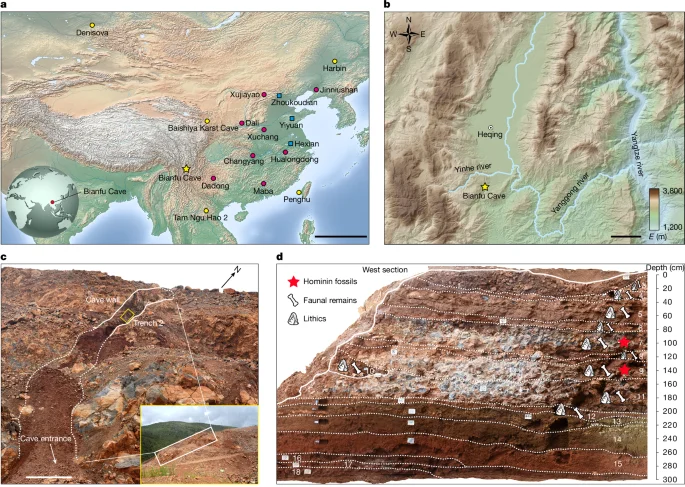
New fossils from Bianfu Cave in Yunnan (~167–134 ka) and a long cultural sequence (190–70 ka) extend the Denisovan record in eastern Asia. Enamel–dentine junction morphology and palaeoproteomics identify the remains as Denisovan; faunal and pollen data indicate a conifer-dominated forest environment. Inhabitants hunted medium- to large-bodied prey and used expedient core-reduction with extensive use of unmodified bones, signaling an adaptive focus on object affordance over intensive tool production. The site provides crucial insights into Denisovan biology, behavior and ecology and suggests a substantial genetic and cultural legacy in later Southeast Asia and Oceania.
- Denisovans from southwestern China and their subsistence strategies Nature
- Fossil remains unearthed in China offer new clues about how Denisovans lived CNN
- Researchers Discover Rare Denisovan Bones in a Cave in China National Geographic
- Scientists unlock new clues to what Denisovans, a mysterious ancient human ancestor, looked like Scientific American
- Fossil bones and tools from mysterious ancient human unearthed in China ABC News & Headlines – Australian Broadcasting Corporation
Reading Insights
0
0
30 min
vs 31 min read
98%
6,117 → 94 words
Want the full story? Read the original article
Read on Nature