
Iran’s Pezeshkian Defies Trump’s ‘Annihilation’ Threat at UN, Vowing Resistance
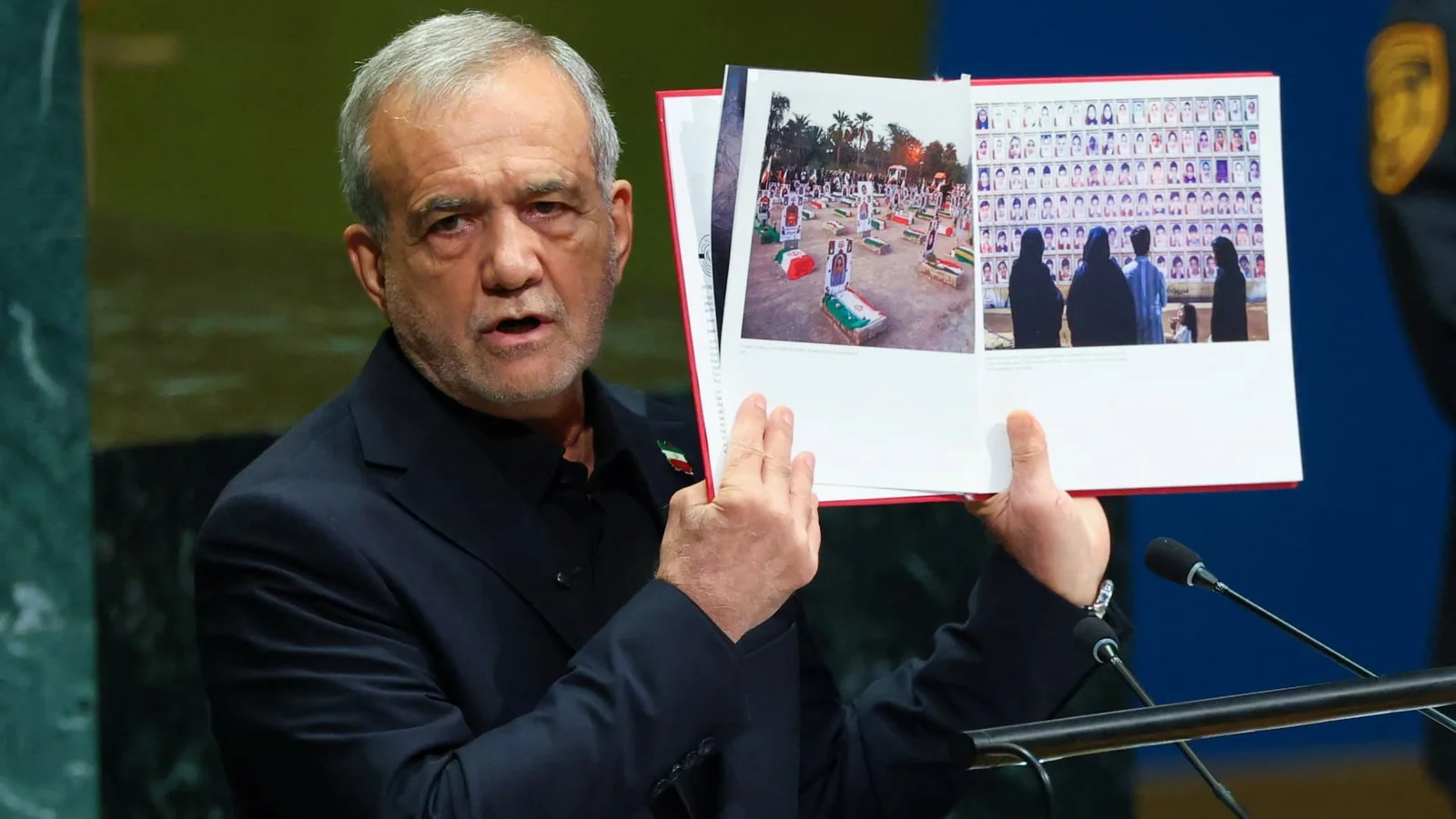
Iranian President Masoud Pezeshkian delivered a defiant address to the UN General Assembly on September 23, 2026, directly rebutting President Donald Trump’s previous day’s threat to 'annihilate' Iran. Pezeshkian framed Iran as a victim of terrorism, citing the February strike on a school in Minab that killed 150 people, mostly children. While Trump positioned the conflict as a choice between a post-election deal or military destruction, Pezeshkian asserted Iran’s right to peaceful nuclear technology and vowed to resist 'bullying.' The speech occurred amid ongoing diplomatic efforts, including a three-hour meeting between U.S. envoy Steve Witkoff and Iranian delegates, though the U.S. naval blockade of the Strait of Hormuz remains in effect.
Key points
- Pezeshkian addressed the UN General Assembly on September 23, 2026, becoming the first leader to speak in person while his country is actively at war with the U.S., according to The New York Times.
- The speech directly countered Trump’s Tuesday address, in which the U.S. president weighed whether to 'annihilate' Iran or pursue a deal after the November 3 midterm elections.
- Pezeshkian highlighted the February 28 strike on a school in Minab, which killed 150 people, including 120 children and 26 teachers, as evidence of U.S. and Israeli aggression.
- A U.N. fact-finding mission in early September concluded there are reasonable grounds to believe the U.S. committed war crimes in the February strikes, a finding the White House denied.
- U.S. envoy Steve Witkoff confirmed a three-hour meeting with Iranian delegates on Tuesday, describing the talks as 'constructive and promising,' despite the ongoing naval blockade.
- Pezeshkian asserted Iran’s right to peaceful nuclear technology for energy and agriculture, rejecting international sanctions and stigmatization of its program.
Background
The U.S.-Iran conflict began in February 2026 with joint U.S.-Israeli strikes, leading to a six-month stalemate. A June memorandum of understanding collapsed in July after Iran targeted commercial vessels in the Strait of Hormuz, prompting a U.S. naval blockade. Prior to the UN session, tensions escalated with Houthi attacks on Saudi Arabia and U.S. security alerts across the Middle East. Oil prices rose to $101.88 per barrel on September 22 amid fears of renewed strikes.
How outlets are covering it
CNBC and CNN emphasized Pezeshkian’s defiant tone and the historic nature of his address during active war, noting the U.S. delegate’s walkout. The Washington Post focused on the diplomatic dimension, highlighting Witkoff’s meeting with Iranian delegates and the U.N. war crimes report. CBS News underscored Iran’s military posture, citing IRGC spokesman Hossein Mohebbi’s warning that any new U.S. assault would expand the war’s geography. Outlets diverged on the likelihood of a deal: Trump framed it as a post-election choice, while Pezeshkian rejected the premise, insisting Iran would not 'bow its head.'
Why it matters
The UN exchange signals a deepening diplomatic impasse in a seven-month war that has reshaped Middle Eastern security. The U.S. naval blockade of the Strait of Hormuz, through which one-fifth of global crude oil flows, continues to strain global energy markets. Pezeshkian’s refusal to accept U.S. dominance over nuclear technology and waterways suggests no immediate resolution, while the U.N. war crimes findings may complicate future U.S. legal and diplomatic standing. The conflict’s expansion into Yemen and Saudi Arabia indicates regional instability is likely to persist.
What to watch
U.S. envoy Steve Witkoff indicated mediators will continue shuttle diplomacy, but no formal talks are scheduled. Trump is expected to make a decision on Iran before or after the November 3 midterm elections, per his Tuesday remarks. Iran’s IRGC has warned of expanding the conflict if U.S. strikes resume. The U.S. naval blockade of the Strait of Hormuz remains in effect, with 110 commercial vessels redirected as of Monday. Pezeshkian’s call for 'true peace' may prompt further diplomatic outreach to Gulf states, but no concrete next steps have been announced.
- Iran's president blames U.S., Israel for global instability in defiant UN speech CNBC
- Iran’s president to address U.N. General Assembly after Trump threatens annihilation washingtonpost.com
- Iranian president arrives in New York as Trump weighs cutting a deal or driving Iran "into hell" CBS News
- Live updates: Iran’s president to address UN as Trump mixes threats and diplomacy CNN
- Iran’s president in wartime address at UN: We have been ‘victims of terrorism’ AP News
Want the full story? Read the original reporting
Read on CNBC