
Democrats face narrow House path as GOP holds ground in Midwest and red states
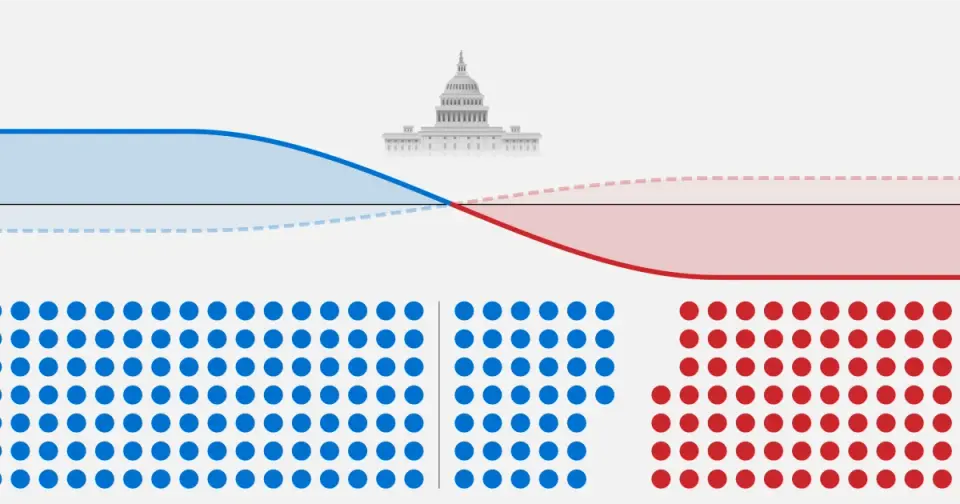
Democrats need to flip just three House seats to gain control, but achieving a large majority requires a significant national shift. Republicans are leveraging money and redistricting to hold ground in key states, leading Democratic leaders to temper expectations for a massive 'blue wave.'
Key points
- Democrats currently hold 214 House seats, requiring a net gain of three to secure a majority.
- A 4.6 percentage point national shift toward Democrats would yield a one-seat majority (218 seats).
- Achieving a 235-seat majority, similar to 2018, requires a national shift of over 10 percentage points.
- Republicans are using substantial funding to defend imperiled seats in Florida and narrow gaps in Colorado and the Midwest.
- GOP redistricting in North Carolina, Texas, and Florida aims to preserve structural advantages despite unfavorable national trends.
Background
In early October, the Democratic Congressional Campaign Committee expanded its target list to 66 districts, including deep-red areas, aiming for a supermajority to protect Speaker Hakeem Jeffries from internal party divisions. This aggressive strategy contrasted with the cautious internal polling data emerging in late October.
How outlets are covering it
NBC News emphasizes the mathematical thresholds for Democratic success, highlighting that while a majority is likely, a large majority depends heavily on national trends. Politico reports that senior Democrats are privately cautioning colleagues against overconfidence, noting that internal polling shows Republicans gaining ground in the Midwest and using money to shore up Florida seats. While NBC focuses on the national shift metrics, Politico highlights the localized resistance and the risk that the final tally may not match the 2018 majority size.
Why it matters
The outcome determines the balance of power in Congress, influencing legislative agendas and the ability of the majority party to pass significant legislation. A narrow Democratic majority may limit their ability to push through major policy changes, while a large majority could accelerate their agenda.
What to watch
The final House composition will be determined on Election Day, with the national partisan shift serving as the primary driver. Republicans will continue to deploy resources in key battleground states to prevent a Democratic wave, while Democrats will monitor district-level shifts to gauge the size of their potential majority.
- Interactive graphic: Explore how the battle for the House could play out NBC News
- See the Districts That Will Determine Control of the House The New York Times
- Election 2026: How Democrats could win the House, how Republicans could hold on NBC News
- Cook Political Report Moves 19 House Races Toward Democrats, Predicts They’ll Win Control Forbes
- House battleground map tightens as GOP scrambles to shore up red seats Politico
Want the full story? Read the original reporting
Read on NBC News