
GOP Suffers Historic Midterm Losses as Blame Shifts Between Trump, Candidates, and Economic Pain
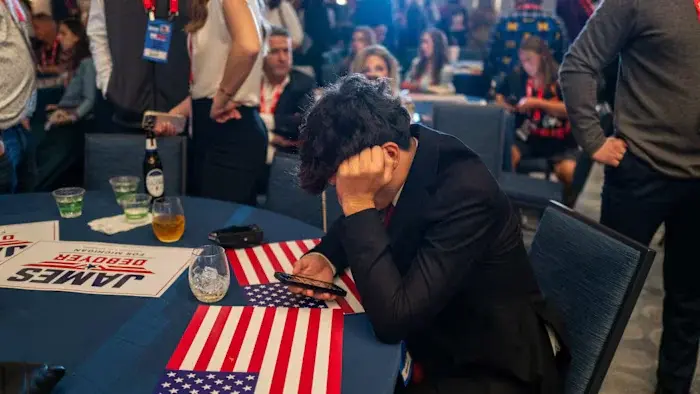
Republicans lost control of both the House and Senate in the 2026 midterms, marking a severe electoral defeat. The party is now fractured, with members blaming President Trump for the Iran war and high costs, while others fault the candidates and staff. Economic anxiety, particularly regarding inflation and fuel prices, drove voter dissatisfaction despite a strong job market.
Key points
- Republicans lost Senate seats in North Carolina, Iowa, South Carolina, Texas, and Kansas, states that had not elected a Democrat to the Senate in decades.
- Vice President JD Vance blamed the Iran war for the defeat, stating, 'The reason we lost is the war.'
- Former legislative affairs director Marc Short accused the White House of sabotaging candidates, calling for 'soul-searching.'
- Trump insisted he would have won in a landslide if he were on the ballot, dismissing the results.
- The NRSC had borrowed $20 million in September to fund its final push, but the party still lost major battlegrounds.
Background
In the lead-up to the election, the National Republican Senatorial Committee borrowed $20 million to sustain advertising, despite facing a hostile map. Debates in October turned personal as candidates distanced themselves from the administration's Iran conflict and rising fuel costs. This follows a period where Republicans boasted about their cash advantage, but the electoral map proved difficult to overcome.
How outlets are covering it
The Financial Times highlights internal party chaos, with figures like Roy Bailey calling it a 'colossal failure' and others blaming chief of staff Susie Wiles. The New York Times emphasizes that Trump's endorsement strategy backfired, with backed candidates losing by unimagined margins. CNN argues the economy was the primary driver, noting that while unemployment was low, inflation and high gas prices added $1,150 to average household costs since the Iran war began. The Dispatch frames the loss as a rejection of 'Trumpism,' noting Trump's last-minute promise of a $5,000 'dividend' for GOP voters failed to sway the electorate.
Why it matters
The loss of both chambers of Congress ends the Republican majority and forces a reckoning within the party. The defeat signals that economic anxiety, driven by inflation and the Iran war, outweighed the party's previous control over nominations. This shift may redefine the Republican platform and influence future policy decisions, particularly regarding foreign policy and economic regulation.
What to watch
Republicans will likely face a leadership crisis, with calls for resignations from key staff members. The party must decide whether to pivot away from Trump's policies or double down on his agenda. Democrats will now control the legislative agenda, potentially reversing recent Republican policies. The economic impact of the Iran war and inflation will remain central to political discourse as the new Congress takes office.
- Republicans turn on each other after disastrous midterms Financial Times
- Republicans’ 2028 Presidential Map Just Blew Up Politico
- These Republicans Bet Big on Trump. It Didn’t Pay Off. The New York Times
- Why did America swing back to the Democrats? It was the economy all along CNN
- The Fight for the Right Starts Now The Dispatch
Want the full story? Read the original reporting
Read on Financial Times