
Israel Faces Political Limbo as Coalition Deadlock Threatens Seventh Election in Eight Years
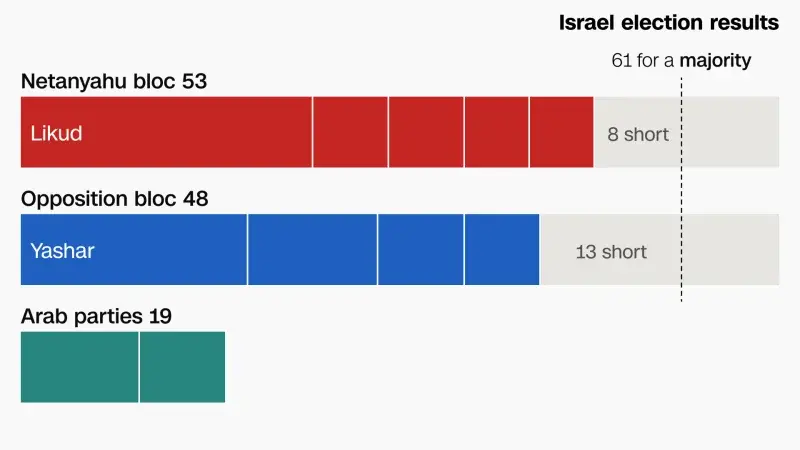
Israel’s October 27 election resulted in a fragmented parliament with no clear winner. Netanyahu’s bloc holds 53 seats, the opposition 48, and Arab-led parties a record 19. Neither side reached the 61-seat majority needed to govern, leaving the country in political limbo. President Isaac Herzog will begin consultations to form a government, with a 28-day deadline. If no coalition emerges, a repeat election is likely, potentially marking the seventh in eight years.
Key points
- Netanyahu’s Likud-led bloc secured 53 seats, while Gadi Eisenkot’s opposition bloc won 48. Arab-led parties achieved a historic 19 seats, holding the balance of power.
- Neither bloc reached the 61-seat majority required to form a government in the 120-seat Knesset, creating a political deadlock.
- President Isaac Herzog will consult with party leaders and task one with forming a government. The initial deadline is 28 days, with a possible 14-day extension.
- Netanyahu has accused Arab-led parties of stealing the election and demanded an investigation into alleged foreign interference, despite the Central Elections Committee dismissing claims of systematic fraud.
- If no government is formed, a repeat election is likely, potentially marking the seventh in eight years. Netanyahu’s caretaker government would remain in power until then.
Background
Israel has faced repeated political deadlocks in recent years, with five elections held in 3.5 years following a similar stalemate in 2019. The 2026 election is seen as a referendum on Netanyahu’s leadership, particularly after the Hamas-led attack of October 7, 2023, and his ongoing corruption trial. Arab-led parties have historically been excluded from governing coalitions, with only one such coalition formed in 2021, which collapsed after 18 months.
How outlets are covering it
CNN emphasizes the complexity of forming a coalition, highlighting the ideological divisions between right-wing and centrist parties, and the potential for a repeat election. NBC News focuses on the political sensitivity of partnering with Arab-led parties, noting Netanyahu’s attempts to delegitimize the election results and the opposition’s reluctance to ally with them. AP News stresses the tough compromises required for any coalition, particularly the risk of voter backlash for Eisenkot if he partners with Arab parties, and the potential for Netanyahu to poach defectors from the opposition. All sources agree that the 19 seats won by Arab-led parties are pivotal, but they differ on the likelihood of a successful coalition, with CNN and AP News expressing skepticism, while NBC News highlights the political pressure on Eisenkot to avoid such an alliance.
Why it matters
The outcome of the coalition negotiations will determine whether Netanyahu remains in power or faces accountability for security failures and corruption. A repeat election could further polarize Israeli society and delay critical decisions on military exemptions for ultra-Orthodox parties and economic reforms. The role of Arab-led parties as kingmakers also raises questions about Israel’s democratic norms and the treatment of its Arab citizens, who make up 20% of the population.
What to watch
President Isaac Herzog will begin consultations with party leaders and task one with forming a government. The initial deadline is 28 days, with a possible 14-day extension. If no government is formed, a repeat election is likely, potentially marking the seventh in eight years. Netanyahu’s caretaker government would remain in power until then.
- Israel election results: How to break the deadlock CNN
- Netanyahu, at risk of losing power, steps up attacks on Israel's Arab parties Reuters
- Difficult negotiations lie ahead in Israel after Netanyahu’s bloc lost its parliamentary majority NBC News
- Israel’s election results are in. Here’s what could happen next AP News
- ‘A win is a win’: Lapid claims opposition victory, urges patience in coalition talks The Times of Israel
Want the full story? Read the original reporting
Read on CNN