
Poland’s Constitutional Crisis Deepens as Tusk and Nawrocki Clash Over Court Control
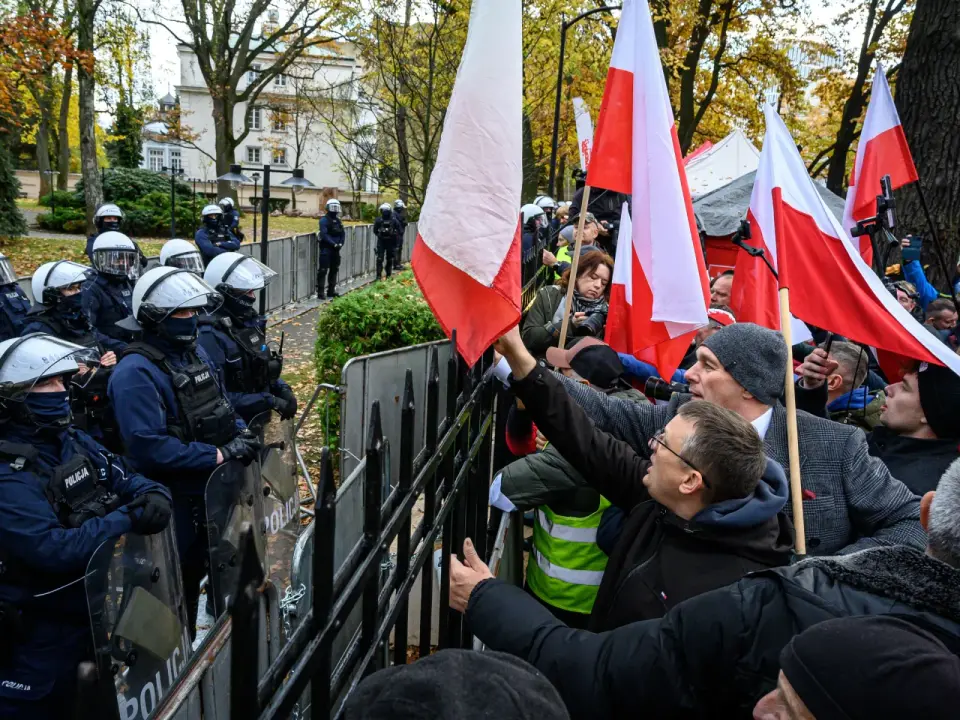
Poland faces a severe constitutional crisis after the government suspended Constitutional Tribunal President Bogdan Swieczkowski, triggering protests and a direct confrontation between Prime Minister Donald Tusk and President Karol Nawrocki. Tusk argues the move is necessary to restore judicial independence, while Nawrocki and the opposition label it a coup. No breakthrough emerged from emergency talks, and the dispute threatens to polarize the country ahead of next year’s elections.
Key points
- Prime Minister Donald Tusk’s government suspended Constitutional Tribunal President Bogdan Swieczkowski on Friday, citing his obstruction of newly elected judges.
- President Karol Nawrocki aborted a state visit to Senegal to return to Warsaw, where he physically entered the court building and accused the government of a forcible takeover.
- Tusk held emergency cross-party talks on Saturday, but no resolution was reached; his Civic Coalition party did not attend the presidential consultations.
- Protests erupted outside the court, with riot police deployed and three individuals detained after clashes with security forces.
- The European Commission urged Nawrocki to accept new judicial nominations, while the US ambassador called for calm to prevent further escalation.
Background
This crisis stems from a decade-long dispute over the politicization of Poland’s judiciary, beginning with the Law and Justice (PiS) party’s 2015-2023 rule. Tusk’s pro-European coalition took power in 2023 with a mandate to restore judicial independence, but faced repeated vetoes from PiS-aligned presidents, including Nawrocki. The Constitutional Tribunal had been paralyzed for years, with the EU’s Court of Justice ruling it no longer impartial. Recent tensions escalated after Nawrocki refused to swear in judges nominated by parliament in 2026.
How outlets are covering it
Tusk and his pro-European coalition view the suspension as a necessary, albeit painful, step to restore the rule of law and depoliticize the judiciary, arguing that PiS-aligned judges had subverted the court. In contrast, Nawrocki and the PiS opposition describe the move as a 'coup d’etat' and an illegal seizure of a constitutional institution. The European Commission supports Tusk’s stance, urging the acceptance of new judges, while the US ambassador called for de-escalation. Some legal experts, including Poland’s Helsinki Foundation for Human Rights, questioned the legality of the suspension, warning it may not resolve the crisis. Tusk compared the opposition’s reaction to a thief claiming victimhood, while Nawrocki’s aide called Tusk a 'pathological liar.'
Why it matters
The standoff highlights deep divisions in Poland’s political landscape and threatens to undermine the country’s rule of law ahead of next year’s parliamentary elections. It also risks straining Poland’s relationship with the EU, which has previously imposed fines over judicial reforms. The crisis could further polarize the nation and set the stage for a contentious election between Tusk’s coalition and the nationalist right.
What to watch
The situation remains volatile, with no immediate resolution in sight. Tusk has vowed to press ahead with restoring the court’s independence, while Nawrocki and the opposition continue to rally support. The outcome of the crisis will likely shape the political dynamics of Poland’s upcoming elections and its standing within the EU.
- Polish president holds crisis talks in court standoff Al Jazeera
- Tensions over Poland’s top court ignite as the country’s prime minister and president square off CNN
- Tusk defends rule of law as President Nawrocki alleges tribunal coup The Jerusalem Post
- Tusk defends overhaul of Poland’s constitutional court despite protests The Guardian
- Poland Deploys Riot Police in Standoff Over Country’s Top Court The New York Times
Want the full story? Read the original reporting
Read on Al Jazeera