
Sahara meteorite Teghaza 001 reveals Mars had active water cycle 4.1 billion years ago
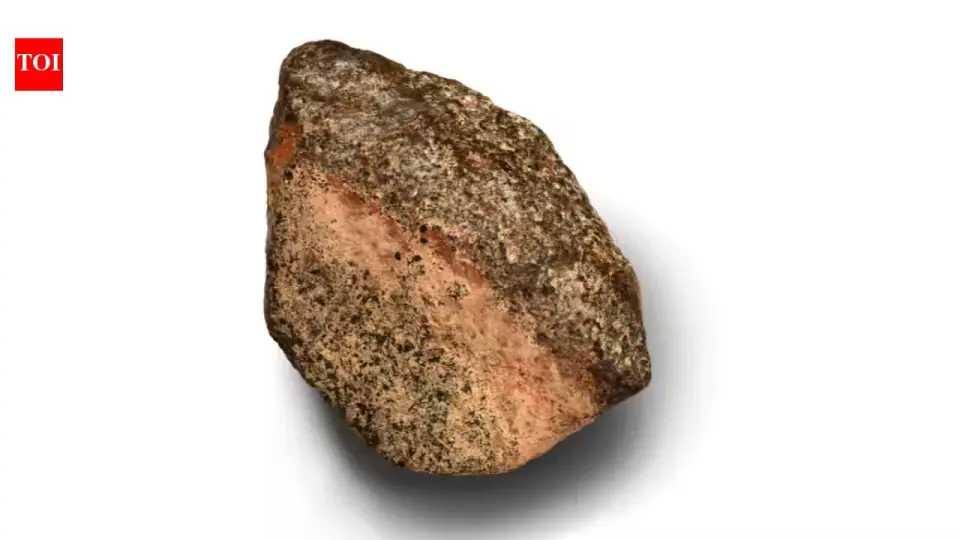
NASA-funded researchers have confirmed that Teghaza 001, an 800-gram pink rock found in the Sahara Desert in 2022, is a Martian meteorite formed more than 4.1 billion years ago. Published in the journal Science on October 29, 2026, the study reveals the rock is one of the oldest known samples from Mars, offering rare insights into the planet's early crust and water activity. Unlike younger Martian meteorites, this specimen preserves evidence of a dynamic hydrosphere and complex mantle evolution, potentially indicating habitable conditions billions of years ago.
Key points
- Teghaza 001, discovered in Mali’s Sahara Desert in 2022, weighs approximately 800 grams and consists of eight fragments.
- The rock is dated to at least 4.1 billion years old, making it one of only three known ancient Martian meteorites on Earth.
- Analysis of zircon crystals and rubidium-strontium dating confirms the age, while oxygen isotopes verify its Martian origin.
- The meteorite contains evidence of water-rock interactions, suggesting active circulation of water through Mars’ crust during its early history.
- The rock’s mineral composition matches the southern highlands of Mars, specifically near the Hellas impact basin, though its exact origin remains uncertain.
Background
Previous coverage noted that Teghaza 001 was identified as a 4.1-billion-year-old fragment of Mars, offering a rare look at the planet’s ancient crust. Earlier reports highlighted its status as the oldest known igneous rock from Mars and its distinction from younger meteorite families like shergottites. This finding complements recent Perseverance rover discoveries in Jezero Crater, which identified multiple water-related epochs, reinforcing the narrative of a wetter early Mars.
How outlets are covering it
The Times of India emphasizes the rock’s role in revealing ancient volcanic activity and water-rock interactions, highlighting its significance as one of the oldest Martian meteorites. NASA Science focuses on the technical analysis, noting the use of reflected light images to identify minerals like iron-titanium oxides and pyroxene, which inform the formation of Mars’ crust and mantle. Ars Technica provides deeper context on why ancient Martian rocks are rare, explaining that impacts act as a filter, preventing weak rocks from reaching Earth. It also details the rock’s slow cooling rate and its unique mantle source, which does not match known reservoirs. Mashable highlights the meteorite’s status as a 'Rosetta Stone' for Mars, noting that its water content indicates the planet began losing water early in its history, potentially impacting the viability of early life. All sources agree on the rock’s age and Martian origin but differ in emphasis, with some focusing on geological processes and others on implications for habitability.
Why it matters
Teghaza 001 provides a rare physical sample of Mars’ ancient crust, offering insights into the planet’s early geological and hydrological history. Its age and mineral composition help scientists understand how Mars’ crust formed and how water interacted with it, potentially revealing conditions that could have supported life. The discovery also highlights the limitations of current meteorite collections, as most known Martian meteorites are younger, and underscores the need for future sample return missions to capture older terrains. This finding could revolutionize our understanding of Mars and the early solar system, bridging gaps in knowledge about planetary evolution and habitability.
What to watch
Researchers plan further studies on Teghaza 001 to determine its exact origin on Mars and to analyze its water content in greater detail. Multiple groups are already studying the specimen to extract more insights, and scientists hope that future sample return missions, such as those involving Perseverance, will provide samples from terrains as old or older than Teghaza 001. These efforts aim to refine models of Mars’ mantle evolution and water cycle, potentially uncovering new discoveries about the planet’s early environment and the potential for life.
- In 2022, an 800-gram pink rock was found in the Sahara Desert; NASA-funded researchers have now confirmed The Times of India
- A Meteorite Found in the Sahara Is a 4.1-Billion-Year-Old Piece of Mars The New York Times
- Slice of Martian Meteorite Teghaza 001 NASA Science (.gov)
- Rare meteorite from Mars gives us a view into its ancient crust Ars Technica
- Scientists date Martian meteorite to foundational era of solar system Mashable
Want the full story? Read the original reporting
Read on The Times of India