
Poland’s Constitutional Crisis Peaks as President Nawrocki Halts Flight to Confront Court Takeover
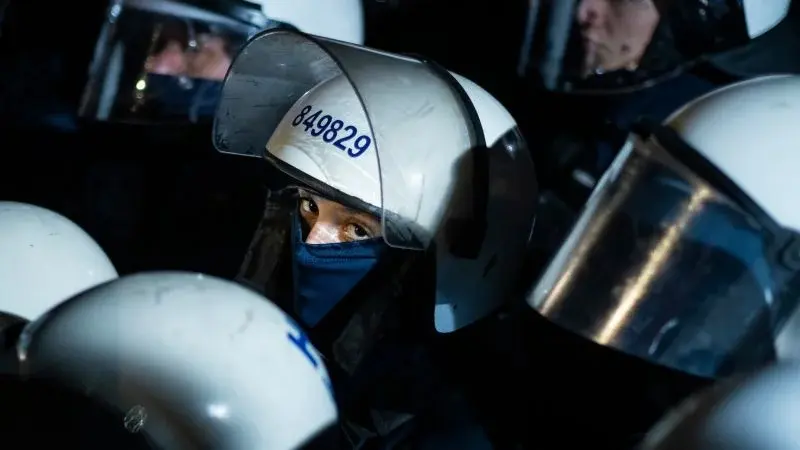
Poland faces a constitutional emergency after the government suspended Constitutional Tribunal President Bogdan Święczkowski, triggering violent protests and a direct confrontation between Prime Minister Donald Tusk and President Karol Nawrocki. Nawrocki aborted a state visit to Senegal to return to Warsaw, declaring the government’s actions a 'forcible takeover' of the court. The crisis stems from a decade-long dispute over judicial legitimacy, with the government seeking to depoliticize the judiciary and the opposition accusing Tusk of undermining constitutional order. Riot police were deployed as protesters clashed with security forces, while the court itself issued conflicting statements on its own leadership.
Key points
- President Karol Nawrocki turned back his plane from Senegal to return to Warsaw, stating the president must be present during a 'breach of constitutional order.'
- Hundreds of anti-government protesters, including PiS leader Jarosław Kaczyński, rallied outside the Constitutional Tribunal, leading to police detentions and clashes with security fences.
- The government suspended Tribunal President Bogdan Święczkowski and Vice-President Bartłomiej Sochański, with Justice Minister Waldemar Żurek seeking to strip their immunity to bring criminal charges.
- Judge Anna Korwin-Piotrowska assumed temporary charge of the court, claiming the suspension was necessary to restore functionality, while the suspended leadership declared the move unlawful.
- Prime Minister Donald Tusk defended the actions as a necessary step to restore the rule of law after years of 'lawlessness' under the previous PiS government.
Background
This crisis is the latest escalation in a decade-long dispute over the legitimacy of Poland’s Constitutional Tribunal, originating in 2015 when the Law and Justice (PiS) party challenged the validity of judges appointed by the previous government. European courts later ruled that PiS-era appointments were improper, leading to fines and a loss of the court’s status as an 'independent and impartial tribunal.' Since 2023, Tusk’s pro-European government has attempted to reverse these reforms, but efforts were blocked by presidential vetoes from PiS-aligned leaders, including Nawrocki, who refused to swear in judges elected by parliament in 2026.
How outlets are covering it
Outlets diverge on the characterization of the event. CNN and USA Today frame the suspension as a government effort to restore rule of law, quoting Tusk’s defense of 'decisive action.' Conversely, Nawrocki and PiS figures, cited by USA Today and Euronews, describe the move as a 'criminal attack' and 'forcible takeover' of a constitutional body. BBC highlights the legal ambiguity, noting that while the government seeks criminal charges, the court itself posted that the suspended judges remain legally appointed. Euronews provides a detailed historical breakdown, emphasizing that the dispute has paralyzed the institution for over a decade, with both sides disputing the other’s legitimacy. Critics like lawyer Marcin Matczak, cited by BBC, argue the suspension has no legal basis and will damage the rule of law for years.
Why it matters
The standoff threatens to paralyze Poland’s highest court, creating legal uncertainty for citizens and businesses as rulings remain unpublished. It deepens the rift between the pro-European government and the nationalist opposition, potentially affecting Poland’s standing within the EU. The crisis also raises fundamental questions about the separation of powers and the authority of constitutional rulings, with no clear resolution in sight as both sides claim legal superiority.
What to watch
President Nawrocki has called for urgent meetings with parliamentary group heads to 'stabilize the political situation.' Święczkowski has stated he and remaining judges will seek to regain control of the Tribunal, while Korwin-Piotrowska plans to convene a General Assembly of judges on November 3. The government is expected to proceed with criminal charges against the suspended leaders, while the opposition may escalate protests or seek international legal intervention.
- Police detain 3 protesters during overnight rally as Polish president backs suspended judge CNN
- Police deployed during stand-off over control of top Poland court BBC
- Polish president accuses Tusk of forced takeover of country's top court USA Today
- Poland crisis explained: a dispute over legitimacy and the courts Euronews.com
- Poland Deploys Riot Police in Standoff Over Country’s Top Court The New York Times
Want the full story? Read the original reporting
Read on CNN