
ESPN Pundits Question if Big Ten Paid Western Michigan to Stay Silent After Clock Controversy
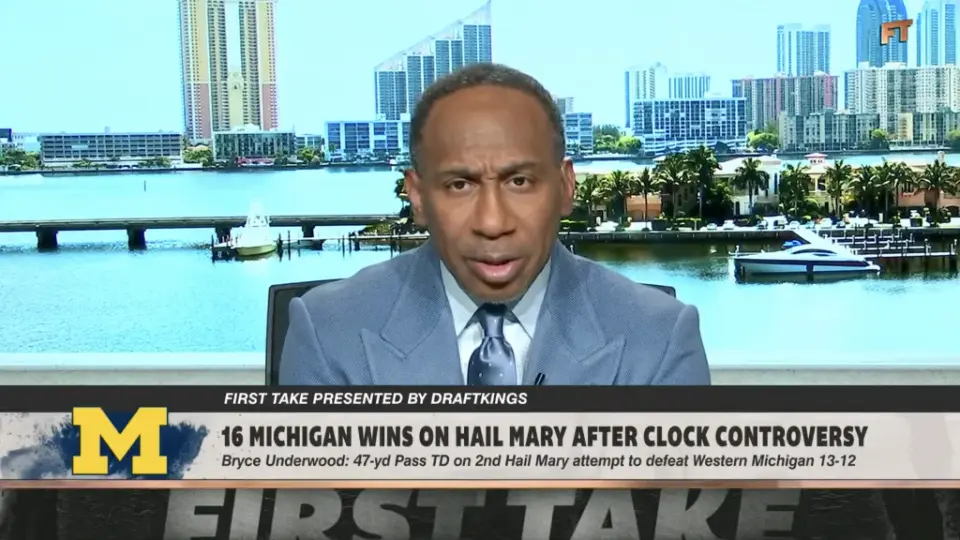
Michigan won 13-12 against Western Michigan after a controversial video review added one second to the clock, allowing a Hail Mary touchdown. While Western Michigan officials accepted the ruling, ESPN analysts Stephen A. Smith and Paul Finebaum suggested the Big Ten may have used financial leverage to ensure the Broncos remained quiet. Dan Orlovsky also criticized the clock discrepancy, calling the explanation 'lying.'
Key points
- Michigan defeated Western Michigan 13-12 after officials added one second to the clock via video review, allowing a Hail Mary touchdown.
- Western Michigan president Russ Kavalhuna and coach Lance Taylor accepted the Big Ten's explanation and showed no public outrage.
- ESPN's Stephen A. Smith and Paul Finebaum suggested the Big Ten may have coerced Western Michigan into silence through financial incentives, noting the $1.5 million game contract.
- Dan Orlovsky criticized the clock discrepancy, stating that in 2026, official and broadcast clocks should be synchronized.
- The Big Ten released a statement and video evidence showing one second remained, while NBC acknowledged its broadcast clock was not the official timekeeper.
Background
This incident follows ongoing debates about college football officiating and conference power dynamics. The Big Ten has been involved in broader discussions regarding CFP expansion and revenue distribution, which may influence perceptions of its influence over smaller conferences like the MAC. Previous controversial finishes, such as the 2001 Michigan-Michigan State 'Spartan Bob' incident, highlight recurring issues with clock management in high-stakes games.
How outlets are covering it
ESPN's Stephen A. Smith and Paul Finebaum argued that Western Michigan's lack of outrage was suspicious, suggesting the Big Ten used its financial power to suppress criticism. They noted that Western Michigan received $1.5 million for the game and may have faced implicit threats of losing future revenue if they complained. Dan Orlovsky focused on the technical failure, questioning why official and broadcast clocks were not synchronized in 2026. In contrast, Western Michigan officials and the Mid-American Conference accepted the Big Ten's explanation, with Kavalhuna confirming he reviewed the video evidence. CBS Sports contextualized the event within a history of controversial college football endings, noting that such errors are not unprecedented but remain highly contentious.
Why it matters
The controversy raises questions about the Big Ten's influence over smaller conferences and the integrity of officiating in high-profile games. It also highlights the tension between broadcast networks and official timekeeping, which can affect game outcomes. The financial implications for Western Michigan may set a precedent for how smaller programs respond to unfavorable rulings in the future.
What to watch
The Big Ten may face increased scrutiny over its handling of the incident, while Western Michigan could face pressure from fans and media to challenge the ruling. The NFL and college football officials may review clock synchronization protocols to prevent similar errors. The outcome may also influence future CFP expansion negotiations, as conference power dynamics continue to shape the sport's landscape.
- Stephen A. Smith, Paul Finebaum question if Big Ten demanded silence from WMU to receive payment Awful Announcing
- Western Michigan president: Big Ten's replay process not 'as good as it could be' ESPN
- ESPN pundits aren't buying Big Ten's reason for clock fiasco: 'Nonsense' The Detroit News
- Why did Michigan-WMU refs use a game clock no one else could see for their pivotal review? - The Athletic The New York Times
- Most controversial finishes in college football history: Revisiting wild endings on heels of Michigan-WMU CBS Sports
Want the full story? Read the original reporting
Read on Awful Announcing