
France's Second Protest Wave: 1,000 Arrested as Peaceful Marches Turn Violent
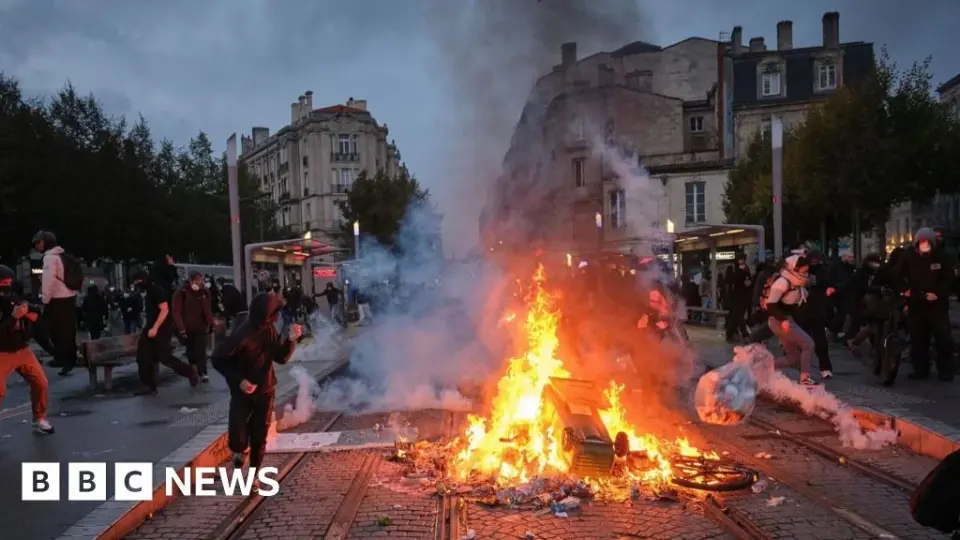
France faced a second major wave of unrest on October 24, 2026, with nearly 1,000 arrests reported by Interior Minister Laurent Nuñez. While initial marches remained peaceful, clashes erupted in Paris, Marseille, and other cities. The government deployed 70,000 police officers to prevent a repeat of the previous week's severe looting, though some property damage and injuries occurred. Protests, driven by high living costs and education funding, continue ahead of the May presidential election.
Key points
- Interior Minister Laurent Nuñez reported nearly 1,000 arrests, a number expected to rise, with 64 arrests in Paris alone.
- The Interior Ministry estimated 410,000 protesters nationwide, while the CGT union claimed 800,000, highlighting a significant discrepancy in turnout figures.
- Clashes in Paris involved masked protesters throwing projectiles and fireworks, prompting police to use tear gas, sound grenades, and water cannons.
- Two people were seriously injured, including a 20-year-old in Toulouse who lost fingers, and another in Clermont-Ferrand.
- Protests in Orléans targeted the far-right National Rally party, with demonstrators chanting against both Macron and Marine Le Pen.
Background
This second wave of protests follows a week of severe unrest that resulted in over 2,500 arrests and hundreds of millions of euros in damage, including the destruction of the Limoges town hall. The initial unrest began in September with student protests over school funding, which quickly expanded to include workers demanding relief from rising living costs. The current demonstrations occur in the final months of President Emmanuel Macron's term, ahead of the May presidential election.
How outlets are covering it
Outlets agreed on the core facts of the protests and arrests but differed on turnout and the nature of the violence. The BBC and AP reported the Interior Ministry's estimate of 410,000 protesters, while the CGT union claimed 800,000. CBS News emphasized the government's claim that the scale of looting was 'far smaller' than the previous week, attributing this to better police preparation. The BBC and AP noted that clashes were limited to the rear of marches in Paris, with Nuñez identifying '500 individuals' as rioters. CBS News highlighted the presence of far-right activists in southern cities like Cannes and Montpellier, a phenomenon Nuñez described as new. All sources agreed that the protests were largely peaceful initially but turned violent in the evening, with police using tear gas and water cannons in multiple cities.
Why it matters
The ongoing unrest tests Macron's authority in the final months of his presidency and could influence the May presidential election, where Marine Le Pen is currently best-placed to win. The protests highlight deep social divisions over cost of living, education, and police conduct, with the far-right accusing the government of failing to protect the public and the left criticizing police violence. The potential for further unrest, including a planned Halloween demonstration by the Yellow Vests, poses a continued challenge to public order and political stability in France.
What to watch
Protesters are expected to continue their demonstrations, with the Yellow Vests calling for rallies and a sit-in outside parliament and city halls on October 31. The government has vowed to maintain a high level of alert, with 70,000 police officers deployed nationwide. The outcome of the May presidential election will be a key factor in determining the future direction of France's political landscape and the resolution of the ongoing social unrest.
- Clashes erupt in Paris after largely peaceful protests across France BBC
- More than 1,000 arrested in France as protestors and police clash in several cities CBS News
- Violence flares in Paris after largely peaceful protests across France Reuters
- Hundreds of Thousands Protest Across France as Clashes Erupt in Paris WSJ
- More than 400,000 protest across France, challenging Macron as Paris clashes erupt AP News
Want the full story? Read the original reporting
Read on BBC