
France’s Second Wave: 400,000 Protesters March Peacefully Before Evening Clashes
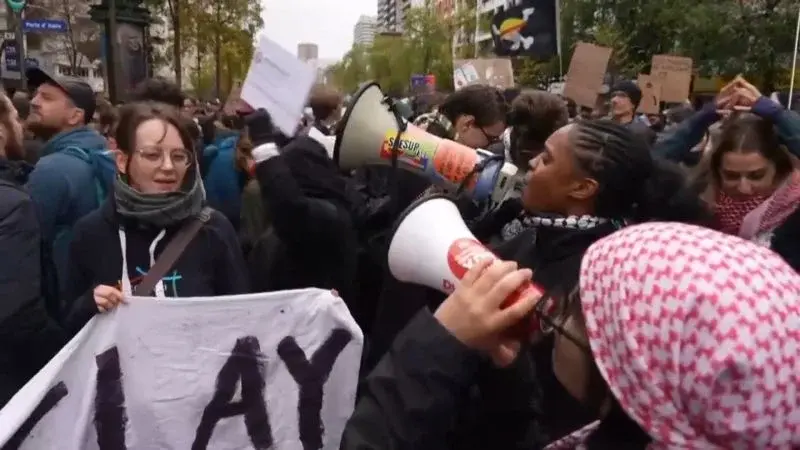
Over 400,000 people protested across France on October 24, 2026, in a second major wave of demonstrations. While the main marches remained largely peaceful, clashes erupted in the evening in Paris, Marseille, and other cities. Interior Minister Laurent Nuñez reported nearly 1,000 detentions, a significant increase from the previous week but with less property damage. The unrest, driven by high living costs and education funding, spread to Italy, Albania, and Belgium, with far-left leader Jean-Luc Mélenchon threatening a general strike if President Emmanuel Macron does not yield to demands.
Key points
- More than 400,000 people participated in protests across France, with 110,000 in Paris, according to the Interior Ministry.
- Nearly 1,000 people were detained nationwide, up from 385 the previous week, though property damage was significantly lower.
- Clashes broke out in Paris, Marseille, Lyon, and Bordeaux, with police using tear gas and water cannons.
- Far-right groups attacked peaceful protesters in Nice, resulting in 63 arrests and five injuries.
- Jean-Luc Mélenchon declared the Paris march a 'total victory' and warned of a general strike on November 5 if Macron does not respond.
- Protests spread across Europe, including Italy, Albania, and Belgium, with police deploying water cannons in Tirana and Brussels.
Background
This is the second major wave of protests in France since October 17, 2026, when approximately 550,000 people demonstrated in a violent youth-led uprising. The initial unrest, which began in September over school funding cuts and high living costs, led to widespread looting, arson, and hundreds of arrests. The current demonstrations follow a pattern of escalating tensions, with the government facing pressure to address the root causes of the discontent while managing public order.
How outlets are covering it
CNN and The New York Times emphasize that the October 24 protests were largely peaceful compared to the previous week, with less property damage and more effective police preparedness. CBS News highlights the significant increase in detentions, noting that nearly 1,000 people were arrested, but also points out that the scale of violence was smaller than the previous week. The New York Times notes that the large-scale police presence and rerouting of protest routes helped prevent wholesale vandalism. CNN reports that far-left leader Jean-Luc Mélenchon described the Paris march as a 'total victory' and warned of a general strike, while Interior Minister Laurent Nuñez blamed 'ultra-left' groups for the violence. CBS News also reports that far-right activists in Nice attacked peaceful protesters, a phenomenon Nuñez described as new. The perspectives differ on the scale of the protests, with the Interior Ministry estimating 410,000 participants, while the CGT union claimed 800,000.
Why it matters
The October 24 protests mark a critical juncture in France's ongoing social unrest, with the potential for a general strike on November 5 if the government does not respond to protesters' demands. The spread of protests across Europe, including Italy, Albania, and Belgium, indicates a broader trend of anti-government sentiment and dissatisfaction with economic policies. The clashes and detentions highlight the tension between the government's efforts to maintain order and the protesters' demands for change, with potential implications for the 2027 presidential elections and the stability of the French social contract.
What to watch
The next major event is the potential general strike on November 5, 2026, as warned by Jean-Luc Mélenchon. The government will likely maintain a high level of security and preparedness for further protests, with police remaining on high alert. The outcome of the November 5 strike will depend on the government's response to the protesters' demands, including increased investment in education and solutions to high living costs. The spread of protests across Europe suggests that similar unrest may continue in other countries, with potential implications for regional stability and economic policies.
- Live updates: Police and protesters clash in France as water cannon deployed in Paris CNN
- More than 1,000 arrested in France as protestors and police clash in several cities CBS News
- Unrest Erupts Again in France, but This Time, With Less Property Damage The New York Times
- Violence flares in Paris after largely peaceful protests across France Reuters
- Hundreds of Thousands Protest Across France as Clashes Erupt in Paris WSJ
Want the full story? Read the original reporting
Read on CNN