
Archaeologists Unearth Planned Military District and Honorific Horse Burial in 3,000-Year-Old Egyptian Fortress
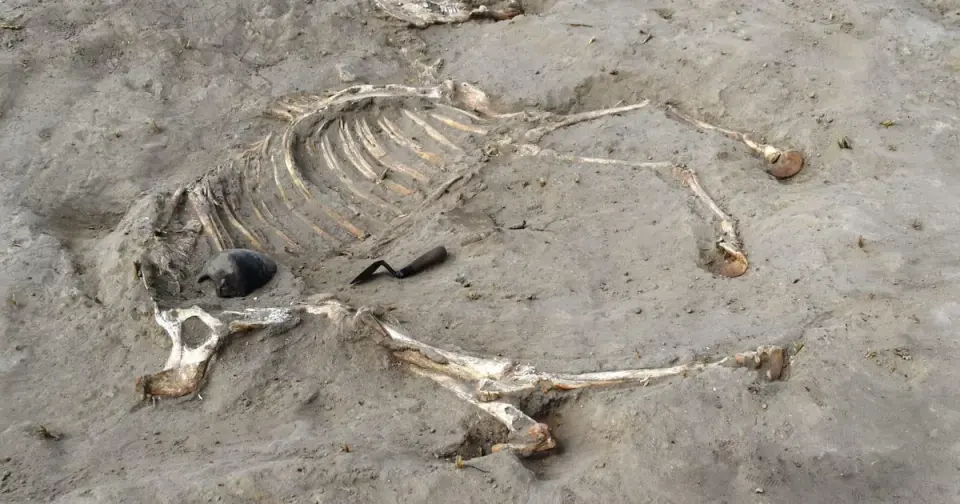
Excavations at Tell Al-Abqain in Egypt’s Nile Delta have revealed a complete residential district and the intact remains of a young male horse, likely given an honorific burial over 3,000 years ago. The site, a New Kingdom fortress built to defend against Libyan tribes, features planned streets, grain silos, and artifacts linking it to Ramesses II and Merneptah.
Key points
- Discovery of a complete, intact horse burial interpreted as an honorific interment for a medium-sized, agile breed used in military activities or chariots.
- Unearthing of a large mudbrick residential complex with a 4-meter-wide main street, grain silos, and pottery ovens, indicating deliberate urban planning.
- Recovery of limestone stelae bearing the names of Ramesses II and Merneptah, along with a depiction of a bound Libyan prisoner from the Meshwesh tribe.
- Findings of religious amulets, scarabs, and a pilgrim’s flask, illustrating the daily religious and domestic life of the fortress’s inhabitants.
- The site is part of the 'Western military road,' a defensive line established during the New Kingdom (1570-1069 B.C.) to protect Egypt’s western border.
Background
Tell Al-Abqain, located in the Hosh Issa district of Beheira governorate, has been the subject of multiple excavation seasons by Egypt’s Supreme Council of Antiquities. Previous campaigns uncovered a ceremonial cow burial and a bronze sword engraved with the cartouche of Ramesses II. This latest season is the first to expose a complete residential district, providing a more comprehensive view of life within the fortress.
How outlets are covering it
All four sources agree on the core findings: the horse burial, the residential complex, and the stelae. CBS News and Egypt Today emphasize the official statements from the Ministry of Tourism and Antiquities and the Supreme Council of Antiquities, highlighting the strategic importance of the site. Archaeology News Online and La Brújula Verde provide more detailed context on the artifacts, such as the hieratic inscription of Merneptah and the specific types of amulets found. La Brújula Verde adds historical context about the Meshwesh tribe eventually ruling Egypt, while Archaeology News Online notes the ongoing nature of the excavations and the goal to complete the fortress’s map. No significant disagreements were found among the sources.
Why it matters
The discovery provides rare, direct evidence of the daily life, urban planning, and military practices within a New Kingdom fortress. The honorific horse burial and chariot harness fragments suggest the high value placed on military assets, while the residential complex and artifacts reveal the social and religious fabric of the garrison. This contributes to a deeper understanding of Egypt’s defensive strategies and the lives of those who served on its borders.
What to watch
Excavation, study, and documentation work will continue at Tell Al-Abqain. The goal is to uncover additional elements of the fortress and clarify its role within Egypt’s western frontier defenses during the New Kingdom. Researchers aim to determine the specific phase of the fortress’s history to which the residential district and horse burial belong.
- Scientists unearth complete remains of Egyptian warhorse given honorific burial some 3,000 years ago CBS News
- 3,000-year-old horse burial and Ramesses II stela found at ancient Egyptian fortress Archaeology News Online Magazine
- New Archaeological Discovery At Tell Al-Abqain Reveals Military And Daily Life Inside A New Kingdom Fortress Egypt Today
- A 3,200-Year-Old War Horse’s Tomb Turns Up Inside a Ramesses II Border Fort La Brújula Verde
- 2,000-Year-Old Fortress With Horse Burial Discovered in Beheira CairoScene
Want the full story? Read the original reporting
Read on CBS News