
Tung Chee-hwa, architect of post-handover Hong Kong, dies at 89
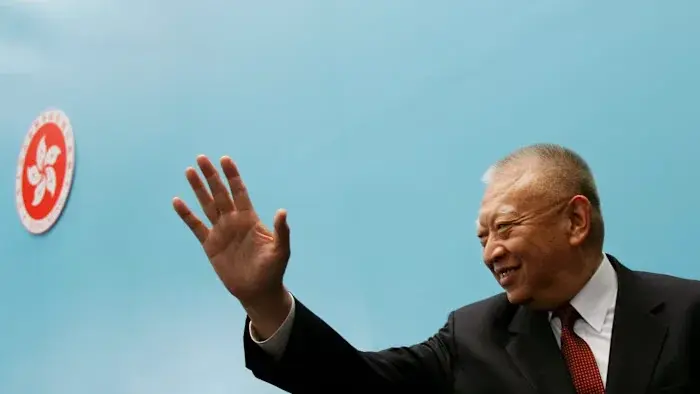
Tung Chee-hwa, Hong Kong’s first chief executive after the 1997 handover, has died at age 89. His tenure was defined by the 1997 Asian financial crisis, the SARS outbreak, and the 2003 protests against a security bill, which he later withdrew. His legacy is marked by the deepening political divide between Hong Kong and Beijing and the erosion of the city’s autonomy.
Key points
- Tung Chee-hwa, a shipping tycoon and former head of Orient Overseas Container Line, died on Tuesday at the age of 89.
- He served as Hong Kong’s first chief executive from 1997 to 2005, tasked with implementing the 'one country, two systems' framework.
- His administration faced the 1997 Asian financial crisis, the 2003 SARS epidemic, and massive protests against a controversial anti-subversion bill.
- The 2003 protests, which drew over 500,000 people, led to the withdrawal of the security bill but sparked nearly two decades of pro-democracy activism.
- Tung’s net worth was estimated at $3.2 billion, and he sold his shipping empire to Chinese state-owned Cosco in 2018.
Background
Tung Chee-hwa’s death occurs amid a period of heightened political tension in Hong Kong, following recent convictions of activists and religious figures under the national security law. The territory’s economic role has shifted, with its contribution to China’s GDP dropping from 18% in 1997 to roughly 2% today, while property prices remain among the world’s highest due to mainland investment.
How outlets are covering it
The Financial Times emphasizes the long-term consequences of Tung’s policies, noting that his administration set the stage for a deepening divide between Hong Kong and Beijing and fueled demands for greater democracy. AP News frames his death as the end of an era for Hong Kong’s post-colonial leadership, highlighting his role as the first leader after the British handover. Both outlets agree on the significance of the 2003 protests and the withdrawal of the security bill, but the FT places greater weight on the economic and political legacy, while AP focuses on the historical milestone of his tenure.
Why it matters
Tung Chee-hwa’s legacy is central to understanding the current state of Hong Kong. His tenure marked the transition from British rule to Chinese sovereignty and the initial implementation of 'one country, two systems.' The crises and protests during his time set the tone for the political tensions that continue to define Hong Kong’s relationship with Beijing, influencing the city’s economic trajectory and its status as a global financial hub.
What to watch
Hong Kong’s economy is slowly recovering, with growth and visitor numbers rebounding after the impacts of political crackdowns and pandemic restrictions. However, the city’s future is increasingly tied to mainland China, with a surge in Chinese company listings on its stock exchange. The legacy of Tung’s policies, particularly the security framework, continues to shape the political landscape and public sentiment in Hong Kong.
- Tung Chee-hwa, Hong Kong’s first chief executive, 1937-2026 Financial Times
- Tung Chee-hwa, Who Led Hong Kong After Its Return to China, Dies at 89 The New York Times
- Tung Chee-hwa, Hong Kong's first leader under Chinese rule, dies at 89 Reuters
- Hong Kong’s first chief executive, Tung Chee-hwa, dies aged 89 South China Morning Post
- Tung Chee-hwa, Hong Kong’s first post-colonial leader, dies at age 89 AP News
Want the full story? Read the original reporting
Read on Financial Times