
Jet-Powered Drones Expose Critical Gaps in Ukraine’s Air Defense
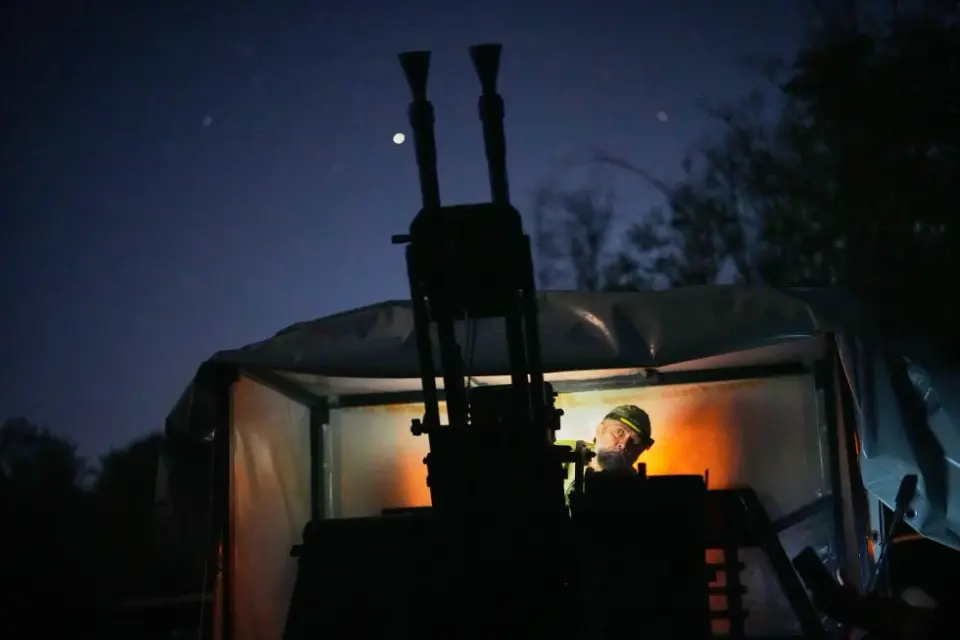
Russian jet-powered Shahed drones are outpacing Ukraine’s current air defenses, forcing the capital into a frontline role. While Ukrainian interceptors struggle with speed and altitude limitations, engineers are racing to scale up new turbojet-powered countermeasures. The shift highlights a critical technological gap that is reshaping the dynamics of the conflict and straining defense budgets.
Key points
- Russian jet-powered Shahed drones fly faster and higher than previous propeller models, exceeding the speed of Ukraine’s current interceptors (300-400 kph).
- Kyiv has become a frontline city, with recent strikes hitting the National Academy of Sciences and a major medical center, causing civilian casualties.
- Ukrainian defense firms are developing new turbojet-powered interceptors, but scaling production faces bottlenecks, particularly in sourcing miniature turbojet engines from Europe.
- F-16 fighter jets are being used to intercept the fastest drones, but many are currently out of service due to maintenance issues.
- Experts estimate it will take three to six months to close the gap in interceptor production and capability.
Background
This development follows earlier reports in August and September 2026, which noted that Russia was expanding jet-powered drone variants (including Geran-4 and Geran-5) to outpace Ukrainian defenses. Previous coverage highlighted a 57% interception rate for these faster drones and the unveiling of turbojet delta-wing interceptors by Ukraine. The current situation reflects the ongoing struggle to match Russian technological advances in drone speed and altitude.
How outlets are covering it
AP News emphasizes the immediate tactical failure of current Ukrainian defenses, noting that drones fly too high and fast for existing machine guns and interceptors to engage effectively. IEEE Spectrum focuses on the technological and industrial challenges, highlighting the lack of a ready solution and the bottleneck in scaling up new interceptor production. The Washington Post frames the issue as a broader shift in the war, describing Kyiv as a 'daytime war zone' due to the increased frequency and lethality of these strikes. All sources agree that Ukraine is actively developing new countermeasures, but they differ in emphasis: AP and IEEE focus on the technical and production gaps, while the Washington Post highlights the humanitarian and strategic implications for the capital.
Why it matters
The effectiveness of jet-powered drones is changing the nature of the conflict, forcing Ukraine to rely on costly and limited resources like F-16s for interception. The inability to quickly scale up new defenses threatens the safety of major cities and could shift the balance of power in favor of Russian air superiority. This technological gap also highlights the broader challenges of modern warfare, where rapid innovation by one side can outpace the defensive capabilities of the other.
What to watch
Ukraine is expected to continue testing and deploying new turbojet-powered interceptors, with production scaling up over the next three to six months. The reliance on F-16s for interception will likely continue until new systems are fully operational. Russia may further expand its use of jet-powered drones, potentially increasing the frequency and intensity of strikes on Ukrainian cities. The outcome of this technological race will be critical in determining the future dynamics of the conflict.
- Jet-powered drones outpace Ukrainian defenses as manufacturers race to build new interceptors AP News
- Ukraine’s Air Defenses Have No Answer for Russia’s New Jet Drones IEEE Spectrum
- Russia’s jet-powered drones are turning Kyiv into a daytime war zone washingtonpost.com
- Neros Nears Release of Fast Drone to Bring Down Jet-Powered Russian Drones theinformation.com
- Ukraine Offers Allies Partnership in Intercepting Russian Jet Drones UNITED24 Media
Want the full story? Read the original reporting
Read on AP News