
Baghdad's New Jewish Museum Sparks Cultural Revival and Political Threats
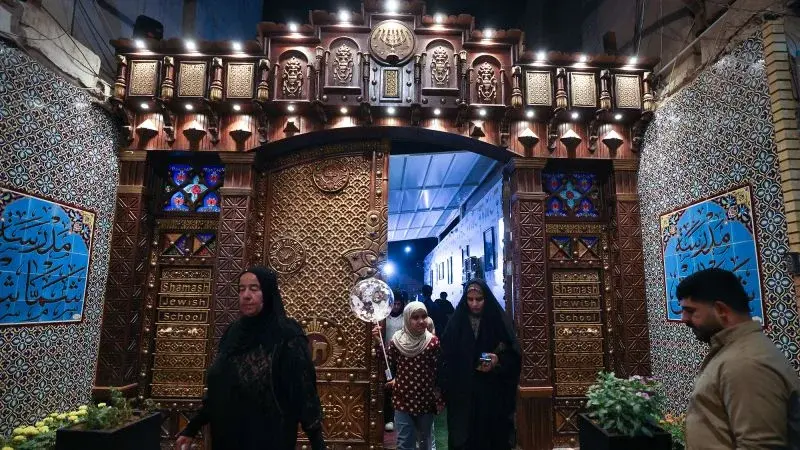
The Shamash Jewish Museum opened in Baghdad last month, drawing crowds to view artifacts from Iraq's vanished Jewish community. While supporters view it as a vital step in preserving national heritage, the opening has triggered fierce opposition from Shiite groups and sparked debate over its political implications amidst regional tensions.
Key points
- The museum, housed in the 1928 Shamash Jewish School on Al-Rashid Street, opened last month and now attracts dozens of daily visitors.
- Exhibits include school certificates, identity cards, and portraits of historical figures like Sassoon Heskel, Iraq's first finance minister, and singer Salima Murad.
- The project was funded entirely by the Jewish Endowment, led by community head Khalida Fouad Eliyahu, to preserve the site after the area became a commercial district.
- Badr Organization leader Muhammad Naji Muhammad condemned the museum as a 'security breach' and a Zionist foothold, calling it a red line for Baghdad's identity.
- Public opinion is divided: some visitors see it as healing a societal wound, while others fear it signals normalization with Israel amid the ongoing Gaza conflict.
Background
Iraq's Jewish community, which numbered 150,000 in 1947, largely emigrated between 1950 and 1952 following the 1941 Farhud pogrom and the establishment of Israel. Today, only a handful of Jews remain in Baghdad, with about 90 living in the Kurdistan region. The Shamash School was impounded by the government in the 1970s but returned to the community via court ruling in 1992. Restoration efforts were previously stalled by sanctions, the 2003 invasion, and sectarian violence. This development follows recent efforts to preserve other historical sites in Baghdad, such as the Agatha Christie residence, which remains in disrepair despite government offers to hand it over for restoration.
How outlets are covering it
CNN and The National emphasize the museum's role in rediscovering Iraq's diverse heritage, noting that many Iraqi visitors, including a 71-year-old resident and a 24-year-old student, view it as a way to acknowledge the Jewish community's contribution to the state. They highlight the emotional connection of visitors to the past and the hope for reconciliation. In contrast, Israel Hayom focuses on the immediate political backlash, detailing threats from the Badr Organization, which labeled the museum a 'Zionist' project and a threat to national identity. The National also captures the internal Iraqi debate, where some visitors express fear that the museum could lead to normalization with Israel, while others distinguish between Judaism and Zionism, viewing the museum as a necessary correction of historical wrongs. The sources agree on the factual details of the museum's contents and funding but diverge sharply on the interpretation of its opening as either a cultural triumph or a political provocation.
Why it matters
The opening of the Shamash Jewish Museum marks a significant shift in Iraq's public discourse regarding its multi-ethnic past. It tests the limits of cultural expression in a region where historical memory is often politicized. The strong opposition from powerful Shiite groups highlights the fragility of such initiatives and the deep-seated tensions surrounding Israel and Jewish heritage in the Middle East. For Iraq, it represents a potential step toward acknowledging its full historical narrative, while for the broader region, it underscores the ongoing sensitivity of any cultural project linked to Jewish identity.
What to watch
The Jewish community, led by Khalida Fouad Eliyahu, plans to restore other landmarks linked to the country's Jewish presence. The museum will continue to operate three days a week, with the Jewish Endowment managing its finances through state banks. The response from Iraqi authorities to the threats from the Badr Organization will determine the museum's long-term viability. Broader discussions on the preservation of other Jewish sites, such as synagogues in Baghdad and Hilla, may gain momentum if the museum continues to draw public interest.
- Baghdad’s first Jewish museum draws crowds to rediscover Iraq’s Jewish past CNN
- Shiite terror group in Iraq threatens new Jewish museum in Baghdad www.israelhayom.com
- Iraq Jewish Museum Bluefield Daily Telegraph
- Iraq's first Jewish Museum opens a door to the past �� and a contentious debate on the present The National
Want the full story? Read the original reporting
Read on CNN