
Australia Reveals Ghost Shark’s Modular Payload Bay for Mines and Drones
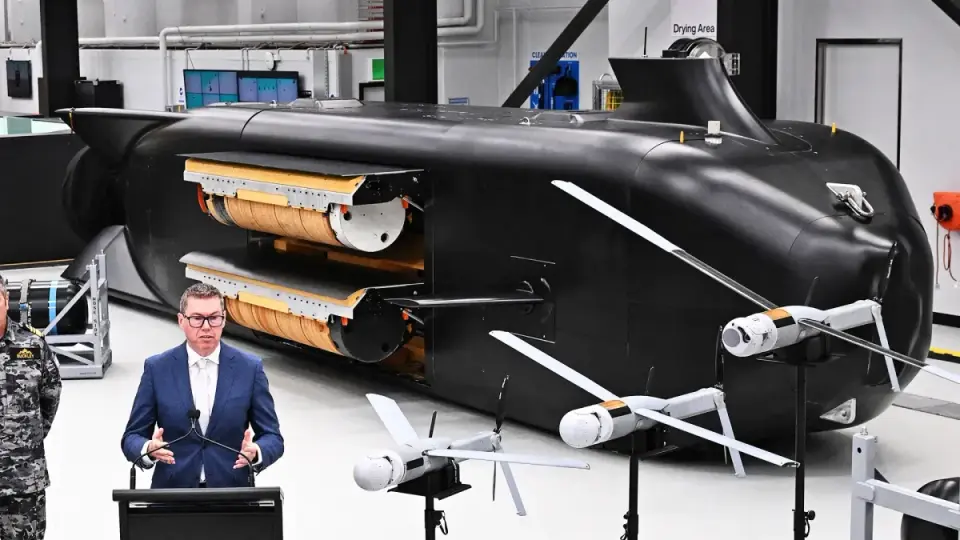
On October 19, 2026, Australia unveiled the first public images of the payload bay for its Ghost Shark extra-large uncrewed underwater vehicle. The announcement confirmed three new mission capabilities: deploying up to 12 sea mines, leaving underwater supply caches, and launching Anduril ALTIUS aerial drones. These modular payloads, developed under AUKUS Pillar II, allow the Royal Australian Navy to configure the vehicle for strike, surveillance, and logistics missions. The reveal coincided with Exercise Maritime Big Play Pacific in San Diego, highlighting Australia’s shift toward autonomous undersea warfare as part of a A$5.8 billion decade-long investment.
Key points
- First public photos of the Ghost Shark’s internal payload bay were released at an Anduril facility in Sydney, showing modular hull sections and cylindrical spacers.
- Three new payload options were disclosed: deploying up to 12 Rheinmetall Asteria sea mines, placing seabed supply caches, and launching Anduril ALTIUS aerial drones for reconnaissance or strike.
- The Ghost Shark’s modular design allows for rapid reconfiguration between mission types, including intelligence, surveillance, reconnaissance, and strike operations.
- The program is part of a A$5.8 billion (approx. $4.05 billion) investment in autonomous undersea warfare, with A$1.7 billion allocated specifically for the Ghost Shark fleet.
- Some payloads will be demonstrated during Exercise Maritime Big Play Pacific in San Diego, an AUKUS Pillar II activity focused on interoperability and advanced maritime capabilities.
Background
Australia’s Ghost Shark program has been a central component of its AUKUS Pillar II strategy since 2023, focusing on joint development of advanced defense technologies with the US and UK. Previous coverage noted that the vehicle was designed for persistent intelligence and surveillance missions, but specific combat payloads remained classified until this October 2026 announcement. The program is distinct from the AUKUS Pillar I nuclear submarine acquisition, which is expected to begin in the early 2030s. The current development phase involves collaboration between the Royal Australian Navy, the Defense Science and Technology Group, and Anduril Australia, with production moving from prototype to large-scale manufacturing within three years.
How outlets are covering it
The War Zone emphasized the technical implications of the modular design, noting that the visible spacers in the payload bay suggest a flexible platform capable of accommodating various mission-specific systems. They highlighted the strategic value of launching aerial drones from underwater vehicles to extend sensor reach and conduct strikes without risking crewed personnel. Interesting Engineering focused on the industrial and economic aspects, highlighting the A$1.7 billion contract with Anduril and the involvement of over 40 Australian companies in the supply chain. They noted that Conroy framed the Ghost Shark as a 'flagship Australian success story' for sovereign defense capability. Breaking Defense and Naval News provided more concise overviews, confirming the official government statement that the payloads will be tested at Exercise Maritime Big Play Pacific. Naval News noted that the official press release was vague on specific capabilities, relying on defense media reports for details on mines and drones. All sources agreed on the core facts of the payload reveal but differed in emphasis: TWZ on technical modularity, Interesting Engineering on industrial production, and Breaking Defense/Naval News on the official government stance and AUKUS cooperation.
Why it matters
The revelation of lethal and logistical payloads for the Ghost Shark marks a significant shift in Australia’s naval strategy, moving from passive surveillance to active sea denial and strike capabilities. The modular design allows the Royal Australian Navy to rapidly adapt to changing threats across the vast Indo-Pacific region. The integration of aerial drones with underwater vehicles creates a new dimension of warfare, extending the reach of naval forces beyond traditional submarine sensors. This development also strengthens AUKUS Pillar II cooperation, demonstrating tangible progress in joint technology development. The A$5.8 billion investment signals a long-term commitment to autonomous systems, which could reduce reliance on crewed vessels for dangerous missions and enhance Australia’s sovereign defense industrial base.
What to watch
The next key milestones will involve the integration of the newly disclosed payloads into the Ghost Shark vehicles and their deployment during Exercise Maritime Big Play Pacific in San Diego. The Australian government expects to provide more details on how the payloads will be integrated and used in practice following the exercise. Anduril has indicated plans to equip the submarines with heavyweight and lightweight torpedoes in the future. The program is also exploring export opportunities with allied nations, including the US and UK. The first production Ghost Shark has already been delivered to the Royal Australian Navy, with more units expected to roll off the line in increasing rates over the next decade.
- Ghost Shark Extra-Large Uncrewed Underwater Vehicles’ Payload Bay Seen For First Time TWZ
- Ghost Shark robotic submarines gain new weapons and drone capabilities Interesting Engineering
- Ghost Shark with teeth: Australia unveils underwater drone payloads Breaking Defense
- Australia advances undersea warfare capabilities Naval News
- Australia unveils sea mines, logistics cache and drone swarm payloads for Ghost Shark XL AUV Defence Connect
Want the full story? Read the original reporting
Read on TWZ