
Kongsberg Unveils Arctic Hunter USV to Address Royal Navy ASW Gaps
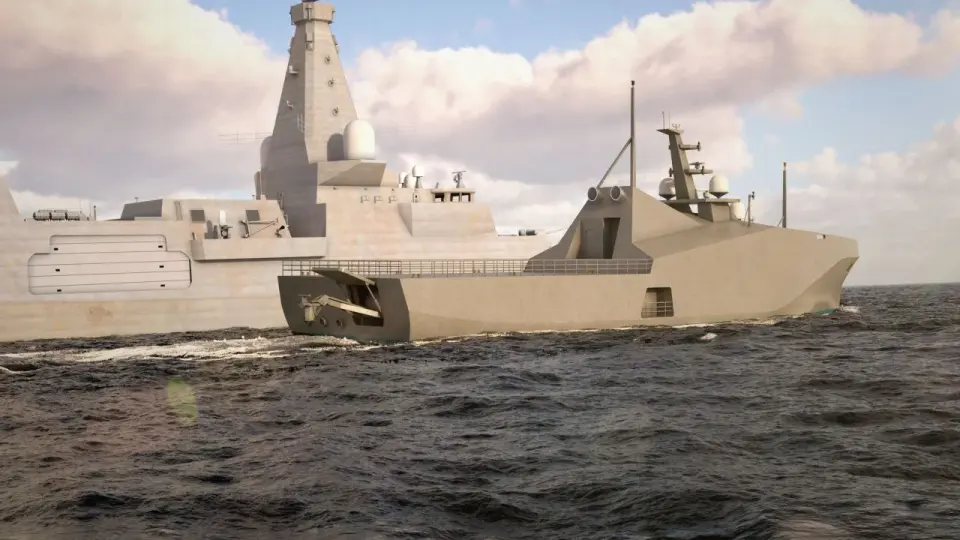
Kongsberg Maritime has unveiled the Arctic Hunter, an uncrewed surface vessel (USV) designed for the UK Royal Navy’s Type 92 requirement. The platform adapts a 184-foot commercial Arctic fishing hull for persistent anti-submarine warfare (ASW) in the High North. It integrates Thales’ Sonar 2087 and autonomous technologies to detect Russian submarines. Construction is planned at Balaena Maritime’s Birkenhead yard, with operational deployment targeted by the end of the decade.
Key points
- Kongsberg Maritime unveiled the Arctic Hunter USV on November 9, 2026, as a candidate for the Royal Navy’s Type 92 requirement.
- The vessel is based on a proven 184-foot commercial Arctic fishing hull, adapted to tow Thales’ Sonar 2087 for ASW missions.
- The design aims for up to 60 days of autonomous operation at sea, leveraging Kongsberg’s existing remote-control technology from the Reach Remote project.
- Construction is planned at Balaena Maritime’s Birkenhead yard, with the goal of delivering vessels by the end of the decade.
- The platform is designed to operate from a forward base in the Arctic Circle, augmenting existing ASW infrastructure in the High North.
Background
This development follows a UK parliamentary committee report in October 2026 warning of Royal Navy shortfalls in the High North. The report highlighted critical gaps in ship availability and capability, urging the government to accelerate deployments before 2030. Additionally, concerns over Russian submarine activity in the North Atlantic have intensified, with a UK-Norway operation in April 2026 tracking Russian submarines near critical undersea infrastructure.
How outlets are covering it
Naval News emphasizes the strategic alignment of the Arctic Hunter with the UK-Norway Lunna House agreement, which aims to lead NATO’s adoption of autonomous systems in the High North. The outlet highlights the vessel’s potential for export to other NATO and Joint Expeditionary Force nations. In contrast, The War Zone focuses on the practical engineering aspects, noting that the vessel is adapted from a fishing trawler to ensure quiet operation and robustness in Arctic conditions. TWZ also highlights the Royal Navy’s broader Hybrid Navy concept, which includes four new uncrewed vessel types, and the recent commissioning of the 1st Autonomous Squadron at Portsmouth.
Why it matters
The Arctic Hunter USV represents a significant shift in the Royal Navy’s approach to ASW, moving towards a hybrid fleet of crewed and uncrewed assets. This strategy aims to address persistent surveillance gaps in the High North, where Russian submarine activity poses a growing threat to NATO’s maritime communications and reinforcement routes. The use of commercial shipbuilding and proven autonomous technologies could accelerate the deployment of these capabilities, enhancing the UK’s defense posture in the Arctic region.
What to watch
Kongsberg Maritime is set to sign Technology Collaboration Agreements with Thales UK and Balaena Maritime during the Atlantic Future Forum conference in Oslo. These agreements will further strengthen UK-Norway industrial collaboration and support skilled jobs. The next steps include the construction of the first Arctic Hunter vessels at the Birkenhead yard, with the goal of operational deployment by the end of the decade.
- Kongsberg Maritime launches Arctic Hunter USV for the Hybrid Navy Naval News
- Firm bets on converted fishing trawlers to tackle Russian submarines in the Arctic Defense News
- Fishing Trawler Adapted Into Arctic Hunter Drone Ship Aims To Scour For Russian Submarines TWZ
- Arctic Hunter Uncrewed Anti-Submarine Vessel Launched in Norway Мілітарний
- Kongsberg offers design for Royal Navy Type 92 Large USV requirement to be built in the UK Navy Lookout
Want the full story? Read the original reporting
Read on Naval News